
The Loop District in Chicago in Cook County, Illinois — The American Midwest (Great Lakes)
The Bridges of Chicago
Friends of Libraries U.S.A.
| — | Literary Landmarks Register | — |
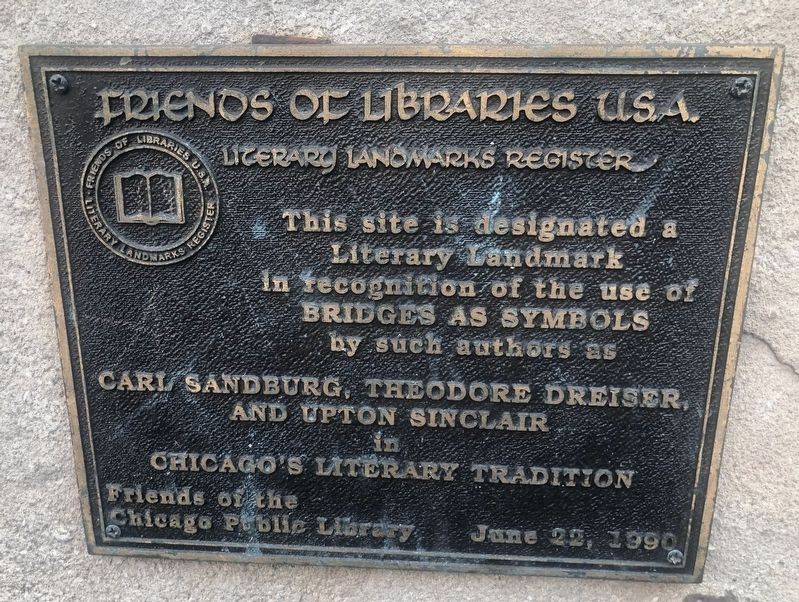
Photographed by Sean P. Flynn, October 30, 2024
1. Bridges of Chicago Marker
Erected 1990 by Friends of the Chicago Public Library.
Topics and series. This historical marker is listed in these topic lists: Arts, Letters, Music • Bridges & Viaducts. In addition, it is included in the Literary Landmarks series list.
Location. 41° 53.315′ N, 87° 37.459′ W. Marker is in Chicago, Illinois, in Cook County. It is in The Loop District. It is at the intersection of North Michigan Avenue and East Wacker Drive, on the right when traveling north on North Michigan Avenue. The marker is on the side of the small building on the southeast side of the DuSable (Michigan Avenue) Bridge. Touch for map. Marker is in this post office area: Chicago IL 60611, United States of America. Touch for directions.

Regionally, this marker is in the American Midwest and on the Great Lakes. Globally, it is in North America, the Western Hemisphere, the Western World, and
this page online
Other nearby markers. At least 8 other markers are within walking distance of this marker: Regeneration (a few steps from this marker); Rene Robert Cavalier Sieur de La Salle (within shouting distance of this marker); Chicago River (within shouting distance of this marker); Chicago's Movable Bridges (within shouting distance of this marker); Fort Dearborn (within shouting distance of this marker); Kin Link, 2023 (within shouting distance of this marker); Chicago River Wildlife (within shouting distance of this marker); Michigan Avenue Bridge and Wacker Drive Esplanade (within shouting distance of this marker). Touch for a list and map of all markers in Chicago.
More about this marker. This marker on the southeast corner of what was previously known as the Michigan Avenue Bridge (renamed after settler Jean Baptiste Point DuSable in 2010) is one of eight Literary Landmarks designated in Illinois by United for Libraries. Two of the other seven Literary Landmarks
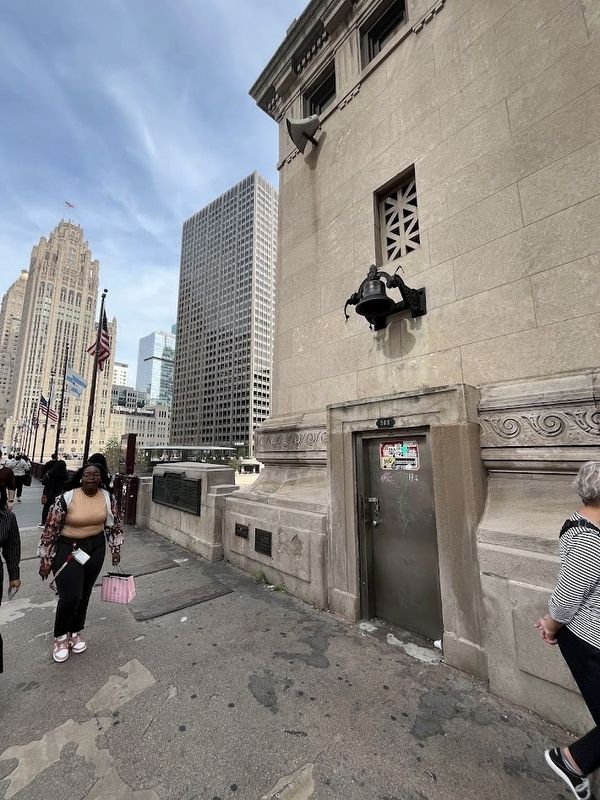
Photographed by Sean P. Flynn, October 30, 2024
2. The Bridges of Chicago Marker
The marker is the first to the left of the door. The Tribune Tower, north of the Chicago River, is on the far left side of the photo, and to its right is the Equitable Building.
Regarding The Bridges of Chicago. The Michigan Avenue Bridge opened in 1920 and its decorative elements were completed around 1928. In 2010 it was renamed after Jean Baptiste Point DuSable, the settler of Haitian descent whose home, on the north bank of the Chicago River on the other side of this bridge, was the first permanent settlement in Chicago. The DuSable Bridge is one of the most famous of Chicago's trunnion bascule bridges, with "leaves" that lift upward to allow boats to pass beneath.
Writer Carl Sandburg spent much of his adult life in Chicago and wrote the poem "Clark Street Bridge," whose namesake is about four blocks west of this bridge. Upton Sinclair is best remembered for The Jungle, which exposed the squalid conditions at Chicago's Union Stockyards. Author Theodore Dreiser spent time as a journalist in Chicago, which featured in some of his later novels, including Sister Carrie.
Also see . . .
1. Literary Landmark: The Bridges of Chicago, Wacker Drive.
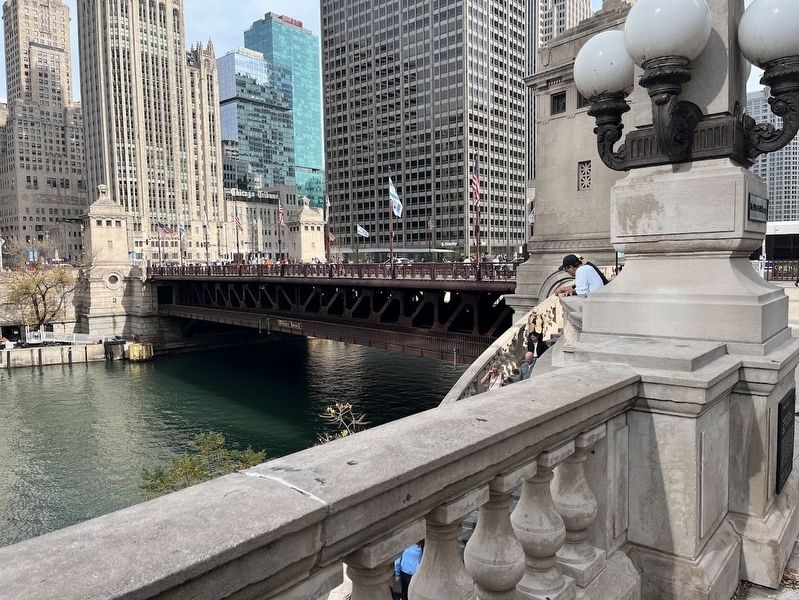
Photographed by Sean P. Flynn, October 30, 2024
3. DuSable Bridge
2. Chicago Architecture Center: Michigan Avenue Bridge (DuSable Bridge).
Excerpt, a quote from Constance Rajala, CAC Docent, Class of 2008: "I think of it as the gateway to Chicago. How many times do you see that iconic view of the city, looking west from the lake, with the bridge right in the center, or vanishing point, of the composition? The bridge is the symbol of the expansion that became the Magnificent Mile, the finishing flourish to Michigan Avenue and an elegant, and utilitarian, expression of The Plan of 1909."(Submitted on October 31, 2024, by Sean P. Flynn of Oak Park, Illinois.)

Photographed by Sean P. Flynn, November 18, 2023
4. DuSable Bridge
The bridge was known as Michigan Avenue Bridge until being renamed after Chicago's first permanent settler in 2010. The Literary Landmark marker is on the tower on the far side of the bridge on the right side
Credits. This page was last revised on October 31, 2024. It was originally submitted on October 31, 2024, by Sean P. Flynn of Oak Park, Illinois. This page has been viewed 322 times since then and 28 times this year. Photos: 1, 2, 3. submitted on October 31, 2024, by Sean P. Flynn of Oak Park, Illinois. 4. submitted on September 11, 2024, by Sean P. Flynn of Oak Park, Illinois.
