Rheinau in Schwetzingen in Rhein-Neckar-Kreis, Baden-Württemberg, Germany — Central Europe
Die kurfürstliche Hofmusik
⎯⎯⎯
The Electoral Court Music
Photographed by James Hulse, September 23, 2024
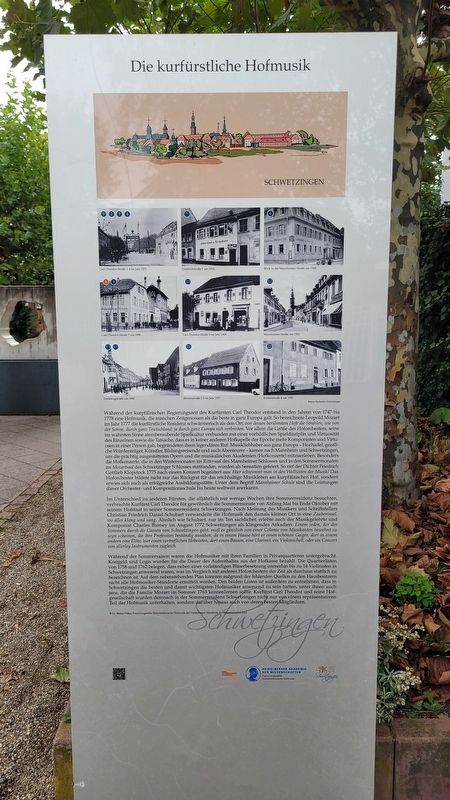
1. Die kurfürstliche Hofmusik / The Electoral Court Music Marker

Während der kurpfälzischen Regierungszeit des Kurfürsten Carl Theodor entstand in den Jahren von 1747 bis 1778 eine Hofmusik, die manchen Zeitgenossen als die beste in ganz Europa galt. So bezeichnete Leopold Mozart im Jahr 1777 die kurfürstliche Residenz schwärmerisch als den Ort, von dessen berühmtem Hofe die Strahlen, wie von der Sonne, durch ganz Teutschland, ja durch ganz Europa sich verbreiten. Vor allem die Größe des Hoforchesters, seine im wahrsten Sinne atemberaubende Spielkultur verbunden mit einer vorbildlichen Spieldisziplin und Virtuosität des Einzelnen sowie die Tatsache, dass es in keiner anderen Hofkapelle der Epoche mehr Komponisten und Virtuosen in einer Person gab, begründeten ihren legendären Ruf. Musikliebhaber aus ganz Europa - Hochadel, geistliche Würdenträger, Künstler, Bildungsreisende und auch Abenteurer - kamen nach Mannheim und Schwetzingen, um die prächtig ausgestatteten Opern und die musikalischen Akademien (Hofkonzerte) mitzuerleben. Besonders die Hofkonzerte, die in den Wintermonaten im Rittersaal des Mannheimer Schlosses und in den Sommermonaten im Mozartsaal des Schwetzinger Schlosses stattfanden, wurden als Sensation gefeiert. So rief der Dichter Friedrich Gottlieb Klopstock 1775 nach einem Konzert begeistert aus: Hier schwimmt man in den Wollüsten der Musik! Das Hoforchester bildete nicht nur das Rückgrat für das reichhaltige Musikleben am kurpfälzischen Hof, sondern erwies sich auch als erfolgreiche Ausbildungsstätte. Unter dem Begriff Mannheimer Schule sind die Leistungen dieser Orchester- und Kompositionsschule bis heute weltweit anerkannt.
Im Unterschied zu anderen Fürsten, die alljährlich nur wenige Wochen ihre Sommerresidenz besuchten, verbrachte Kurfürst Carl Theodor für gewöhnlich die Sommermonate von Anfang Mai bis Ende Oktober mit seinem Hofstaat
this page online
Während der Sommersaison waren die Hofmusiker mit ihren Familien in Privatquartieren untergebracht. Kostgeld und Logis wurden für die Dauer des Aufenthaltes aus der Hofkasse bezahlt. Die Quartierlisten von 1758 und 1762 belegen, dass neben einer vollständigen Bläserbesetzung immerhin bis zu 14 Violinisten in Schwetzingen anwesend waren, was im Vergleich mit anderen Hoforchestern
Photographed by James Hulse, September 23, 2024
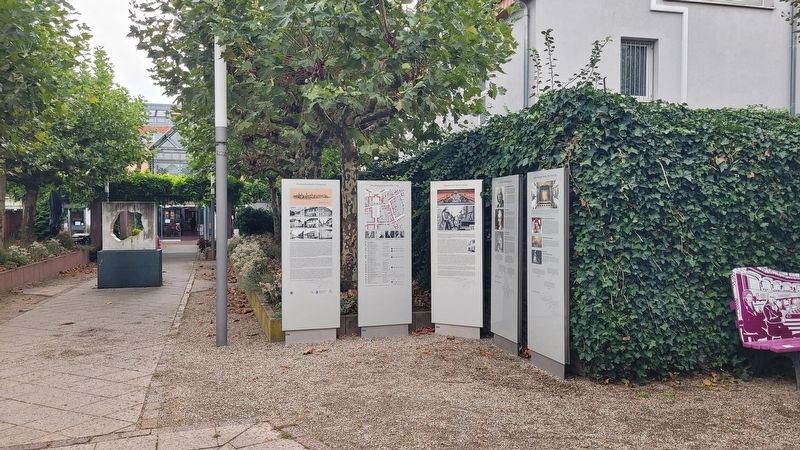
2. The Electoral Court Music Marker is the first left marker of the group of markers
© Dr. Bärbel Pelker, Forschungsstelle Südwestdeutsche Hofmusik der Heidelberger Akademie der Wissenschaften 2013
Bildunterschriften
(Foto Nr. 1) Carl-Theodor-Straße 1-4 im Jahr 1871
(Foto Nr. 2) Friedrichstraße 2 um 1910
(Foto Nr. 3) Blick in die Mannheimer Straße um 1900
(Foto Nr. 4) Carl-Theodor-Straße 7 um 1890
(Foto Nr. 5) Carl-Theodor-Straße 9 im Jahr 1906
(Foto Nr. 6) Mannheimer Straße um 1916
(Foto Nr. 7) Dreikönigstraße um 1890
(Foto Nr. 8) Kronenstraße 1-3 im Jahr 1977
(Foto Nr. 9) Kronenstraße 4 um 1935
During the Palatine rule of Elector Carl Theodor, a court music ensemble was created between 1747 and 1778, which some contemporaries considered the finest in all of Europe. In 1777, Leopold Mozart rapturously described the electoral residence as a place from which, like rays from the sun, fame spread throughout all of Germany and even all of Europe. The orchestra’s legendary reputation was based primarily on its size, its breathtaking playing culture combined with exemplary discipline and individual virtuosity, and the fact that no other court ensemble of the time boasted so many composers and virtuosos in one person. Music enthusiasts from across Europe — nobility, clergy, artists, travelers, and adventurers — flocked to Mannheim and Schwetzingen to witness the lavishly staged operas and musical academies (court concerts). The court concerts, held in winter in the Knight's Hall of Mannheim Palace and in summer in the Mozart Hall of Schwetzingen Palace, were celebrated as a sensation. After a concert in 1775, the poet Friedrich Gottlieb Klopstock enthusiastically exclaimed, "Here one swims in the voluptuousness of music!" The court orchestra not only formed the backbone of the rich musical life at the Palatine court but also served as a successful training ground. The achievements of this orchestra and composition school, known as the Mannheim School, are recognized worldwide to this day.
Unlike other princes who only visited their summer residences for a few weeks each year, Elector Carl Theodor typically spent the summer months from early May to the end of October in his summer residence in Schwetzingen with his court. According to the musician and writer Christian Friedrich Daniel Schubart, the court music transformed the then-small town into an “enchanted island, where everything resounded and sang.” Similarly, though in a more objective tone, the music scholar and composer Charles Burney experienced Schwetzingen in August 1772 as a “sounding Arcadia”: “To anyone walking through the streets of Schwetzingen in the summer, it must seem to be entirely inhabited by a colony of musicians constantly practicing their craft; in one house, one hears a fine violinist, in another a flute; here an excellent oboist, there a bassoon, a clarinet, a cello, or a concert of various instruments together.”
"During the summer season, the court musicians and their families were housed in private quarters. Board and lodging were paid from the court treasury for the duration of their stay. The accommodation lists from 1758 and 1762 show that, in addition to a full complement of wind players, as many as 14 violinists were present in Schwetzingen, which can be regarded as quite impressive compared to other court orchestras of the time. Due to a lack of sources regarding property owners, not all court musician locations could be identified on the adjacent map. The two lists also reveal that the best and therefore most important court musicians had to be present in Schwetzingen, among them those whom the Mozart family would meet in the summer of 1763. Thus, Elector Carl Theodor and his court society were entertained in the summer residence of Schwetzingen not only by a representative part of the court musicians but also by their finest members."
Captions
(Photo No. 1) Carl-Theodor-Straße 1-4 in 1871
(Photo No. 2) Friedrichstraße 2 around 1910
(Photo No. 3) View into Mannheimer Straße around 1900
(Photo No. 4) Carl-Theodor-Straße 7 around 1890
(Photo No. 5) Carl-Theodor-Straße 9 in 1906
(Photo No. 6) Mannheimer Straße around 1916
(Photo No. 7) Dreikönigstraße around 1890
(Photo No. 8) Kronenstraße 1-3 in 1977
(Photo No. 9) Kronenstraße 4 around 1935
Erected 2013 by SWR Schwetzingen Festspiele and Heidelberger Akademie der Wissenschaften.
Topics. This historical marker is listed in this topic list: Notable Buildings. A significant historical month for this entry is August 1772.
Location. 49° 23.12′ N, 8° 34.381′ E. Marker is in Schwetzingen, Baden-Württemberg, in Rhein-Neckar-Kreis. It is in Rheinau. It is on Schloßplatz. The marker is located with a group of other markers along the pathway. Touch for map. Marker is at or near this postal address: Schloßpl 4A, Schwetzingen BW 68723, Germany. Touch for directions.

Regionally, this marker is on the German Upper Rhine. Globally, it is in Europe, the European Union, Atlantic Europe, Central Europe, the Schengen Area, Western Europe, and the Western World. Historically, it finds itself in what was once the Roman Empire, the Holy Roman Empire, and the former West Germany.
Other nearby markers. At least 8 other markers are within walking distance of this marker: Mozart und die Kurpfalz / Mozart and the Electorate of the Palatinate (here, next to this marker); Im Paradies der Tonkünstler / In the Paradise of Music Artists (here, next to this marker); Musikerfamilie Toeschi / Christian Cannabich (here, next to this marker); "Ein Paradies der Tonkünstler - HörBar" / "A paradise for sound artists - HörBar" (here, next to this marker); Musikerfamilie Cramer / Musikerfamilie Fränzl (here, next to this marker); Musikerfamilie Ziwny / Ignaz Holzbauer (here, next to this marker); Musikerfamilie Wendling / Musikerfamilie Danzi (a few steps from this marker); Ein Paradies der Tonkünstler / A Paradise for Musicians (a few steps from this marker). Touch for a list and map of all markers in Schwetzingen.
Credits. This page was last revised on November 2, 2024. It was originally submitted on October 31, 2024, by James Hulse of Medina, Texas. This page has been viewed 147 times since then and 23 times this year. Photos: 1, 2. submitted on November 2, 2024, by James Hulse of Medina, Texas.
