Waterfront in Halifax in Halifax Region, Nova Scotia — The Atlantic Provinces (North America)
Juno Beach
⎯⎯⎯
Plage Juno
Photographed by Sandra Hughes Tidwell, October 15, 2024
1. Juno Beach/Plage Juno Marker
Hometown Heroes
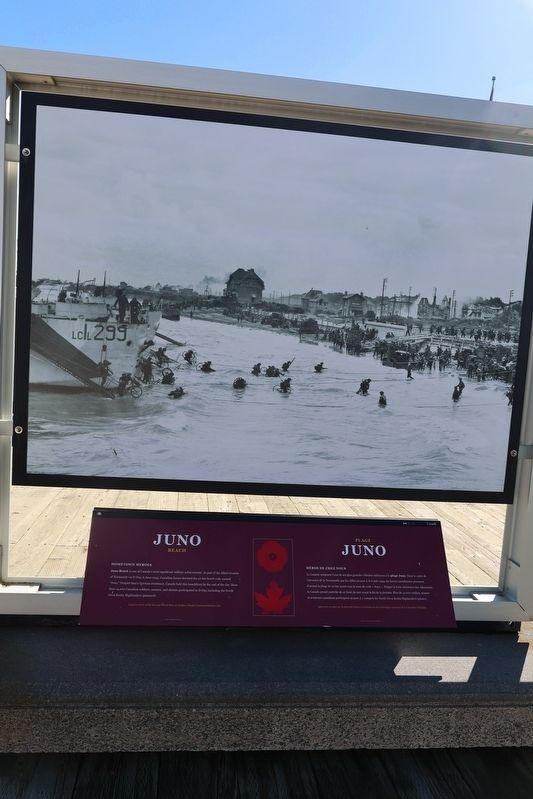
Juno Beach is one of Canada's most significant military achievements. As part of the Allied invasion of Normandy on D-Day, 6 June 1944, Canadian forces stormed the 10km beach code-named "Juno." Despite heavy German resistance, Canada held this beachfront by the end of the day. More than 14,000 Canadian soldiers, seamen, and airmen participated in D-Day, including the North Nova Scotia Highlanders (pictured).
Explore more of the Second World War at Halifax Citadel National Site.
Héros de chez nous
Le Canada reporte l'une de ses plus grandes victoires militaires à la plage Juno. Le cadre de l'invasion de la Normandie par les Alliés au jour J, le 6 Juin 1944, les forces canadiennes prennent d'assaut la plage de 10 km ayant reach le nom de code «Juno». Malgré la forte résistance des Allemands, le Canada prend contrôle de ce front de mer avant la fin de la journée. Plus de 14,000 soldats, marins et aviateurs canadiens participent au jour J, y compris les North Nova Scotia Highlanders (photo).
Apprenez-en plus sur la Seconde Guerre mondiale au lieu historique national de la Citadelle-d’Halifax
Topics. This historical marker is listed in this topic list: War, World II. A significant historical date for this entry is June 6, 1944.
Location. 44° 38.868′ N, 63° 34.193′ W. Marker is in Halifax, Nova Scotia, in Halifax Region. It is in Waterfront. It can be reached from Lower Water Street. The marker is on the dock in front of the museum. Touch for map. Marker is at or near this postal address: 1675 Lower Water Street, Halifax NS B3J 1S5, Canada. Touch for directions.

Regionally, this marker is in the Maritimes and in Atlantic Canada. Globally, it is in the North Atlantic Region, North America, the Western Hemisphere, the Western World, and the Anglosphere. Historically, it finds
this page online
Other nearby markers. At least 8 other markers are within walking distance of this marker: Battle of the Atlantic / La Bataille De L'Atlantique (here, next to this marker); Gertrude Ritchie 1903-1998 (here, next to this marker); Returning Home / Retour à la maison (here, next to this marker); Harry DeWolf 1903-2000 (a few steps from this marker); Bedford Magazine Explosion / Explosion du Magasin de Bedford (a few steps from this marker); Entertainment / Divertissement (a few steps from this marker); Harry Foster 1902-1964 (a few steps from this marker); Allan Bundy 1920-2001 (a few steps from this marker). Touch for a list and map of all markers in Halifax.
Also see . . . Juno Beach. Juno and or Juno Beach was one of five beaches of the Allied invasion of German-occupied France in the Normandy landings on 6 June 1944 during the Second World War. The beach spanned from Courseulles, a village just east of the British beach Gold, to Saint-Aubin-sur-Mer, and just west of the British beach Sword. Taking Juno was the responsibility of the

Photographed by Sandra Hughes Tidwell, October 15, 2024
2. Juno Beach/Plage Juno Marker
Credits. This page was last revised on November 12, 2024. It was originally submitted on October 31, 2024, by Sandra Hughes Tidwell of Killen, Alabama, USA. This page has been viewed 139 times since then and 16 times this year. Photos: 1, 2. submitted on October 31, 2024, by Sandra Hughes Tidwell of Killen, Alabama, USA. • Andrew Ruppenstein was the editor who published this page.
