New Britain in Capitol Region, Connecticut — The American Northeast (New England)
City Hall
From Hotel Russwin to hallowed halls of government
⎯⎯⎯
Monuments of War
Remembering those who sacrificed for freedom
| — | New Britain Historic Walking Trail | — |

Photographed by Duane and Tracy Marsteller, September 29, 2024
1. City Hall side of marker
New Britain's first mayor, industrialist Frederick T. Stanley (The Stanley Works) reflected the city's manufacturing identity. Likewise, its downtown architecture echoed styles including Beaux Arts, Neo-classical, Gothic Revival, and Art Deco which were popular in America's most prominent industrial cities. New Britain City Hall, formerly known as the Hotel Russwin, was built in 1886. Financed by the owners of the the flourishing Russell and Erwin Manufacturing Company (also known as “Russwin”), the hotel was designed by one of the nation's premier architecture firms of that era, McKim, Mead, and White, who also designed national landmarks such as the Boston Public Library, the National Museum of American History, and renovations to the West and East wings of the White House, to name a few. The Hotel Russwin served the Russell and Erwin Manufacturing Company's numerous sales representatives and clients, and boasted 40 bedroom, a barbershop, laundry facilities, and the first passenger elevator in New Britain.
Designed in the Venetian Palazzo style using red brick and brownstone, the Hotel Russwin's noteworthy
this page online
The Anvil Building sits just next to City Hall at 55 West Main Street. This Romanesque-Revival style building with Gothic flourishes is constructed with a limestone and red brick exterior and echoes the architectural details of City Hall through its use of expensive materials and lavish details that display the ambition and prosperity of New Britain in the 1920s.
The Anvil Building was originally built in 1927 for the Commercial Trust Company. This short-lived institution closed its doors on December 13, 1930 after panicked depositors had withdrawn too much cash following the crash of the stock market in 1929. The New Britain National Bank opened at the site of its competitor almost a decade later.
Both New Britain City Hall and the Anvil Building

Photographed by Duane and Tracy Marsteller, September 29, 2024
2. Monuments of War side of marker
Monuments of War
New Britain citizens have served and sacrificed in every major conflict with both its people and its goods. Monuments honoring these citizens are located throughout the city, but the Soldiers Monument located in Central Park is among the most prominent.
This monument was built to honor the 483 New Britain residents who fought for the Union in the Civil War, and stands as a testament to their sacrifice and as a representation of the Union victory.
The building of the Soldiers Monument was a topic of ongoing discussion in New Britain for nearly 30 years beginning in 1868, and work on the monument finally commenced in 1897 when the City voted to levy a tax to fund the building

Photographed by Duane and Tracy Marsteller, September 29, 2024
3. City Hall / Monuments of War Marker
Famous New York City architect Ernest Flagg was hired to design the Soldiers Monument, and he designed it in the Beaux-Arts style he was most known for another notable accomplishment of Ernest Flagg involves designing the Singer Building in New York City which once stood as the tallest building in the world, and was a landmark in downtown Manhattan for decades.
The Soldiers Monument was dedicated on September 19, 1900 with a grand parade of bands and marching units including the Governor's Foot Guard. Connecticut Governor George E. Lounsbury delivered remarks. General Joseph Hawley, a U S. Senator and former governor of Connecticut delivered an oration. He opened saying. “I have just learned that I am expected to deliver an oration” which was a line he kiddingly used many times as he had served in the Union army and was ever present at dedications for Civil War monuments.
The Soldiers Monument is a 44-foot tall limestone structure designed in three parts: the base, tomb, and attic. A dome and the 7-foot Winged Victory sculpture crown the attic. The Winged Victory bears
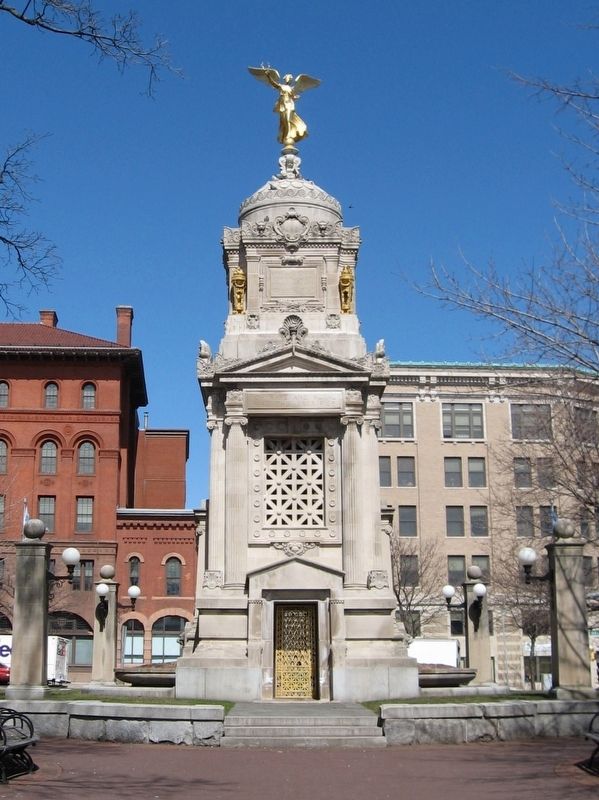
Photographed by Michael Herrick, March 29, 2011
4. New Britain Soldiers' Monument
Cast-iron doors at the base of the monument once allowed entry to the space below the monument, and also to plaques that list the names of citizens from New Britain that served in the Civil War. Due to deterioration, the original copper Winged Victory sculpture located atop the Soldiers Monument was replaced in 1950 in time for the monument's 100th commemoration celebration on September 18, 2000. The original Winged Victory is displayed in City Hall.
While lesser in size but not stature, Central Park also has memorials to the Korean War, Vietnam War, and WWII. The three collective memorials, dedicated on November 11, 1972, replaced a temporary memorial to the Veterans of WWII, which had been dedicated in 1945.
The Soldiers Monument, along with City Hall and Walnut Hill Park, are all listed on the

Kenneth C. Zirkel via Wikimedia Commons (CC BY-SA 4.0), August 14, 2020
5. West Main Street, New Britain, CT
The Anvil building (left) and New Britain City Hall (right) are both on the National Register of Historic Places. Built for the Commercial Trust Company in 1927, the Anvil was listed in 2009. City Hall (built as Russwin Hotel in 1882) is a component of the City Hall Monument District, listed in 1973. Both are also contributing properties in the Downtown New Britain historic district (listed 2016).
[Captions}
• Left: The Soldiers Monument in Central Park on the day of its dedication, September 19, 1900. (Local History, NBPL)
• Right: The “Soldiers Monument” pictured on a postcard c. 1920. (Local History, NBPL)
Erected by City of New Britain, CT. (Marker Number G1.)
Topics and series. This historical marker is listed in this topic list: Architecture. In addition, it is included in the National Register of Historic Places (NRHP) series list. A significant historical year for this entry is 1907.
Location. 41° 40.058′ N, 72° 46.949′ W. Marker is in New Britain in Capitol Region, Connecticut. It is at the intersection of West Main Street and Main Street, on the right when traveling east on West Main Street. Touch for map. Marker is in this post office area: New Britain CT 06051, United States of America. Touch for directions.

Regionally, this marker is in the Connecticut River Valley, in Greater Hartford, and in the Knowledge Corridor. It is also in the American Northeast and in New England. Globally, it is in North America, the Western Hemisphere, the Western World, and the Anglosphere. Historically, it finds itself in what was once Hartford County and also one of the original Thirteen Colonies.
Other nearby markers. At least 8 other markers are within walking distance of this marker: New Britain (a few steps from this marker); New Britain Soldiers' Monument (within shouting distance of this marker); Burritt Hotel (within shouting distance of this marker); New Britain Veterans Memorial (within shouting distance of this marker); Central Park / Early Industries (about 400 feet away, measured in a direct line); 1st Sgt. Henry J. Szczesny (about 600 feet away); Laying the Urban Fabric / Normal School (about 600 feet away); Leo A. Milewski Park (about 700 feet away). Touch for a list and map of all markers in New Britain.
Also see . . .
1. City Hall-Monument District (PDF). National Register nomination for the district, which was listed in 1973 and includes City Hall and the Soldiers Monument. (Prepared by Robert D. Yaro; via National Archives) (Submitted on November 2, 2024, by Duane and Tracy Marsteller of Murfreesboro, Tennessee.)
2. Commercial Trust Company Building (PDF). National Register nomination for the Anvil building, which was listed in 2009. (Prepared by David F. Ransom; via National Archives) (Submitted on November 2, 2024, by Duane and Tracy Marsteller of Murfreesboro, Tennessee.)
Credits. This page was last revised on May 19, 2026. It was originally submitted on October 31, 2024, by Duane and Tracy Marsteller of Murfreesboro, Tennessee. This page has been viewed 287 times since then and 39 times this year. Photos: 1, 2, 3. submitted on October 31, 2024, by Duane and Tracy Marsteller of Murfreesboro, Tennessee. 4. submitted on April 5, 2011, by Michael Herrick of Southbury, Connecticut. 5. submitted on November 2, 2024, by Duane and Tracy Marsteller of Murfreesboro, Tennessee.
