
Wyebridge in Simcoe County, Ontario — Central Canada (North America)
Franz Johnston
1888-1949

Photographed by Cosmos Mariner, June 7, 2024
1. Franz Johnston Marker
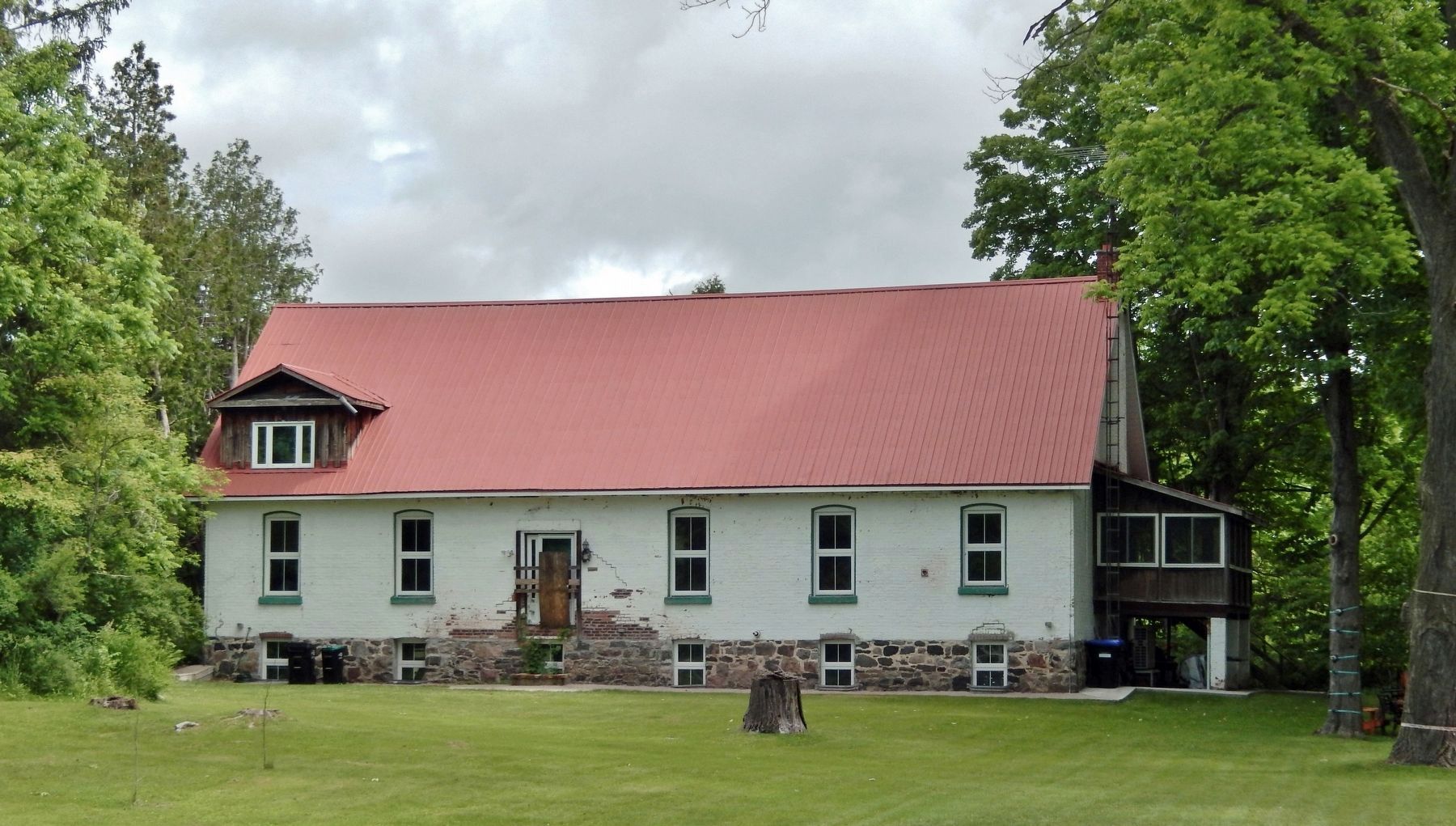
This was the home and studio, 1940-48, of the noted Canadian painter Francis Hans (Franz) Johnston. Born in Toronto, he studied there and in the United States, and at first worked as a commercial artist. An official war artist, 1917-18, he participated in the first exhibition of the Group of Seven in 1920. With others of the Group, he captured on canvas the lonely grandeur of the Canadian northland, thus ending Canadian dependence upon Europe for artistic inspiration and inaugurating our first national art movement. Johnston, who was principal of the Winnipeg School of Art, 1921-24, also taught in Toronto, 1927-29, and from then until 1940 conducted summer classes on Georgian Bay.
Erected by Archaeological and Historic Sites Board of Ontario.
Topics and series. This historical marker is listed in these topic lists: Arts, Letters, Music • Education. In addition, it is included in the Canada, Ontario Heritage Trust series list. A significant historical year for this entry is 1888.
Location. 44° 41.663′ N, 79° 52.961′ W. Marker is in Wyebridge, Ontario, in Simcoe County. It is on Provincial Highway 93 just south of
this page online

Regionally, this marker is in Central Ontario Cottage Country and specifically in Georgian Bay Country. It is also in Central Canada. Globally, it is in North America, on the Great Lakes, in the Western Hemisphere, in the Western World, and in the Anglosphere. Historically, it finds itself in what was once a British colony, the Viceroyalty of New France, the Haudenosaunee (Iroquois) Confederacy, and Rupert’s Land.
Other nearby markers. At least 8 other markers are within 10 kilometers of this marker, measured as the crow flies: Saint-Marie Among the Hurons / Saint-Marie-au-pays-des-Hurons (approx. 5.4 kilometers away); Gateway to Huronia (approx. 5.9 kilometers away); The Founding of Midland (approx. 6 kilometers away); Heritage & Rural Tay (approx. 7.6 kilometers away); Ataronchronon Village (approx. 8.9 kilometers away); The Arrival of the Jesuits in New France (approx. 8.9 kilometers away); Huron-Wendat Circle of Nations / Cercle des Nations huronnes-wendat (approx.

Photographed by Cosmos Mariner, June 7, 2024
2. Franz Johnston Marker
Looking northeast from Ontario Highway 93.
More about this marker. Both sides of this marker have the same English inscription.
Also see . . .
1. Francis Hans Johnston (Wikipedia).
Excerpt: A member of the Group of Seven, he most commonly worked as a landscape painter though in a more conservative mode than other members of the Group. He also used tempera rather than oil paint in his Algoma landscapes, a fast-drying material that was more often associated with commercial art of his day. In 1920, he was invited to join the Group of Seven, but his association with it was brief. In January 1922 he held an exhibition at the Winnipeg Art Gallery that included 326 works. He claimed that he had no disagreement with the group, only that he wanted to go his own way with regard to exhibition. He was made an associate member of the Royal Canadian Academy of Arts. He was also a member of the Ontario Society of Artists. His work is in many public collections such as the National Gallery of Canada.(Submitted on November 3, 2024, by Cosmos Mariner of Cape Canaveral, Florida.)
2. Franz Johnston (National Gallery of Canada).
Photographed by Cosmos Mariner, June 7, 2024
3. Franz Johnston Home and Studio — 1940-48
Excerpt: Johnston was commissioned to paint the home front during the First World War for the Canadian War Memorials Fund in 1918. During evenings and weekends he sketched Ontario's Royal Canadian Air Force training camps including aircraft in various manoeuvres, some of which he developed into paintings.(Submitted on November 3, 2024, by Cosmos Mariner of Cape Canaveral, Florida.)Johnston was invited to Eldorado on Great Bear Lake, NWT, where he spent six months in 1939 sketching both the landscape and activities of northern Indigenous Peoples. Upon his return, he settled in Wyebridge, Ontario, converting the village hall into a home and studio. He travelled regularly to northern Ontario to paint, and made his last trip into the Nipigon territory in 1946. During his last summers he painted pastoral subjects in Quebec, Baie St. Paul, villages in the Laurentians and the Ottawa Valley.
Credits. This page was last revised on November 3, 2024. It was originally submitted on November 2, 2024, by Cosmos Mariner of Cape Canaveral, Florida. This page has been viewed 116 times since then and 18 times this year. Photos: 1, 2, 3. submitted on November 3, 2024, by Cosmos Mariner of Cape Canaveral, Florida.
