Prospect in Waldo County, Maine — The American Northeast (New England)
The Architecture of Defense
Photographed by William Fischer, Jr., September 23, 2011
1. The Architecture of Defense Marker
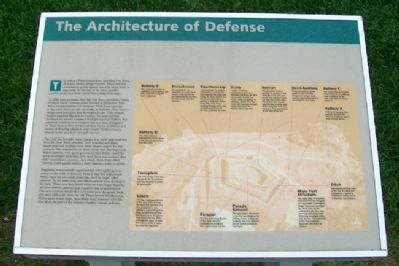
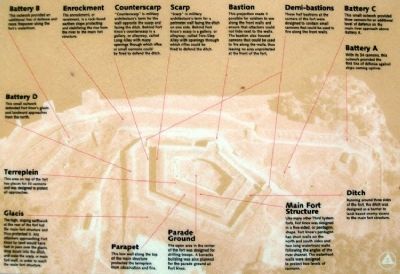
The nation's Third System forts, including Fort Knox, all shared similar design features. These features combined to guard against attack by ships, make it impossible for the fort to be taken quickly, [and] provide protection from a land-based, long-term siege.
To fulfill these purposes, forts like Fort Knox provided a variety of places where cannons could fire and be protected. Fort Knox was planned for 135 cannons. With these cannons in the main structure and outworks, or batteries, Fort Knox's design used principles first developed by the 17th century French engineer Marquis de Vauban. He believed that fortifications should consist of multiple layers of defenses that attackers would have to conquer one at a time. Designers of Third System forts envisioned these layers of defense as a means of delaying attackers until outside reinforcements arrived or the attackers' strength ran out.
The Civil War brought many changes that made large masonry forts like Fort Knox obsolete. New armored and faster steam-powered warships were more elusive targets for fort cannons. The armaments on these vessels had also improved. Rifled
this page online
Engineers unsuccessfully experimented with applying iron armor to walls of masonry forts so that the walls could better repel the powerful projectiles fired by ships' rifled cannons. At the same time, new rifled cannons were developed for forts. These new land-based weapons were larger than the old smoothbore cannons and required new emplacements. The new cannons meant that new forts were designed, built, and sited differently than the old Third System fortifications. Never again would large, beautifully-built masonry forts like Fort Knox be part of the nation's modern coastal defenses.
Erected by Maine Department of Conservation.
Topics. This historical marker is listed in these topic lists: Architecture • Forts and Castles.
Location. 44° 33.987′ N, 68° 48.124′ W. Marker is in Prospect, Maine, in Waldo County. It can be reached from Fort
Photographed by Maine Dept of Conservation, undated
2. Photo on The Architecture of Defense Marker

Regionally, this marker is in Midcoast Maine and on Penobscot Bay. It is also in the American Northeast, in New England, and on the Eastern Seaboard. Globally, it is in the North Atlantic Region, North America, the Western Hemisphere, the Western World, and the Anglosphere.
Other nearby markers. At least 8 other markers are within walking distance of this marker: A Question of Boundaries (here, next to this marker); A Grand Plan (here, next to this marker); Fort Knox (within shouting distance of this marker); Digging Down and Building Up (within shouting distance of this marker); The Heart of the Fort (within shouting distance of this marker); Where Did the Soldiers Sleep? (within shouting distance of this marker); The Casemate - Key to Fort Design (within shouting distance of this marker); Firing a Cannon (within shouting distance of this marker).
Photographed by William Fischer, Jr., September 23, 2011
3. The Architecture of Defense Marker
Also see . . .
1. Star Fort. Wikipedia entry (Submitted on May 7, 2012, by William Fischer, Jr. of Reynoldsburg, Ohio.)
2. Fort Pulaski National Monument. National Park Service website entry (Submitted on May 7, 2012, by William Fischer, Jr. of Reynoldsburg, Ohio.)
3. Fort Knox State Historic Site, Maine guide PDF. Maine.gov website entry (Submitted on May 7, 2012, by William Fischer, Jr. of Reynoldsburg, Ohio.)
4. Sébastien Le Prestre de Vauban. Wikipedia entry (Submitted on October 9, 2021, by Larry Gertner of New York, New York.)
Credits. This page was last revised on November 19, 2024. It was originally submitted on May 7, 2012, by William Fischer, Jr. of Reynoldsburg, Ohio. This page has been viewed 740 times since then and 25 times this year. Last updated on November 3, 2024, by Darren Jefferson Clay of Duluth, Georgia. Photos: 1, 2, 3. submitted on May 7, 2012, by William Fischer, Jr. of Reynoldsburg, Ohio. • Devry Becker Jones was the editor who published this page.
