East Side in San Antonio in Bexar County, Texas — The American South (West South Central)
Frederick Douglass School
Photographed by James Hulse, October 29, 2024
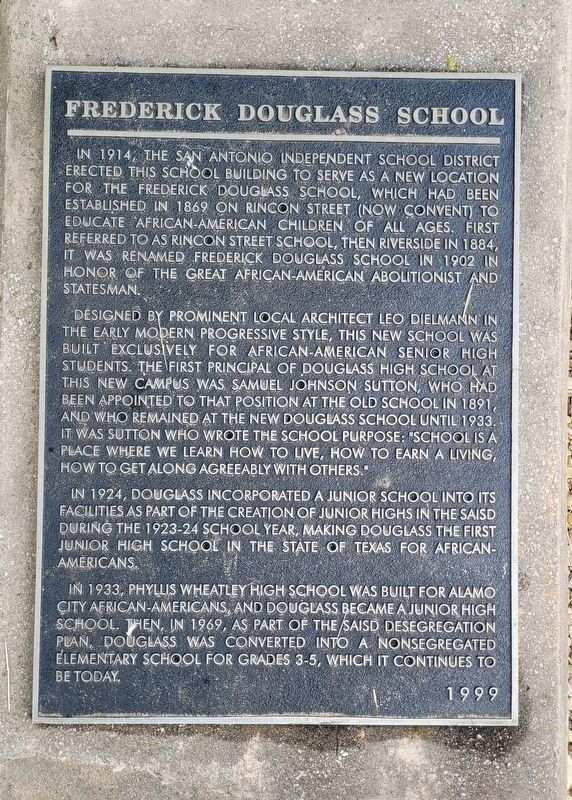
1. Frederick Douglass School Marker
Designed by prominent local architect Leo Dielmann in the early modern progressive style, this new school was built exclusively for African-American senior high students. The first principal of Douglass High School at this new campus was Samuel Johnson Sutton, who had been appointed to that position at the old school in 1891, and who remained at the new Douglass School until 1933. It was Sutton who wrote the school purpose: "School is a place where we learn how to live, how to earn a living, how to get along agreeably with others."
In 1924, Douglass incorporated a junior school into its facilities as part of the creation of junior highs in the SAISD during the 1923-24 school year,
this page online
In 1933, Phyllis Wheatley High School was built for Alamo City African-Americans, and Douglass became a junior high school. Then, in 1969, as part of the SAISD desegregation plan, Douglass was converted into a nonsegregated elementary school for grades 3-5, which it continues to be today.
Erected 1999.
Topics. This historical marker is listed in these topic lists: African Americans • Education. A significant historical year for this entry is 1914.
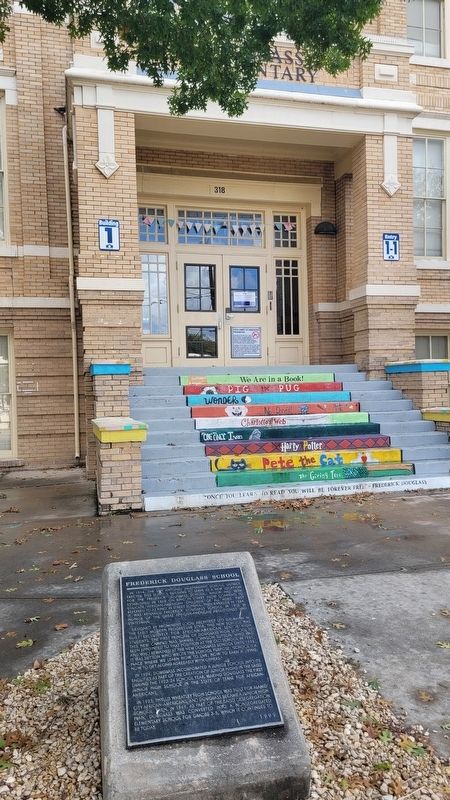
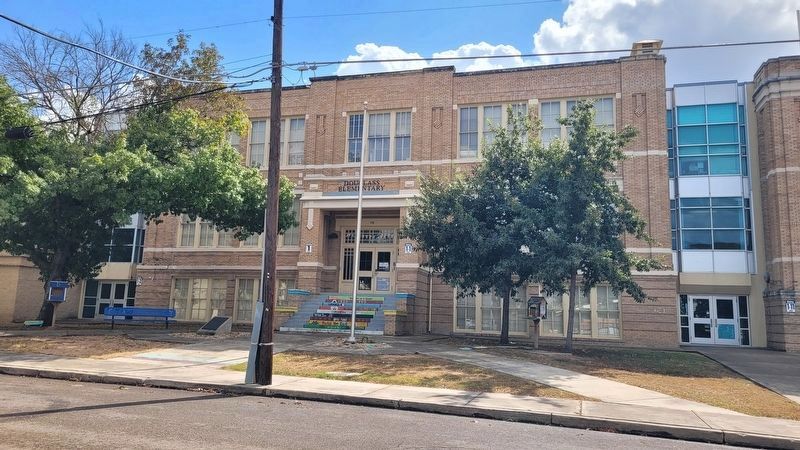
Location. 29° 24.791′ N, 98° 28.439′ W. Marker is in San Antonio, Texas, in Bexar County. It is in the East Side. It is on Martin Luther King Drive west of South Hackberry Street. The marker is located in front of the Frederick Douglass Elementary School. Touch for map. Marker is at or near this postal address: 318 Martin Luther King Dr, San Antonio TX 78203, United States of America. Touch for directions.

Regionally, this marker is in South Texas. It is also in the American South. Globally, it is in North America, a Gulf of Mexico state, the Western Hemisphere, the Western World,
Photographed by James Hulse, October 29, 2024
2. The entrance to the Frederick Douglass School with the Marker
Other nearby markers. At least 8 other markers are within walking distance of this marker: John Inman Fighter for Human Rights (within shouting distance of this marker); The SNCC Legacy Project (approx. ¼ mile away); John Lang Sinclair (approx. half a mile away); Clara Driscoll (approx. half a mile away); Old Powder Mill (approx. 0.6 miles away); Col. Edward Miles (approx. 0.6 miles away); Mrs. Simona Smith Fisk (approx. 0.6 miles away); James Nathaniel Fisk (approx. 0.6 miles away). Touch for a list and map of all markers in San Antonio.
Also see . . . Frederick Douglass. Wikipedia
After escaping from slavery in Maryland in 1838, Douglass became a national leader of the abolitionist movement in Massachusetts and New York and gained fame for his oratory and incisive antislavery writings. Accordingly, he was described by abolitionists in his time as a living counterexample to claims by supporters of slavery that enslaved people lacked the intellectual capacity to function as independent American citizens. Northerners at the time found it hard to believe that such a great orator had once been enslaved. It was in response to this disbelief that Douglass wrote his first autobiography.(Submitted on November 5, 2024, by James Hulse of Medina, Texas.)
Photographed by James Hulse, October 29, 2024
3. The view of the Frederick Douglass Elementary School from across the street
Credits. This page was last revised on November 5, 2024. It was originally submitted on November 4, 2024, by James Hulse of Medina, Texas. This page has been viewed 734 times since then and 276 times this year. Photos: 1, 2, 3. submitted on November 5, 2024, by James Hulse of Medina, Texas.
