Villette in Paris in Département de Paris, Île-de-France, France — Western Europe
Le Premier Obus de la Bertha
⎯⎯⎯
First Shell of the Paris Gun

Photographed by Andrew Ruppenstein, November 1, 2024
1. Le Premier Obus de la Bertha / First Shell of the Paris Gun Marker

a 7:20 du matin
le premier obus de la Bertha
est tombe devant cet immeuble
Topics. This historical marker is listed in this topic list: War, World I. A significant historical date for this entry is March 23, 1918.
Location. 48° 53.087′ N, 2° 22.254′ E. Marker is in Paris, Île-de-France, in Département de Paris. It is in Villette. It is on Quai de la Seine, on the left when traveling south. Touch for map. Marker is at or near this postal address: 6 Quai de la Seine, Paris, Île-de-France 75019, France. Touch for directions.

Regionally, it is in the North Atlantic Region, Europe, the European Union, Atlantic Europe, the Schengen Area, Western Europe, a coastal Mediterranean country, and the Western World. Historically, it finds itself in what was once a French colony and also the Roman Empire.
Other nearby markers. At least 8 other markers are within walking distance of this marker: La Bassin de Villette (about 150 meters away, measured in a direct line); Jardin Luc-Hoffmann (1967) (about
this page online
Also see . . . Paris Gun (Wikipedia). Excerpt:
The Paris Gun (German: Paris-Geschütz / Pariser Kanone) was a type of German long-range siege gun, several of which were used to bombard Paris during World War I. They were in service from March to August 1918. When the guns were first employed, Parisians believed they had been bombed by a high-altitude Zeppelin, as the sound of neither an airplane nor a gun could be heard. They were the largest pieces of artillery used during the war by barrel length, and qualify under the (later) formal definition of large-calibre artillery. Also called the "Kaiser Wilhelm Geschütz" ("Kaiser Wilhelm Gun"), they were often confused with Big Bertha, the German howitzer used against Belgian forts in the Battle(Submitted on November 5, 2024.)of Liège in 1914; indeed, the French called them by this name as well…Photographed by Andrew Ruppenstein, November 1, 20242. Le Premier Obus de la Bertha / First Shell of the Paris Gun Marker - wide view
As military weapons, the Paris Guns were not a great success: the payload was small, the barrel required frequent replacement, and the guns' accuracy was good enough for only city-sized targets. The German objective was to build a psychological weapon to attack the morale of the Parisians, not to destroy the city itself.
The Paris gun was used to shell Paris at a range of 120 km (75 mi). The gun was fired from a wooded hill (Le mont de Joie) near Crépy, and the first shell landed at 7:18 a.m. on 23 March 1918 on the Quai de la Seine, the explosion being heard across the city. Shells continued to land at 15-minute intervals, with 21 counted on the first day. On the first day, fifteen people were killed and thirty-six wounded. The effect on morale in Paris was immediate: by 27 March, queues of thousands had started at the Gare d'Orsay and, at the Gare Montparnasse, ticket sales out of the capital were suspended due to demand.

Additional keywords. artillery
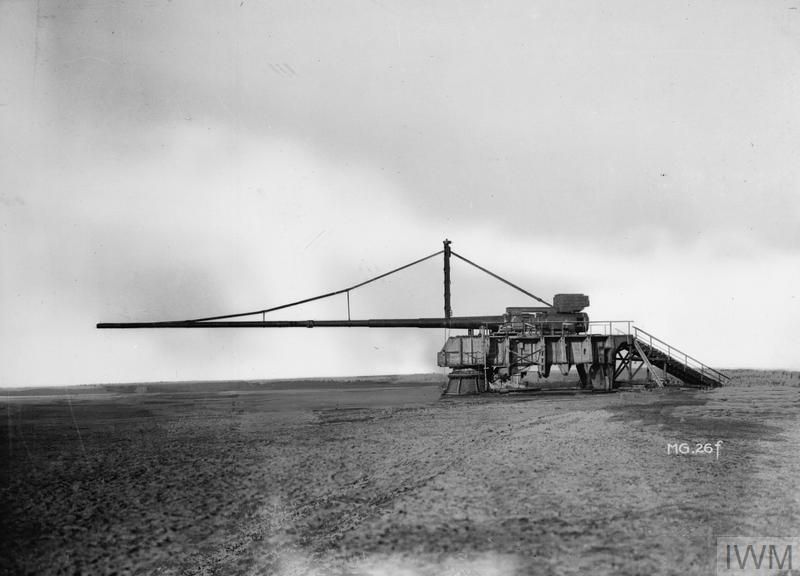
Unknown Author, courtesy of the Imperial War Museum via Wikimedia Commons, circa 1918
3. The Paris Gun
“ The German Paris Gun, also known as the Kaiser Wilhelm Gun, was the largest gun of World War I. In 1918, the Paris Gun shelled Paris from 120 km (75 mi) away.”
Credits. This page was last revised on November 5, 2024. It was originally submitted on November 5, 2024, by Andrew Ruppenstein of Lamorinda, California. This page has been viewed 147 times since then and 22 times this year. Photos: 1, 2, 3. submitted on November 5, 2024, by Andrew Ruppenstein of Lamorinda, California.
