
Downtown in Charlottetown in Queens County, Prince Edward Island — The Atlantic Provinces (North America)
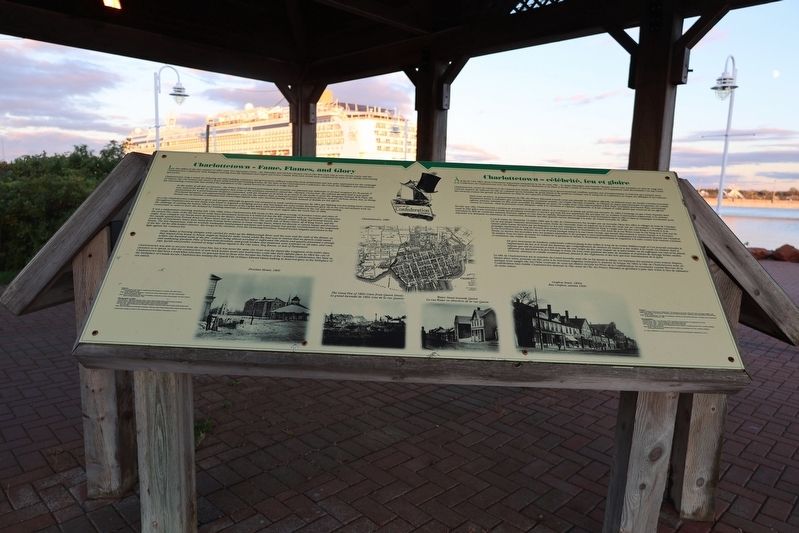
Charlottetown - Fame, Flames, and Glory
Photographed by Sandra Hughes Tidwell, October 13, 2024
1. Charlottetown - Fame, Flames, and Glory Marker
Charlottetown, long a centre for shipping and shipbuilding, commerce, and government, suffered somewhat from isolationism and was quite unprepared for the onslaught of visitors. The city hosted only about a dozen small hotels and boarding houses. By the time of the Charlottetown Conference, the Circus, the Delegates, and visitors from the surrounding countryside had swelled the population of the capital beyond its capacity to lodge them all.
In the midst of all this excitement,... the Prince of Edward Island government had certainly not planned any elaborate or formal reception for its guests. It was rumored darkly by the newspapers that some of the ministers wanted to attend the...Olympic Circus; but the cabinet decided that it was quite unnecessary for a governmental reception
this page online
As a city, Charlottetown continued to grow and prosper, although its growth was measured in small, careful increments. By 1864, gas lighting was becoming more common throughout, Charlestown as new funds were found to augment a fledging service that had begun ten years earlier. Businesses grew up in the city and artisans took up the challenge of creating the homes, offices, churches, and streets of the capital. Brickyards and lumber yards flourished in the city and surrounding countryside in order to meet the demand for building materials, a demand that became evermore urgent after the Great Fire of 1866.
It was a midsummer morning, Sunday, July 15th, 1866, when Charlottetown fell victim to fire, the great scourge of wooden towns and cities
Photographed by Sandra Hughes Tidwell, October 13, 2024
2. Charlottetown - Fame, Flames, and Glory Marker
Large flakes of burning shingles were carried for miles up the Hillsborough River and the roar and the rush of the flames, as they leaped from house to house, might be heard for miles around; whilst the heat was so intense that one person could stand within one hundred yards of the fire...without being almost scorched or suffocated. The streets and squares presented a strange and saddening spectacle. Piles of household furniture, and goods broken and shattered, were scattered on all sides, and cows, pigs, horses, and poultry roamed at large without regard to the City Laws, Hog Reeves, or Act of Parliament.
Charlottetown was able to recover from the Great Fire but was never the same city. Gone was the shanty-like roughness of its earlier days-cleansed, so to speak, that the construction of new brick homes, stores, and warehouses could take their rightful place. In 1864 the city of Charlottetown had been a somewhat reluctant, yet gracious host to those who became the Fathers of the Canadian Confederation. Her fame as the birthplace of Canada secure, Charlottetown remains the Queen City of Prince Edward Island basking in deserved glory as the birthplace of our nation. Province House 1860.
Captions:
Province House, 1860 The Great Fire of 1866 (View from Queen Street) Le grand incendie de 1866 (vue de la rue Queen)
Water Street toward Queen La vue Water en direction de la rue Queen
Grafton Street, 1890s Rue Grafton, anne`es 1890
Topics. This historical marker is listed in this topic list: Disasters. A significant historical year for this entry is 1864.
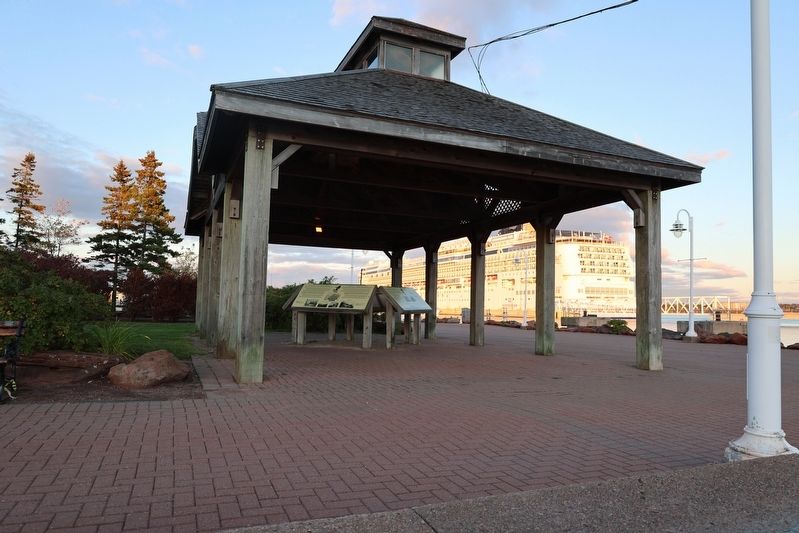
Location. 46° 13.879′ N, 63° 7.233′ W. Marker is in Charlottetown, Prince Edward Island, in Queens County. It is in Downtown. It is on Great George Street near Great George and Water Streets. This marker is located along the pier near the PEI Art tower. Touch for map. Marker is at or near this postal address: Great George St, Charlottetown PE C1A C1A, Canada. Touch for directions.

Regionally, this marker is in Central Coastal P. E. I. It is also in the Maritimes and in Atlantic Canada. Globally, it is in the North Atlantic Region, North America, the Western Hemisphere, the Western World, and the Anglosphere. Historically, it finds itself in what was once a British colony, the Viceroyalty of New France, and Acadia.
Other nearby markers. At least 8 other markers are within walking distance of this marker: The Charlottetown Conference 1861 (here, next to this marker); Prince Edward Island Delegates to the 1864 Charlottetown Conference (here, next to this marker); Charlottetown - The Early Years (a few steps from this marker); Survey of the Gulf and River St. Lawrence (a few steps from this marker); Confederation Birthplace Memorial Park/Confederation Boulevard (within shouting distance of this marker); Canadian Merchant Navy / Marine Marchande Canadienne (about 90 meters away, measured in a direct line); Heralded Arrival… of the Circus (about 150 meters away); Shaw's Hotel- A National Historic Site of Canada (about 150 meters away). Touch for a list and map of all markers in Charlottetown.
Credits. This page was last revised on February 20, 2025. It was originally submitted on November 5, 2024, by Sandra Hughes Tidwell of Killen, Alabama, USA. This page has been viewed 220 times since then and 25 times this year. Photos: 1, 2. submitted on November 5, 2024, by Sandra Hughes Tidwell of Killen, Alabama, USA. • Bill Pfingsten was the editor who published this page.
