Vincennes in Knox County, Indiana — The American Midwest (Great Lakes)
The American Revolution on the Frontier
Photographed by Connor Olson, November 2, 2024
1. The American Revolution on the Frontier Marker
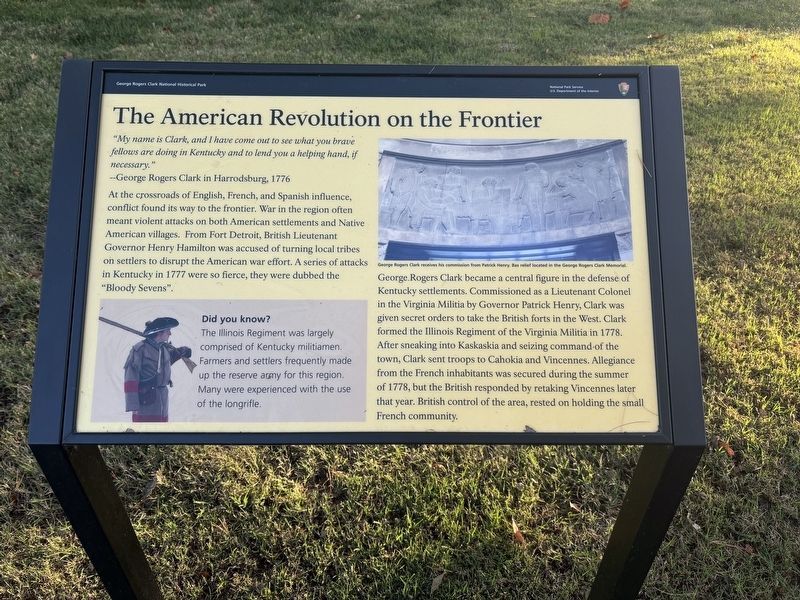
"My name is Clark, and I have come out to see what you brave fellows are doing in Kentucky and to lend you a helping hand, if necessary."
—George Rogers Clark in Harrodsburg, 1776
At the crossroads of English, French, and Spanish influence, conflict found its way to the frontier. War in the region often meant violent attacks on both American settlements and Native American villages. From Fort Detroit, British Lieutenant Governor Henry Hamilton was accused of turning local tribes on settlers to disrupt the American war effort. A series of attacks in Kentucky in 1777 were so fierce, they were dubbed the "Bloody Sevens"
George Rogers Clark became a central figure in the defense of Kentucky settlements. Commissioned as a Lieutenant Colonel in the Virginia Militia by Governor Patrick Henry, Clark was given secret orders to take the British forts in the West. Clark formed the Illinois Regiment of the Virginia Militia in 1778. After sneaking into Kaskaskia and seizing command of the town, Clark sent troops to Cahokia and Vincennes. Allegiance from the French inhabitants was secured during the summer of 1778, but
this page online
Did you know?
The Illinois Regiment was largely comprised of Kentucky militiamen. Farmers and settlers frequently made up the reserve army for this region. Many were experienced with the use of the longrifle.
( photo caption )
— George Rogers Clark receives his commission from Patrick Henry. Bas relief located in the George Rogers Clark Memorial.
Erected by National Park Service.
Topics. This historical marker is listed in this topic list: War, US Revolutionary.
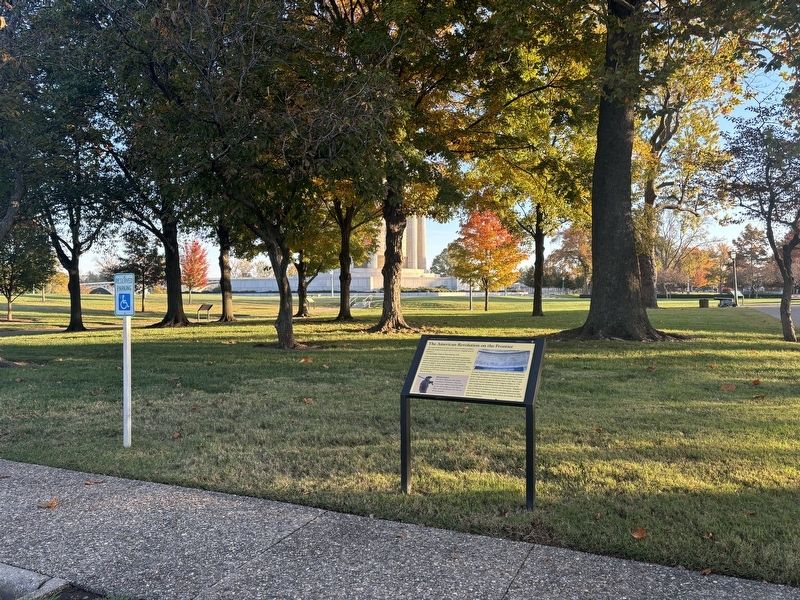
Location. 38° 40.69′ N, 87° 32.174′ W. Marker is in Vincennes, Indiana, in Knox County. It can be reached from the intersection of South 2nd Street and Nicholas Street, on the right when traveling south. Located in George Rogers Clark National Historical Park. Touch for map. Marker is at or near this postal address: 425 South 2nd Street, Vincennes IN 47591, United States of America. Touch for directions.

Regionally, this marker is in the Tri-State Region, in Southern Indiana,
Photographed by Connor Olson, November 2, 2024
2. The American Revolution on the Frontier Marker
Other nearby markers. At least 8 other markers are within walking distance of this marker: Clark after Vincennes (within shouting distance of this marker); Fort Sackville (within shouting distance of this marker); The Northwest Ordinance of 1787 (within shouting distance of this marker); A Journey Through Flooded Waters (about 400 feet away, measured in a direct line); The George Rogers Clark Memorial (about 400 feet away); The Wabash River (about 400 feet away); St. Rose Chapel (about 500 feet away); Inscription on the Big Bell of the Old Cathedral (about 500 feet away). Touch for a list and map of all markers in Vincennes.
Another marker is no longer nearby. Fort Sackville in 1779 (was within shouting distance of this marker but has been permanently removed).
Also see . . . George Rogers Clark (Wikipedia). (Submitted on November 13, 2024, by Michael Herrick of Southbury, Connecticut.)
Credits. This page was last revised on November 13, 2024. It was originally submitted on November 5, 2024, by Connor Olson of Menomonee Falls, Wisconsin. This page has been viewed 157 times since then and 46 times this year. Photos: 1, 2. submitted on November 5, 2024, by Connor Olson of Menomonee Falls, Wisconsin. • Michael Herrick was the editor who published this page.
