
Steinsfurt in Sinsheim in Rhein-Neckar-Kreis, Baden-Württemberg, Germany — Central Europe
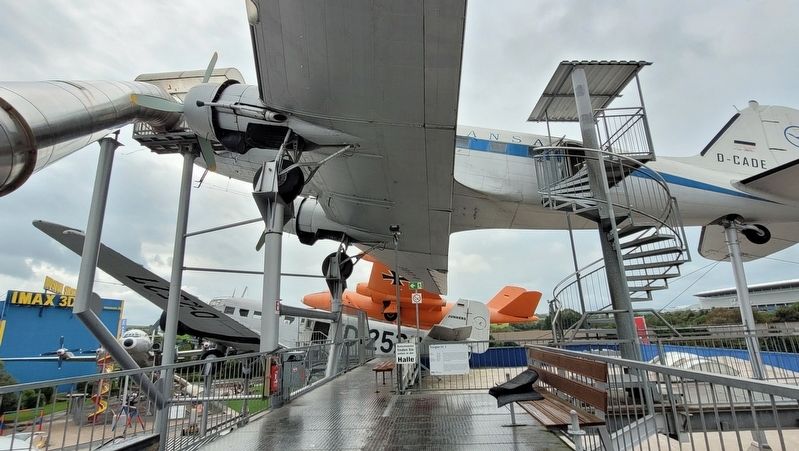
Douglas DC 3

Photographed by James Hulse, September 24, 2024
1. Douglas DC 3 Marker

Die Douglas DC 3 (in der Militärversion C47 genannt) wurde in den 1930er Jahren entwickelt und erwarb sich während der Zeit des Zweiten Weltkriegs einen legendären Ruf als universell einsetzbare Transport- und Passagiermaschine. Auch nach dem Kriegsende waren viele Maschinen noch über Jahrzehnte im Einsatz. Während der Berliner Luftbrücke wurde die DC 3 als „Rosinenbomber" in Deutschland bekannt.
Baujahr: 1936-1952
Motoren: 2x 14-Zyl. Doppelstern-motoren
Leistung: 2x 1.200 PS
Höchstgeschw.: 368 km/h
Spannweite: 28,90 m
The Douglas DC 3 (military version called C47) was developed in the 1930s and acquired a legendary reputation as a universal transport and passenger machine during the time of World War II. Even after the end of the war and untill today many machines are still in use. During the Berlin Airlift the DC 3 became known as the “raisin bomber" in Germany.
Year of construction: 1936-1952
Engines: 2x 14-cylinder double star engines
Power: 2x 1,200 hp
Top speed: 368 km/h
Wingspan: 28.90 m
Erected by Technik Museen Sinsheim Speyer.
Topics. This historical marker
this page online
Location. 49° 14.36′ N, 8° 53.77′ E. Marker is in Sinsheim, Baden-Württemberg, in Rhein-Neckar-Kreis. It is in Steinsfurt. It is at the intersection of Eberhard-Layher-Straße and In d. Au on Eberhard-Layher-Straße. The marker is located on the roof of the museum. Touch for map. Marker is at or near this postal address: Eberhard-Layher-Straße 2A, Sinsheim BW 74889, Germany. Touch for directions.

Regionally, it is in Europe, the European Union, Atlantic Europe, Central Europe, the Schengen Area, Western Europe, and the Western World. Historically, it finds itself in what was once the Roman Empire and specifically also the Holy Roman Empire.
Other nearby markers. At least 8 other markers are within walking distance of this marker: Junkers Ju 52/3m (a few steps from this marker); Iljuschin IL-14 P (a few steps from this marker); Canberra B.2 (a few steps from this marker); Vickers Viscount 800 (within shouting distance of this marker); Snecma ATAR 101 D (within shouting distance of this marker); de Havilland Ghost 48 (within shouting distance
Photographed by James Hulse, September 24, 2024
2. The Douglas DC 3 and Marker
More about this marker. The static displays and markers are located on the grounds of the Technik Museum. There is an entrance fee to visit the museum and markers.
Also see . . . Douglas DC-3. Wikipedia
The Douglas DC-3 is a propeller-driven airliner manufactured by Douglas Aircraft Company, which had a lasting effect on the airline industry in the 1930s to 1940s and World War II. It was developed as a larger, improved 14-bed sleeper version of the Douglas DC-2. It is a low-wing metal monoplane with conventional landing gear, powered by two radial piston engines of 1,000–1,200 hp (750–890 kW). Although the DC-3s originally built for civil service had the Wright R-1820 Cyclone, later civilian DC-3s used the Pratt & Whitney R-1830 Twin Wasp engine. The DC-3 has a cruising speed of 207 mph (333 km/h), a capacity of 21 to 32 passengers or 6,000 lbs (2,700 kg) of cargo, and a range of 1,500 mi (2,400 km), and can operate(Submitted on November 6, 2024, by James Hulse of Medina, Texas.)from short runways.Photographed by James Hulse, September 24, 20243. The tail section of the Douglas DC 3


Photographed by James Hulse, September 24, 2024
4. The side view of the Douglas DC 3
Credits. This page was last revised on November 6, 2024. It was originally submitted on November 5, 2024, by James Hulse of Medina, Texas. This page has been viewed 128 times since then and 7 times this year. Photos: 1. submitted on November 5, 2024, by James Hulse of Medina, Texas. 2, 3, 4. submitted on November 6, 2024, by James Hulse of Medina, Texas.
