
Steinsfurt in Sinsheim in Rhein-Neckar-Kreis, Baden-Württemberg, Germany — Central Europe
Tupolev TU-144

Photographed by James Hulse, September 24, 2024
1. Tupolev TU-144 Marker

Die Tupolev TU-144 war das erste Passagierflugzeug der Welt, das Überschall-Geschwindigkeit erreicht hat. In der westlichen Welt ist sie die einzige Maschine dieser Bauart. Der Transport unserer Tupolev war einer der spektakulärsten Großtransporte der letzen Jahrzehnte. Die Reise führte die TU-144 auf dem Schiffsweg von Moskau nach Heilbronn und von dortaus über die A6 in das Museum.
Erstflug: 31.12.1968
Im Einsatz bis: 01.11.1977
Spannweite: 28,90 m
Länge: 65,68 m
Höhe: 12,85 m
Triebwerke: 4x Kolessow RD-36-51
Schubkraft: 19.997 kp pro Triebwerk
Höchstgeschw.: Mach 2,15 (2.285 km/h)
Flughöhe: 18.000 m
The Tupolev 144 was the first passenger aircraft worldwide, that reached supersonic speed. The TU-144 is the only machine of its type in the western world. The very spectacular transport of our Tupolev led it on ship from Moscow to Heilbronn and from there via the autobahn A6 to the museum.
First flight: December 31, 1968
In service until: November 1, 1977
Wingspan: 28.90 m
Length: 65.68 m
Height: 12.85 m
Engines: 4x Kolesov RD-36-51
Thrust: 19,997 kp per engine
Maximum speed: Mach 2.15 (2,285 km/h)
Flight altitude: 18,000 m
Erected by Technik
this page online
Topics. This historical marker is listed in this topic list: Air & Space. A significant historical date for this entry is November 1, 1977.
Location. 49° 14.351′ N, 8° 53.869′ E. Marker is in Sinsheim, Baden-Württemberg, in Rhein-Neckar-Kreis. It is in Steinsfurt. It is at the intersection of Eberhard-Layher-Straße and In d. Au on Eberhard-Layher-Straße. The marker is located on the roof of the museum. Touch for map. Marker is at or near this postal address: Eberhard-Layher-Straße 2A, Sinsheim BW 74889, Germany. Touch for directions.

Regionally, it is in Europe, the European Union, Atlantic Europe, Central Europe, the Schengen Area, Western Europe, and the Western World. Historically, it finds itself in what was once the Roman Empire and specifically also the Holy Roman Empire.
Other nearby markers. At least 8 other markers are within walking distance of this marker: USAF Matador TM-61 (within shouting distance of this marker); a different marker also named Tupolev TU-144 (within shouting distance of this marker); Aérospatiale/BAC Concorde (within shouting distance of this marker); Tupolev TU-134 (within shouting
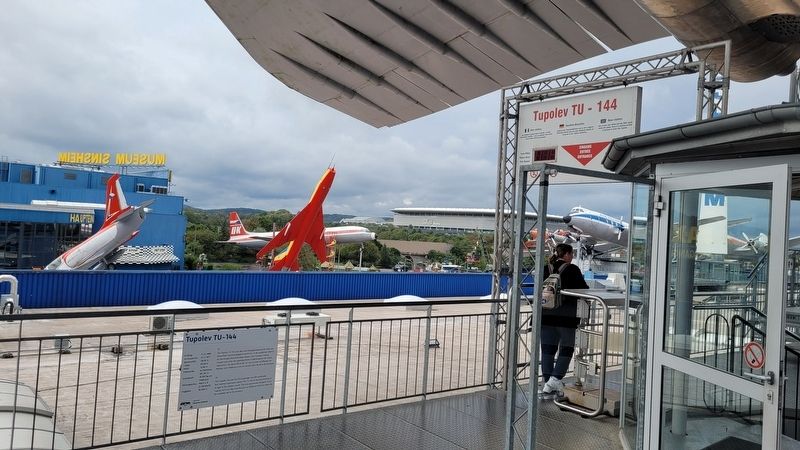
Photographed by James Hulse, September 24, 2024
2. The entrance to the Tupolev TU-144 static display and Marker
More about this marker. The static displays and markers are located on the grounds of the Technik Museum. There is an entrance fee to visit the museum and markers.
Regarding Tupolev TU-144. There is a duplicate marker located at the ground level on the wall of the museum
Also see . . . Tupolev Tu-144. Wikipedia
The Tu-144 was the world's first commercial supersonic transport aircraft with its prototype's maiden flight from Zhukovsky Airport on 31 December 1968, two months before the British-French Concorde. The Tu-144 was a product of the Tupolev Design Bureau, an OKB headed by aeronautics pioneer Aleksey Tupolev, and 16 aircraft were manufactured by the Voronezh Aircraft Production Association in Voronezh.[page needed] The Tu-144 conducted 102 commercial(Submitted on November 6, 2024, by James Hulse of Medina, Texas.)flights, of which only 55 carried passengers, at an average service altitude of 16,000 metres (52,000 ft) and cruised at a speed of around 2,200 kilometres per hour (1,400 mph) (Mach 2). The Tu-144 first went supersonic on 5 June 1969, four months before Concorde, and on 26 May 1970 became the world's first commercial transport to exceed Mach 2.Photographed by James Hulse, September 24, 20243. The reverse view of the Tupolev TU-144
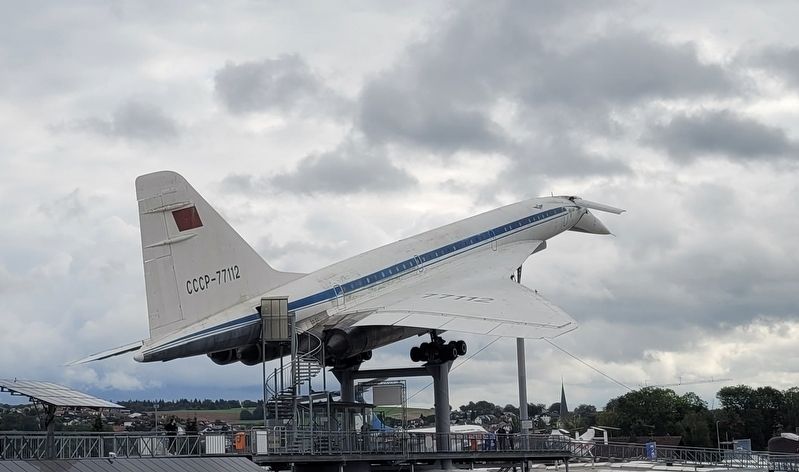

Photographed by James Hulse, September 24, 2024
4. The cockpit of the Tupolev TU-144
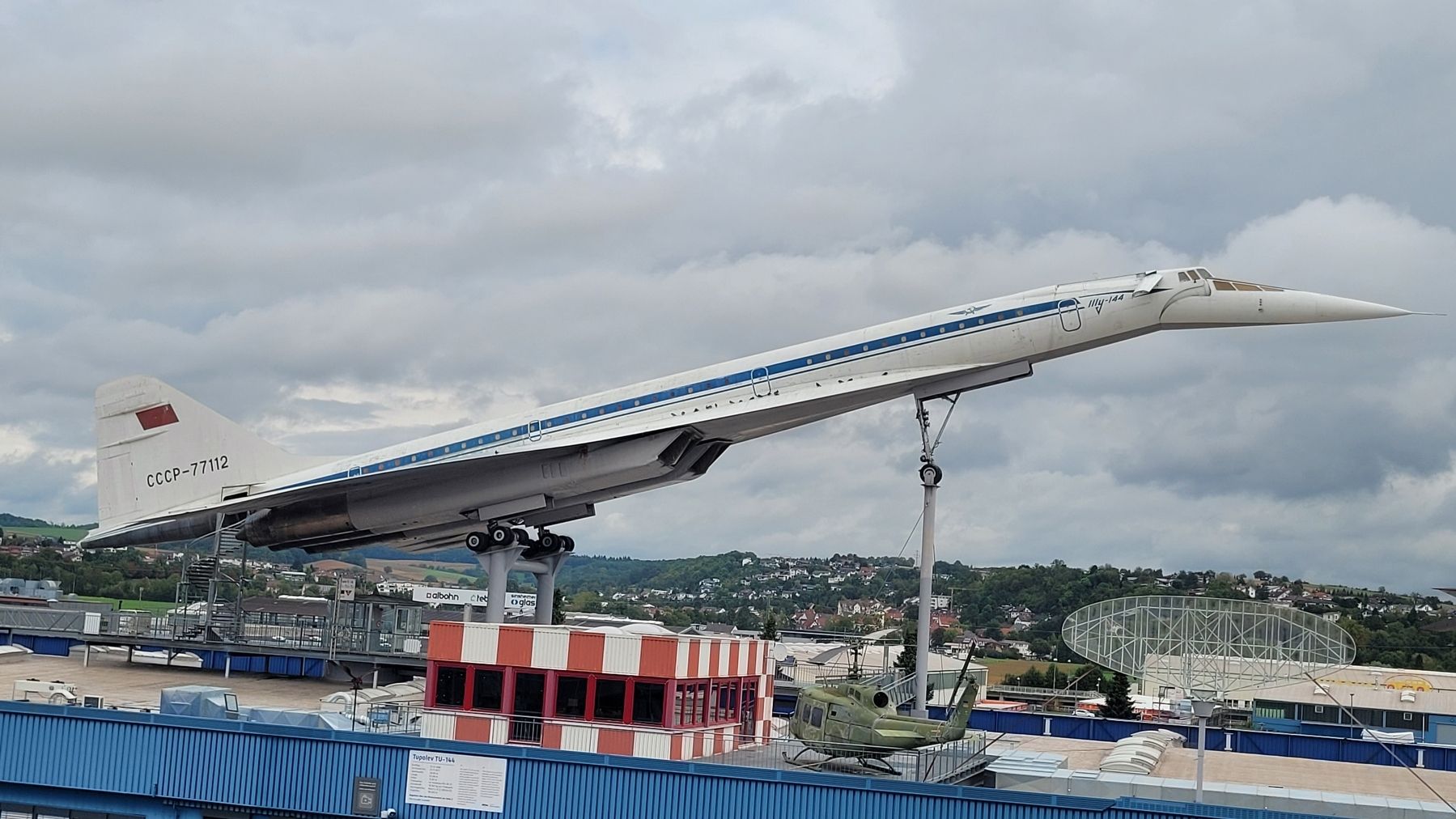
Photographed by James Hulse, September 24, 2024
5. Tupolev TU-144
Credits. This page was last revised on November 6, 2024. It was originally submitted on November 5, 2024, by James Hulse of Medina, Texas. This page has been viewed 161 times since then and 36 times this year. Photos: 1, 2, 3, 4, 5. submitted on November 6, 2024, by James Hulse of Medina, Texas.
