
Riquet Stalingrad in Paris in Département de Paris, Île-de-France, France — Western Europe
Albert Platek
Photographed by Andrew Ruppenstein, November 1, 2024
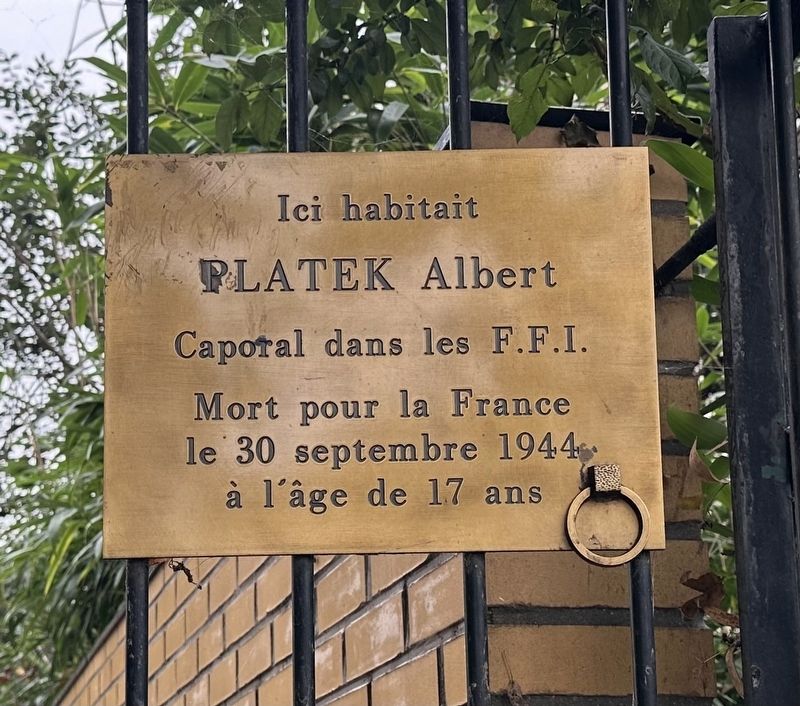
1. Albert Platek Marker

PLATEK Albert
Caporal dans les F.F.I.
Mort pour la France
le 30 septembre 1944
à l'âge de 17 ans
Topics. This memorial is listed in this topic list: War, World II. A significant historical date for this entry is September 30, 1944.
Location. 48° 53.264′ N, 2° 22.355′ E. Memorial is in Paris, Île-de-France, in Département de Paris. It is in Riquet Stalingrad. It is on Avenue de Flandre, on the right when traveling south. Touch for map. Memorial is at or near this postal address: 55 Avenue de Flandre, Paris, Île-de-France 75019, France. Touch for directions.

Regionally, it is in the North Atlantic Region, Europe, the European Union, Atlantic Europe, the Schengen Area, Western Europe, a coastal Mediterranean country, and the Western World. Historically, it finds itself in what was once a French colony and also the Roman Empire.
Other nearby markers. At least 8 other markers are within walking distance of this marker: Salle de la Marseillaise (within shouting distance
this page online
Also see . . . Plaque à la mémoire d’Albert Platek (Musée de la Résistance en ligne, in French). Excerpt (in translation):
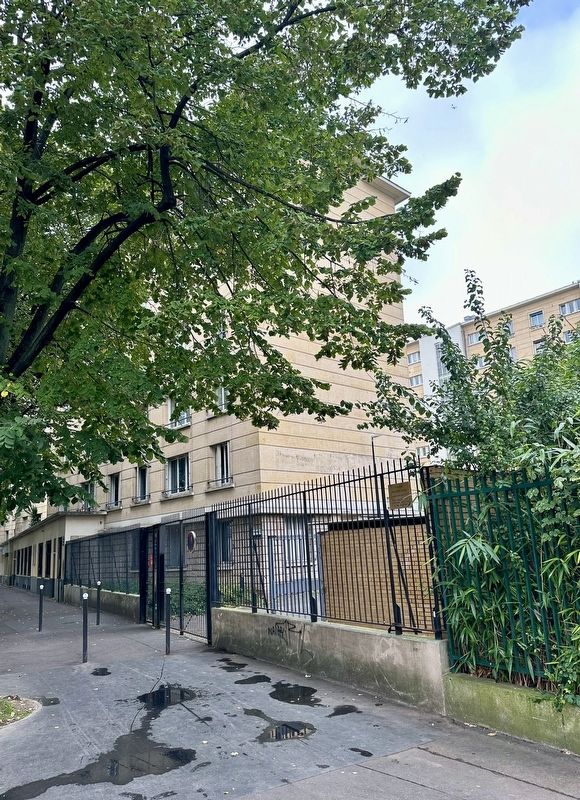
Born on July 20, 1927 in Paris to an immigrant family of Polish Jewish origin, Albert Platek attended the school on rue de Tanger where he obtained his school certificate, then entered the Gambetta apprenticeship school. In 1941, aged only 14, he joined the organization of young Jews of the MOI under the direction of Léon Orensztein. He distributed tracts and newspapers that denounced the racist laws of Vichy and the occupier, calling for vigilance(Submitted on November 6, 2024.)and resistance. He participated in collections to help the families of those interned in the camps of Drancy, Pithiviers and Beaune-la-Rolande.Photographed by Andrew Ruppenstein, November 1, 20242. Albert Platek Marker - wide view
After the great roundup of July 16, 1942, Albert Platek left Paris for Limoges with his parents who had escaped arrest. Despite his young age, in order to help his family, he forced himself to work in agriculture, then in a tile factory and finally as a lumberjack. It was in this department of Haute Vienne that Albert joined the FTP detachment "Bernard" in Saint-Victorien. Following the landing, the German units that were moving back towards Normandy inflicted bloody reprisals on the villages they passed through in this region. Oradour was 3 kilometers from Albert's home. Albert Platek and his FTP group joined the maquis where he was appointed corporal-chief. He would participate in the liberation of Limoges, Angoulême and Périgueux. The war was not over. Pockets of German resistance were established on the Atlantic. This was the case in Royan. The army unit to which the "Bernard" group was attached was sent to the front in La Rochelle. It was there, in the vicinity of the Château de Didonne, that Albert Platek met his death.
Credits. This page was last revised on November 6, 2024. It was originally submitted on November 6, 2024, by Andrew Ruppenstein of Lamorinda, California. This page has been viewed 113 times since then and 10 times this year. Photos: 1, 2. submitted on November 6, 2024, by Andrew Ruppenstein of Lamorinda, California.
