Thurmont in Frederick County, Maryland — The American Northeast (Mid-Atlantic)
Powered by Water
Catoctin Furnace Iron Trail
Photographed by Allen C. Browne, October 30, 2024
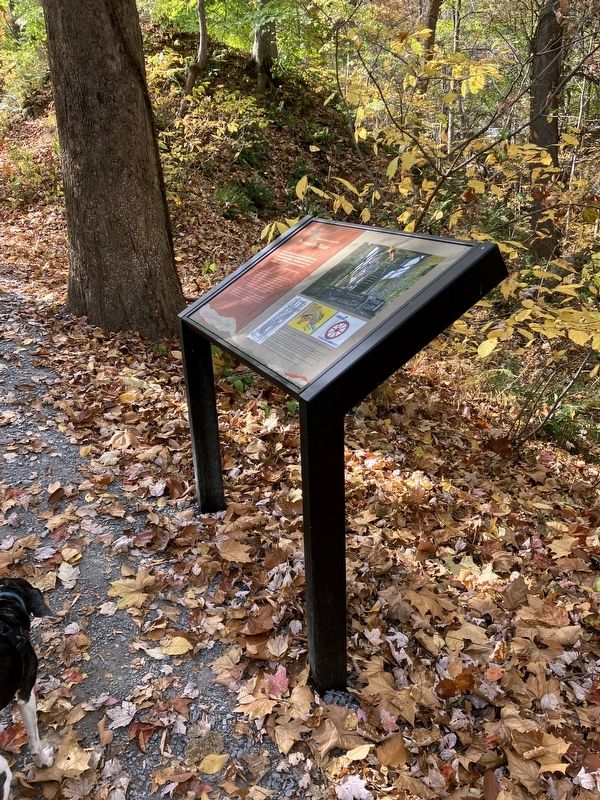
1. Powered by Water Marker
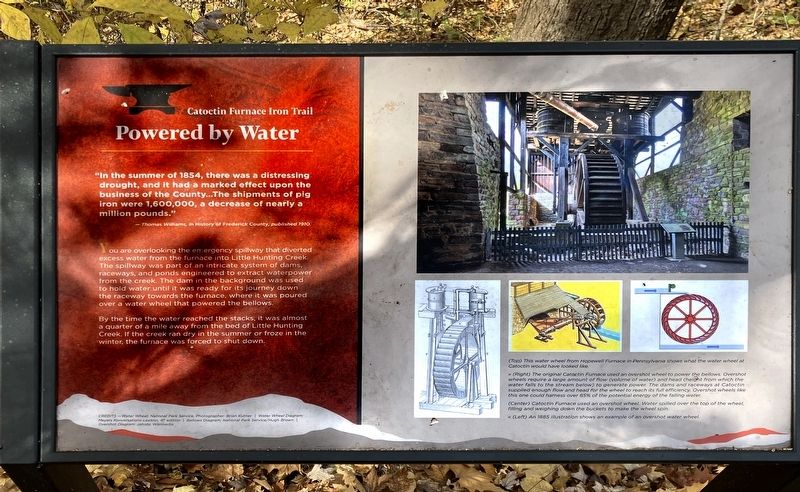
“In the summer of 1854, there was a distressing drought; and it had a marked effect upon the business of the County…The shipments of pig iron were 1,600,000, a decrease of nearly a million pounds.”
— Thomas Williams in History of Frederick County, published 1910.
You are overlooking the emergency spillway that diverted excess water from the furnace into Little Hunting Creek. The spillway was part of an intricate system of dams, raceways, and ponds engineered to extract waterpower from the creek. The dam in the background was used to hold water until it was ready for its journey down the raceway towards the furnace, where it was poured over a water wheel that powered the bellows.
By the time the water reached the stacks, it was almost a quarter of a mi!e away from the bed of Little Hunting Creek. If the creek ran dry in the summer or froze in the winter, the furnace was forced to shut down.
[Captions:]
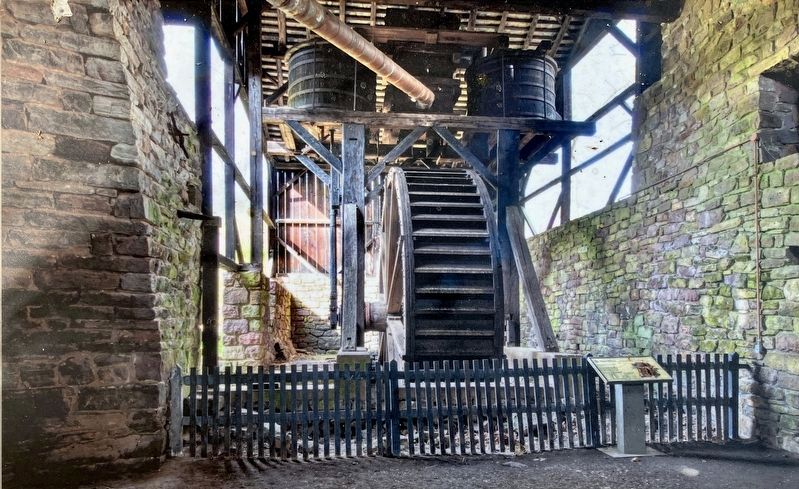
(Top) This water wheel from Hopewell Furnace in Pennsylvania shows what the water wheel at Catoctin would have looked like.
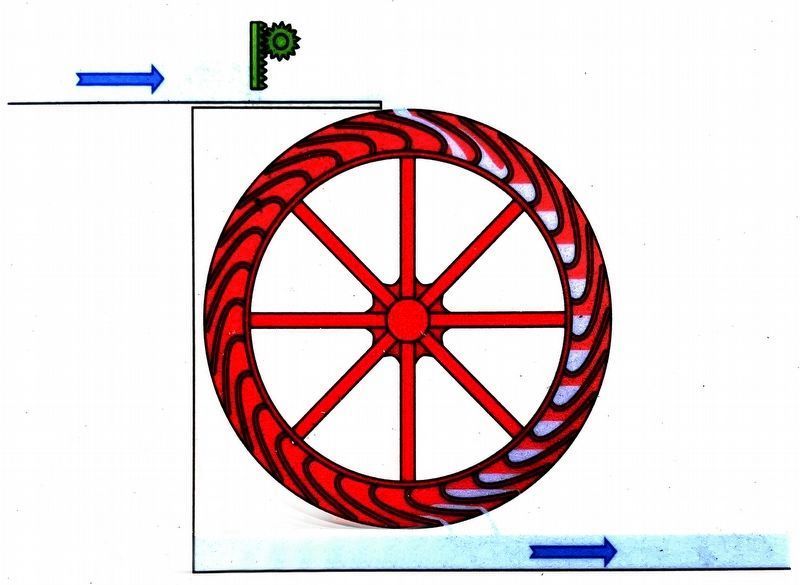
» (Right) The original Catoctin Furnace used an overshot wheel to power the bellows. Overshot wheels require a large amount of flow (volume of water) and head (height from which the water falls to the stream below) to generate power. The dams and raceways at Catoctin supplied enough flow and head for the wheel to reach its full efficiency. Overshot wheels like this one could harness over 85% of the potential energy of the falling water.
(Center) Catoctin Furnace used an overshot wheel. Water spilled over the top of the wheel, filling and weighing down the buckets to make the wheel spin.
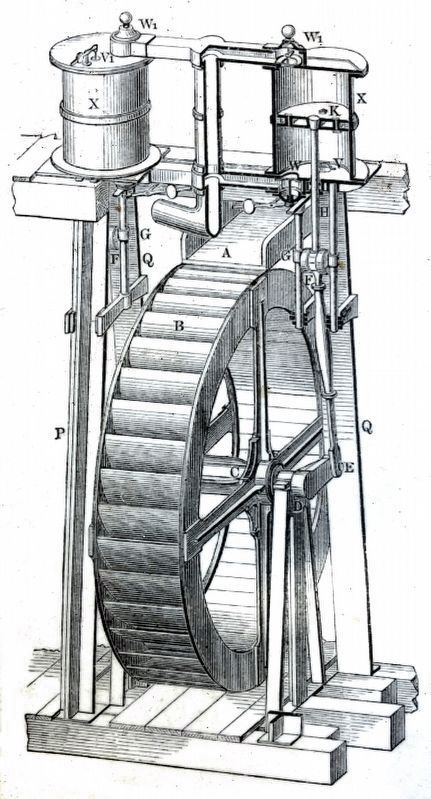
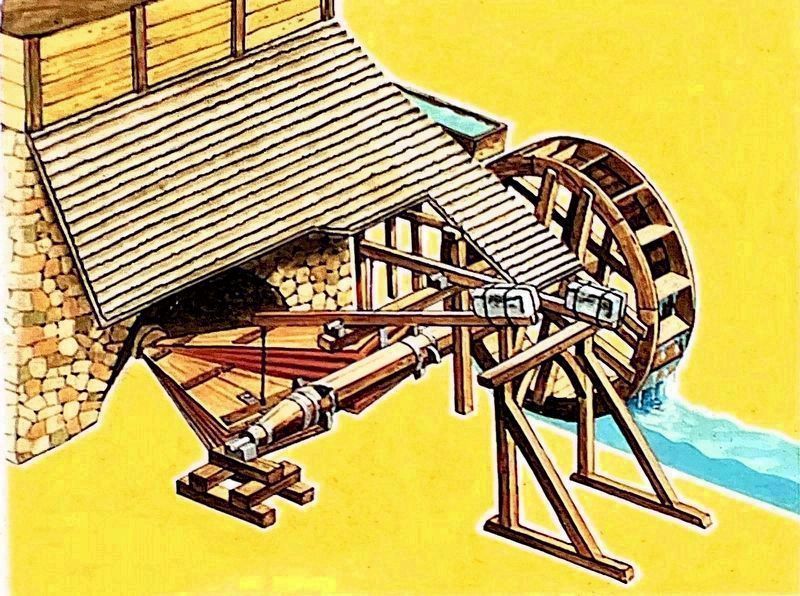
« (Left) An 1885 illustration shows an example of an overshot water wheel.
Erected by Catoctin
this page online
Topics and series. This historical marker is listed in this topic list: Industry & Commerce. In addition, it is included in the William G. Pomeroy Foundation series list. A significant historical year for this entry is 1854.
Location. 39° 34.966′ N, 77° 26.074′ W. Marker is in Thurmont, Maryland, in Frederick County. It can be reached from Catoctin Furnace Road. Touch for map. Marker is at or near this postal address: 12700 Catoctin Furnace Rd, Thurmont MD 21788, United States of America. Touch for directions.

Regionally, this marker is in the Washington Metropolitan Area and in Central Maryland. It is also in the American Mid-Atlantic. Globally, it is in North America, the Western Hemisphere, the Western World, and the Anglosphere. Historically, it finds itself in what was once one of the original Thirteen Colonies and also the Antebellum South.
Other nearby markers. At least 8 other markers are within walking distance of this marker: The Bridge that Moved (within shouting distance of this marker);
Photographed by Allen C. Browne, October 30, 2024
2. Powered by Water Marker
Other markers no longer nearby. Bowstring Arch Bridge (was a few steps from this marker but has been replaced with another marker now near it); Raceway and Dam (was within shouting distance of this marker but has been replaced with another marker now near it); Ruins of the Ironmaster’s House (was within shouting distance of this marker but has been replaced with another marker now near it); Prosperity and Power (was about 300 feet away, measured in a direct line but has been replaced with another marker now near it); Slag Heaps (was about 400 feet away but has been replaced with another marker now near it).
Photographed by Allen C. Browne, October 30, 2024
3. Water Wheel
This water wheel from Hopewell Furnace in Pennsylvania shows what the water wheel at Catoctin would have looked like. Photo by Brian Kutner NPS.
Close-up of photo on marker
Photographed by Allen C. Browne, October 30, 2024
4. Overshot Wheel
An 1885 illustration shows an example of an overshot water wheel. -- Meyers Konversations-Lexicon, 4th edition.
Close-up of diagram on marker
Photographed by Allen C. Browne, October 30, 2024
5. Overshot Wheel
Catoctin Furnace used an overshot wheel. Water spilled over the top of the wheel, filling and weighing down buckets to make the wheel spin. Diagram by Hugh Brown, NPS.
Close-up of diagram on marker
Photographed by Allen C. Browne, October 30, 2024
6. Overshot Wheel
The original Catoctin Furnace used an overshot wheel to power the bellows. Overshot wheels require a large amount of flow (volume of water) and head from which the water falls to the stream below) to generate power. The dams and raceways at Catoctin supplied enough flow and head for the wheel to reach its full efficiency. Overshot wheels like this one could harness over 85% of the potential energy of the falling water. - Diagram by Jahobr, Wikimedia.
Close-up of diagram on marker
Credits. This page was last revised on May 18, 2026. It was originally submitted on November 7, 2024, by Allen C. Browne of Silver Spring, Maryland. This page has been viewed 144 times since then and 29 times this year. Photos: 1, 2, 3, 4, 5, 6. submitted on November 7, 2024, by Allen C. Browne of Silver Spring, Maryland.
