Penetanguishene in Simcoe County, Ontario — Central Canada (North America)
Father Laboureau
1837-1904
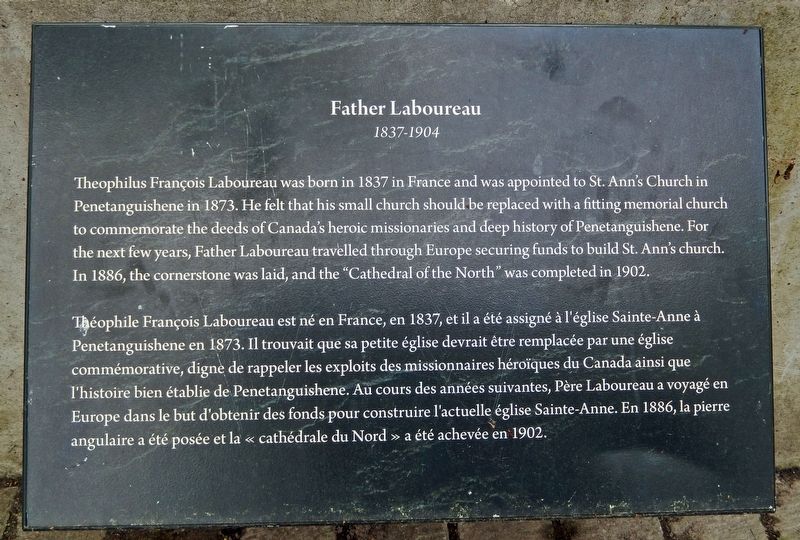
Photographed by Cosmos Mariner, June 7, 2024
1. Father Laboureau Marker

Topics. This historical marker is
this page online
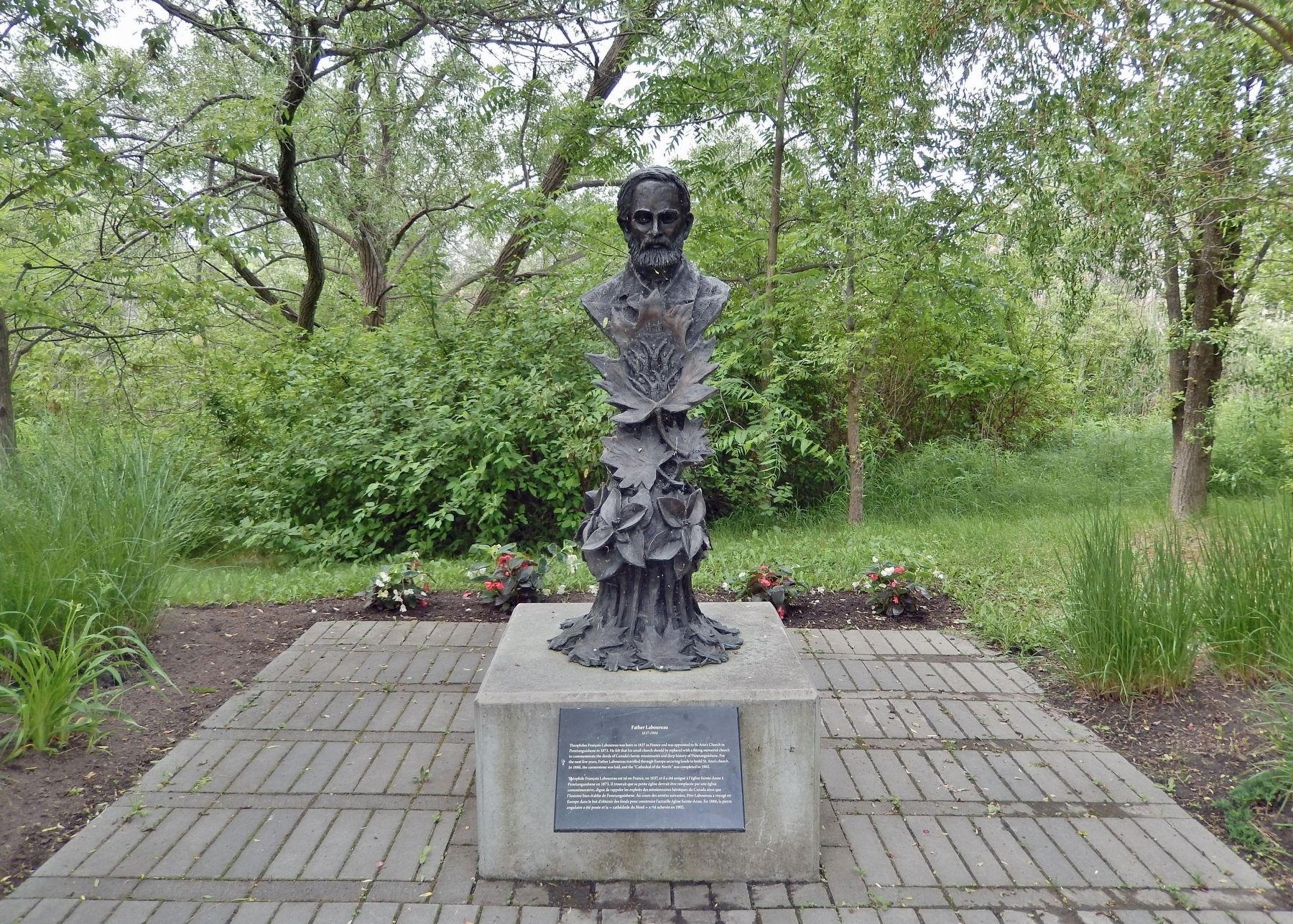
Location. 44° 46.172′ N, 79° 56.33′ W. Marker is in Penetanguishene, Ontario, in Simcoe County. It can be reached from Owen Street just north of Water Street. The marker and sculpture are located along the Trans-Canada Trail in Penetanguishene Rotary Champlain Wendat Park. Touch for map. Marker is at or near this postal address: 8 Owen Street, Penetanguishene ON L9M 1M8, Canada. Touch for directions.

Regionally, this marker is in Central Ontario Cottage Country and specifically in Georgian Bay Country. It is also in Central Canada. Globally, it is in North America, on the Great Lakes, in the Western Hemisphere, in the Western World, and in the Anglosphere. Historically, it finds itself in what was once a British colony, the Viceroyalty of New France, the Haudenosaunee (Iroquois) Confederacy, and Rupert’s Land.
Other nearby markers. At least 8 other markers are within walking distance of this marker: Athol Murray (here, next to this marker); John Graves Simcoe (1752-1806) (a few steps from this marker); Métis
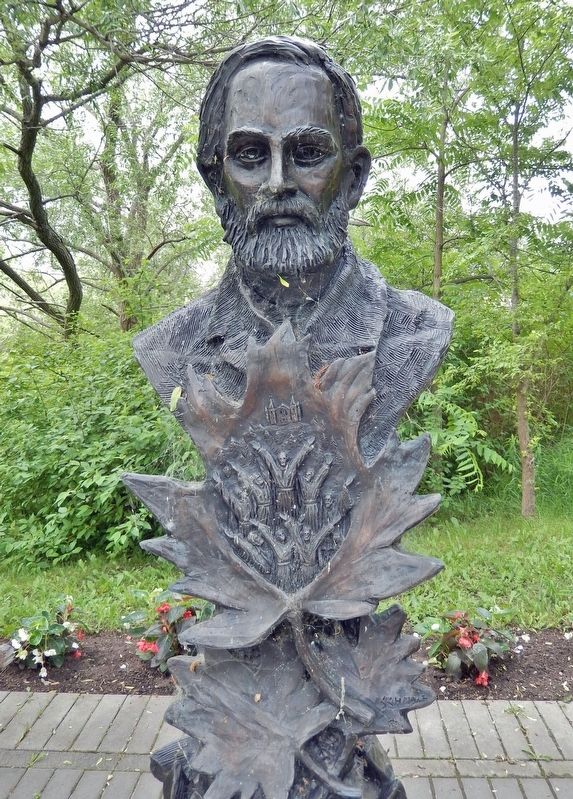
Photographed by Cosmos Mariner, June 7, 2024
2. Father Laboureau Sculpture
Also see . . . The Beauty and Forgotten Heritage, St. Anne’s Jesuit Memorial Church: Canada’s National Shrine.
Excerpt: A new pastor arrived in Penetanguishene in 1873 and Father Theophile Pius Francis Laboureau soon realized that his little wood-sided church, the second St. Anne’s, was too small to accommodate his growing parish. He amazingly decided to replace it with a grand structure, a large shrine dedicated to the Canadian missionaries who had laboured and were martyred here in his parish in the 1600s.(Submitted on November 7, 2024, by Cosmos Mariner of Cape Canaveral, Florida.)Laboureau miraculously galvanized not only the locals, but Canadians and the world at large, to raise the necessary funds. Armed with a concept and supporting letters from Prime
Minister Sir John A. MacDonald, various premiers, dignitaries and a long list of Canadian Catholic bishops, Laboureau secured hundreds of private donations along with funds from the Senate of France and the Congress of the United States. He also secured funds and blessings from church leaders throughout Europe and the Vatican. Also while in France, Laboureau had an architect from Burgundy draw up rough plans. He chose a Romanesque style of architecture reminiscent of many European basilicas constructed between A.D 800-1270.Photographed by Cosmos Mariner, June 7, 20243. Father Laboureau Marker & SculptureOn September 5, 1886, a huge crowd of over 5,000 people from the town, area and throughout Ontario, watched Archbishop of Toronto, J.J. Lynch, bless and lay the historic cornerstone. For sixteen long and arduous years, construction continued on this massive church…
Credits. This page was last revised on November 7, 2024. It was originally submitted on November 7, 2024, by Cosmos Mariner of Cape Canaveral, Florida. This page has been viewed 139 times since then and 23 times this year. Photos: 1, 2, 3. submitted on November 7, 2024, by Cosmos Mariner of Cape Canaveral, Florida.
