Fenwick in Pelham in Niagara Region, Ontario — Central Canada (North America)
The Reverend Daniel W. Eastman
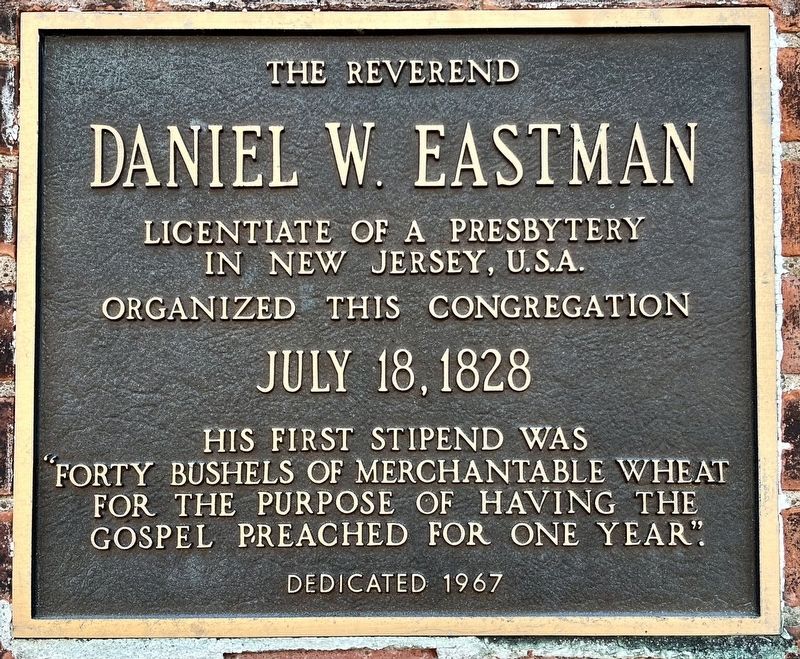
Photographed by Tim Boyd, November 7, 2024
1. The Reverend Daniel W. Eastman Marker
Daniel W. Eastman
Licentiate of a presbytery
in New Jersey, U.S.A.
organized this congregation
July 18, 1828
His first stipend was
"forty bushels of merchantable wheat
for the purpose of having the
gospel preached for one year".
Erected 1967.
Topics. This historical marker is listed in these topic lists: Religion & Religious Structures • Settlements & Settlers. A significant historical date for this entry is July 18, 1828.
Location. 43° 3.664′ N, 79° 20.479′ W. Marker is in Pelham, Ontario, in Niagara Region. It is in Fenwick. It is at the intersection of Metler Road and Cream Street, on the right when traveling east on Metler Road. Touch for map. Marker is at or near this postal address: 602 Metler Road, Pelham ON L0S 1C0, Canada. Touch for directions.

Regionally, this marker is on Ontario’s Golden Horseshoe and in Niagara Canada. It is also in Central Canada. Globally, it is in North America, on the Great Lakes, in the Western Hemisphere, in the Western World, and in the Anglosphere. Historically, it finds itself in what was once a British colony, the Viceroyalty of New France,
this page online
Other nearby markers. At least 8 other markers are within 6 kilometers of this marker, measured as the crow flies: The Comfort Maple (approx. 0.4 kilometers away); The Brethren in Christ Church / L’Église de la Fraternité Chrétienne (approx. 3 kilometers away); Pelham Cenotaph (approx. 3.2 kilometers away); W.W. 1 German Trench Mortar (approx. 3.2 kilometers away); Pelham Quaker Settlement (approx. 4.8 kilometers away); Dexter D’Everardo (approx. 5 kilometers away); The Fenwick Fair (approx. 5.2 kilometers away); St. Johns (approx. 5.4 kilometers away). Touch for a list and map of all markers in Pelham.
Also see . . . The Presbyterian Church in Canada (wikipedia). <blockquote>After the departure of the Thirteen American Colonies from British North America, there was an increase in population within the Canadas, divided in 1791 into Upper Canada (now called Ontario) and Lower Canada (now called Quebec), including most of the previously populated areas of the New France colony, and within the Maritimes, including Nova Scotia, New Brunswick, and Prince Edward

Photographed by Tim Boyd, November 7, 2024
2. The Reverend Daniel W. Eastman Marker
To the right of the doorway
Some of the early Canadian Presbyterians were United Empire Loyalists of Scots descent, and others came directly from Scotland, such as in the 1773 arrival of The Hector in Pictou, Nova Scotia. (Submitted on November 8, 2024, by Tim Boyd of Hamilton, Ontario.)
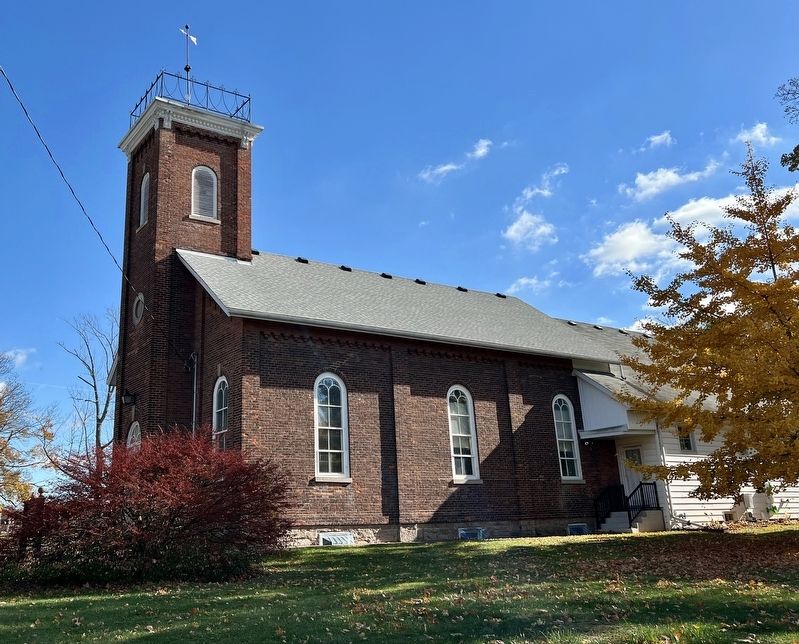
Photographed by Tim Boyd, July 11, 2024
3. First Presbyterian Church, North Pelham
Credits. This page was last revised on November 9, 2024. It was originally submitted on November 8, 2024, by Tim Boyd of Hamilton, Ontario. This page has been viewed 162 times since then and 16 times this year. Photos: 1, 2, 3. submitted on November 8, 2024, by Tim Boyd of Hamilton, Ontario. • Andrew Ruppenstein was the editor who published this page.
