Marlborough in Middlesex County, Massachusetts — The American Northeast (New England)
Overcoming Geography – Making of a Downtown
Marlborough, Massachusetts
| — | The Museum in the Streets® | — |
Photographed by Duane and Tracy Marsteller, September 30, 2024
1. Overcoming Geography – Making of a Downtown Marker
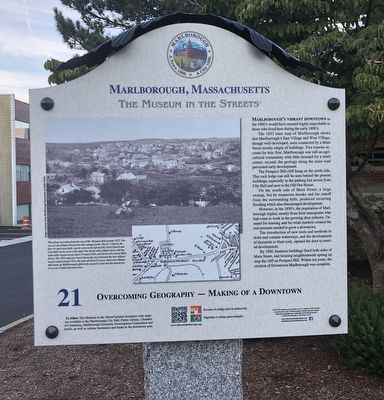
The 1833 state map of Marlborough shows that Marlborough's East Village and West Village, though well-developed, were connected by a Main Street mostly empty of buildings. Two reasons account for this: first, Marlborough was still an agricultural community with little demand for a retail center; second, the geology along the main road prevented early development.
The Prospect Hill cliff hung on the north side. This rock ledge can still be seen behind the present buildings especially in the parking lots across from City Hall and next to the Old Fire House.
On the south side of Main Street, a large swamp, fed by numerous brooks and the runoff from the surrounding hills, produced recurring flooding which also discouraged development.
However, in the 1850s, the population of Marlborough tripled, mostly from Irish immigrants who had come to work in the growing shoe industry. Demand for housing and for retail markets created the real pressure needed to create a downtown.
The introduction
this page online
By 1860, business buildings lined both sides of Main Street, and housing neighborhoods sprang up atop the cliff on Prospect Hill. Within ten years, the creation of Downtown Marlborough was complete.
[Caption] This photo was taken from the top of Mt. Pleasant Hill around 1875. You can see all of Main Street from this vantage point. The I.C. Church, before its spire was built, can be seen on the left and the First Church and City Hall can be seen to the right. The north side of Main Street still has noticeably vacant areas where Prospect Hill, and all its rock, meets Main Street. The 1853 map (see inset) shows the area between the two villages largely undeveloped. Over the span of about 25 years, these two villages that made up Marlborough effectively ceased to exist and the downtown as we see it today had been born.
Erected by The Museum in the Streets®. (Marker Number 21.)
Topics and series. This historical marker is listed in this topic list: Notable Places. In addition, it
Photographed by Duane and Tracy Marsteller, September 30, 2024
2. Overcoming Geography – Making of a Downtown Marker
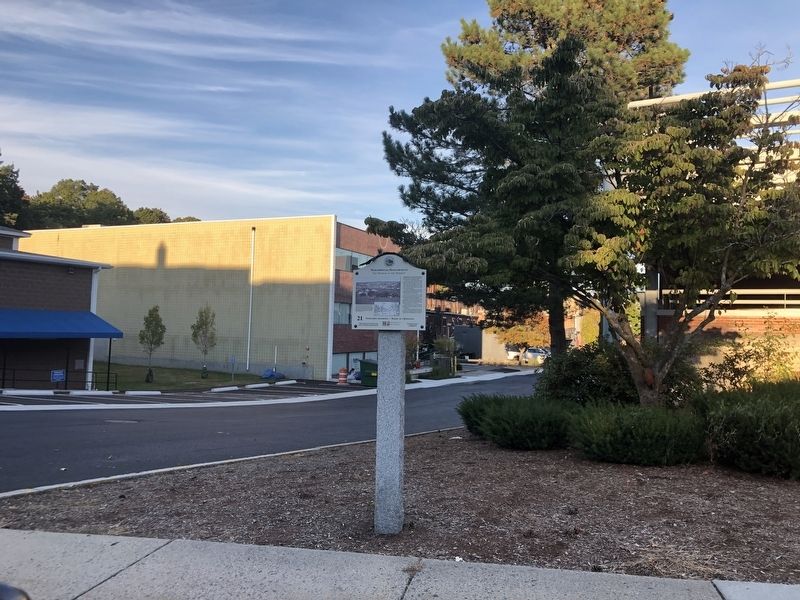
Location. 42° 20.757′ N, 71° 33.03′ W. Marker is in Marlborough, Massachusetts, in Middlesex County. It is at the intersection of Newton Street and Weed Street, on the right when traveling north on Newton Street. Touch for map. Marker is at or near this postal address: 20 Newton St, Marlborough MA 01752, United States of America. Touch for directions.

Regionally, this marker is in Greater Boston. It is also in the American Northeast, in New England, and on the Eastern Seaboard. Globally, it is in the North Atlantic Region, North America, the Western Hemisphere, the Western World, and the Anglosphere. Historically, it finds itself in what was once one of the original Thirteen Colonies.
Other nearby markers. At least 8 other markers are within walking distance of this marker: The Disasters of Downtown Marlborough (within shouting distance of this marker); Gen. Henry Knox Trail (about 400 feet away, measured in a direct line); A Noble Train of Artillery (about 400 feet away); The Praying Indians (about 400 feet away); Artemas Ward Park (about 400 feet away); Doughboy Monument (about 500 feet away); The Parade of Colonial History (about 500 feet away); The Lost Trains of Marlborough (about 500 feet away). Touch for a list and map of all markers in Marlborough.
Credits. This page was last revised on November 9, 2024. It was originally submitted on November 8, 2024, by Duane and Tracy Marsteller of Murfreesboro, Tennessee. This page has been viewed 127 times since then and 19 times this year. Photos: 1, 2. submitted on November 8, 2024, by Duane and Tracy Marsteller of Murfreesboro, Tennessee.
