Marlborough in Middlesex County, Massachusetts — The American Northeast (New England)
The Evolution of Marlborough (1656-2019)
Marlborough, Massachusetts
| — | The Museum in the Streets® | — |
Photographed by Duane and Tracy Marsteller, September 30, 2024
1. The Evolution of Marlborough (1656-2019) Marker
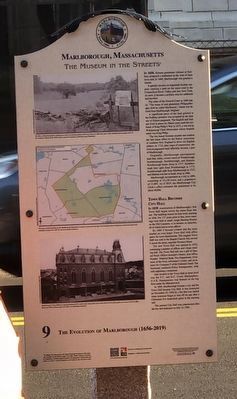
It quickly became an important frontier outpost, opening a path on the main road to the Connecticut River Valley and into New York. As such, it became a primary stop for cattlemen and travelers.
The order of the General Court in 1660 said, “The name of said plantation (Whipsufferage) shall be called Marlborrow,” which was derived from Marlborough, England.
A significant piece of the land granted to the Sudbury pioneers was occupied by the Indians of Ockoocangansett. The English and Indians lived in peace fifteen years until the outbreak of King Philip's War in 1675, a war led by Wampanoag Chief Mettacomet whose English name was King Philip.
The war lasted fourteen months and marked the last major effort by the Native Americans of southern New England to drive out English settlers. By 1718, after years of controversy, the Ockoocangansett had officially become a part of Marlborough.
Originally, Marlborough encompassed land that, today, covers much of Westborough, Northborough, Southborough, and Hudson. Westborough broke away in 1717. Northborough later split from Westborough in 1775. Southborough split from Marlborough in 1727, and Hudson was last to break away in 1866.
Marlborough incorporated as a city in 1890, consisting of 14,150 acres, and a population of 13,805. As of 2019, the Marlborough City Clerk's office estimates the population to be about 40,000.
Town Hall Becomes City Hall
In 1839, construction of Marlborough's first Town Hall began across the street from this site. The building housed its first town meeting in 1840. For 177 years prior to this, some meetings were held in small, rough Meeting Houses on the Old Common, or in taverns,
this page online
By 1869 it became evident that the town needed an even larger Town Hall with office space for town departments. The original Town Hall was sold to the Baptist Church who moved it across the street, opposite Florence Street.
The new Town Hall was opened in 1870, containing a number of offices and a large meeting hall. The Town Hall bell was a gift of Samuel Boyd. Offices included a library, post office, People's National Bank, fire department, selectmen's rooms, and an armory for Company F of the National Guard. The basement contained police headquarters, with cells adjoining a courtroom.
Also located in the Town Hall at street level was the F.C. and N.C. Curtis Marketplace. G.A.R. headquarters was housed on the top floor under the Mansard roof.
In 1890, Marlborough became a city and the Town Hall became City Hall. It was destroyed on December 25, 1902 by a fire that was started when someone forgot to shut off the gas after a Christmas Eve basketball game in the meeting hall.
The present City Hall was constructed after the fire and dedicated on July 16, 1906.
[Captions] Unreadable in photograph
Erected by The
Photographed by Duane and Tracy Marsteller, September 30, 2024
2. The Evolution of Marlborough (1656-2019) Marker
Topics and series. This historical marker is listed in this topic list: Political Subdivisions. In addition, it is included in the King Philip's War 1675-1676, and the The Museum in the Streets: Marlborough, Massachusetts series lists. A significant historical year for this entry is 1656.
Location. 42° 20.813′ N, 71° 32.872′ W. Marker is in Marlborough, Massachusetts, in Middlesex County. It can be reached from Main Street west of Court Street, on the right when traveling west. Marker is in the parking lot across the street from Marlborough City Hall. Touch for map. Marker is at or near this postal address: 147 Main St, Marlborough MA 01752, United States of America. Touch for directions.

Regionally, this marker is in Greater Boston. It is also in the American Northeast, in New England, and on the Eastern Seaboard. Globally, it is in the North Atlantic Region, North America, the Western Hemisphere, the Western World, and the Anglosphere. Historically, it finds itself in what was once one of the original Thirteen Colonies.
Other nearby markers. At least 8 other markers are within walking distance of this marker: The Great Shoe Strike (within shouting distance of this marker); The Princess Theatre (within shouting distance of this marker); Marlborough Trolley System (about 300 feet away, measured in a direct line); The Lost Trains of Marlborough (about 400 feet away); The Saga of Tory Henry Barnes (about 400 feet away); Samuel Boyd – Father of the City & The Boyd & Corey Shoe Factory (about 500 feet away); The John Brown Bell (about 700 feet away); Backbone of the Shoe Industry (about 700 feet away). Touch for a list and map of all markers in Marlborough.
Credits. This page was last revised on November 9, 2024. It was originally submitted on November 8, 2024, by Duane and Tracy Marsteller of Murfreesboro, Tennessee. This page has been viewed 335 times since then and 56 times this year. Photos: 1, 2. submitted on November 8, 2024, by Duane and Tracy Marsteller of Murfreesboro, Tennessee.
Editor’s want-list for this marker. Clear daytime closeup photograph of marker. • Complete text of marker. • Can you help?
