Near Bryce Canyon City in Garfield County, Utah — The American Mountains (Southwest)
Tragedy and Triumph
Emergency Landings
Photographed by Tom Bosse, July 26, 2024
1. Tragedy and Triumph Marker
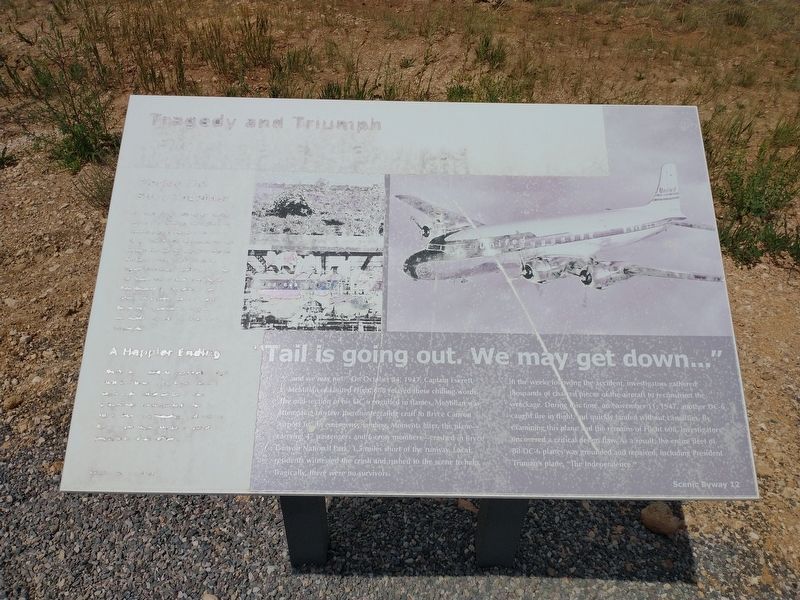
"Tail is going out. We may get down..."
"...and we may not." On October 24, 1947, Captain Everett L, McMillan of United Flight 608 relayed these chilling words. The mid-section of his DC-9 engulfed in flames, McMillan was attempting to steer the disintegrating craft to Bryce Canyon Airport for an emergency landing. Moments later, the plane - carrying 47 passengers and 6 crew members - crashed in Bryce Canyon National Park, 1.5 miles short of the runway. Local residents witnessed the crash and rushed to the scene to help. Tragically, there were no survivors.
In the weeks following the accident, investigators gathered thousands of charred pieces of the aircraft to reconstruct the wreckage. During this time, on November 11, 1947, another DC-6 caught fire in flight, but quickly landed without casualties. By examining this plane and the remains of Flight 608, investigators uncovered a critical design flaw. As a result, the entire fleet of 80 DC-6 planes was grounded and repaired, including President Truman's plane, "The Independence".
Piecing the Story Together
The crash of Flight 608 marked the first time in aviation
this page online
A Happier Ending
On October 6, 2000, American Airlines Flight 2821 from Denver to Los Angeles reported smoke in the cockpit and loss of cabin pressure while cruising at 33,000 feet. The MD-82 airliner was immediately redirected to Bryce Canyon Airport. The aircraft and all 75 people on board landed here safely.
[Caption]: Rabbitbush (Ericameria bloomeri)
[Caption]: Charred engine lies in a local field following the crash of Flight 608,
Erected by Scenic Byway 12.
Topics. This historical marker is listed in these topic lists: Air & Space • Disasters. A significant historical date for this entry is October 24, 1947.
Location. 37° 41.756′ N, 112° 10.197′ W. Marker has been reported unreadable.
Photographed by Tom Bosse, July 26, 2024
2. Tragedy and Triumph Marker
Marker is on the right.

Regionally, this marker is in Canyon Country and specifically in Color Country. It is also in the American Mountain West, on the Colorado Plateau, and at the Four Corners. Globally, it is in North America, the Western Hemisphere, the Western World, and the Anglosphere. Historically, it finds itself in what was once New Spain and also Mexico’s Alta California.

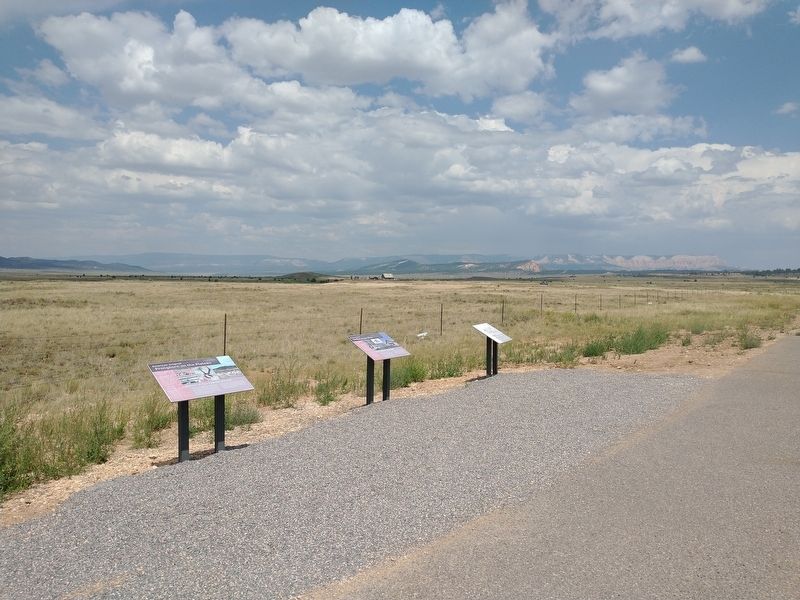
Other nearby markers. At least 8 other markers are within 4 miles of this location, measured as the crow flies: Bryce Airport (here, next to this marker); American Original (here, next to this marker); Historic Tropic Ditch (approx. 1.9 miles away); Bringing Water to the Desert (approx. 3.7 miles away); Hike the Hoodoos (approx. 3.7 miles away); Water Canyon (approx. 3.8 miles away); Stephen Tyng Mather (approx. 3.9 miles away); Mossy Cave (approx. 3.9 miles away). Touch for a list and map of all markers in Bryce Canyon City.
Also see . . . Remembering Flight 608. (Submitted on November 9, 2024, by Tom Bosse of Jefferson City, Tennessee.)
Credits. This page was last revised on November 11, 2024. It was originally submitted on November 9, 2024, by Tom Bosse of Jefferson City, Tennessee. This page has been viewed 350 times since then and 60 times this year. Photos: 1, 2. submitted on November 9, 2024, by Tom Bosse of Jefferson City, Tennessee. • Andrew Ruppenstein was the editor who published this page.
