St. Matthews in Calhoun County, South Carolina — The American South (South Atlantic)
Calhoun County
Photographed by Mickey Ocean, January 9, 2009
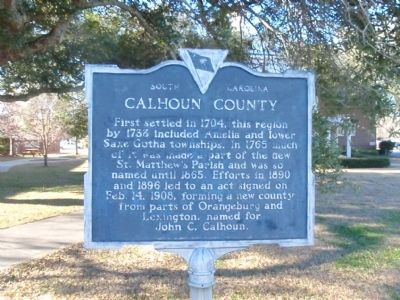
1. Calhoun County Marker
First settled in 1704, this region by 1733 included Amelia and lower Saxe Gotha townships. In 1765 much of it was made part of the new St. Matthew's Parish and was so named until 1865. Efforts in 1890 and 1896 led to an act signed on Feb. 14, 1908 forming a new county from parts of Orangeburg and Lexington, named for John C. Calhoun.
Erected 1958 by South Carolina Department of Archives and History, sponsored by Calhoun County Historical Commission. (Marker Number 9-5.)
Topics and series. This historical marker is listed in these topic lists: Political Subdivisions • Settlements & Settlers. In addition, it is included in the South Carolina Historical Markers, and the South Carolina, Calhoun County Historical Commission/Society series lists. A significant historical month for this entry is February 1930.
Location. 33° 39.793′ N, 80° 46.71′ W. Marker is in St. Matthews, South Carolina, in Calhoun County. It is at the intersection of South Railroad Avenue (State Highway 9-48) and Dantzier Street, on the right when traveling south on South Railroad Avenue. It is on the southeast side of the Calhoun County courthouse. Touch for map.
this page online

Regionally, this marker is in the Lowcountry, in Congaree Country, and specifically in Santee Cooper Country. It is also in the American South and specifically in the Deep South. Globally, it is in North America, the Western Hemisphere, the Western World, and the Anglosphere. Historically, it finds itself in what was once the territory of the Mississippian Culture, one of the original Thirteen Colonies, one of the Confederate States of America, and the Antebellum South.
Other nearby markers. At least 10 other markers are within 5 miles of this marker, measured as the crow flies: "Lest We Forget" (within shouting distance of this marker); Patriots of Calhoun County (within shouting distance of this marker); Bethel A.M.E. Church and School (about 700 feet away, measured in a direct line); West End Public Library (approx. half a mile away); John Ford High School (approx. half a mile away); Tabernacle Cemetery (approx. 3.1 miles away); Mt. Carmel Baptist Church (approx. 4.1 miles away); First Land Granted in Calhoun County Area
Photographed by Mike Stroud, December 29, 2009
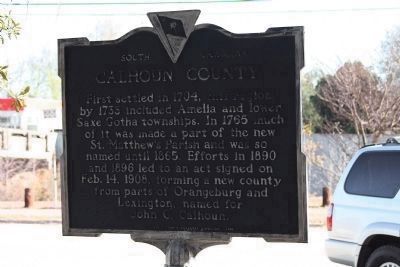
2. Calhoun County Marker, backside view
Also see . . .
1. Calhoun County, South Carolina. Wikipedia entry:
Calhoun County is a county located in the U.S. state of South Carolina. (Submitted on February 10, 2011, by Brian Scott of Anderson, South Carolina.)
2. Calhoun County Courthouse. South Carolina Department of Archives and History website entry:
Calhoun County Courthouse was built in 1913 and designed by renowned South Carolina architect William Augustus Edwards. (Submitted on February 10, 2011, by Brian Scott of Anderson, South Carolina.)
3. A History of Amelia Township, South Carolina. The Known Towns / Villages of South Carolina website entry:
Amelia Township was established and first settled by German Lutherans in 1732. (Submitted on February 10, 2011, by Brian Scott of Anderson, South Carolina.)
4. A History of Saxe-Gotha Township, South Carolina. The Known Towns / Villages of South Carolina website entry:
One of the originals, Congaree
Photographed by Jimmy Emerson, September 9, 2006
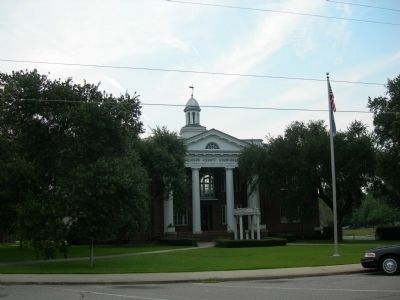
3. Calhoun County Marker
Marker is hidden by low branches of a tree in front of the Calhoun County Courthouse.
5. John C. Calhoun. Wikipedia entry:
John Caldwell Calhoun (March 18, 1782 – March 31, 1850) was a leading politician and political theorist from South Carolina during the first half of the 19th century. (Submitted on February 10, 2011, by Brian Scott of Anderson, South Carolina.)
Additional commentary.
1. Calhoun County Courthouse
Calhoun County Courthouse was built in 1913. W.R. Rose was the contractor and William Augustus Edwards was the architect.
The courthouse is a two-story Georgian Revival building with a colossal Doric portico on the south elevation. The tetrastyle portico projects from a central three-bay entrance pavilion. The columns of the portico are of stuccoed brick with the proportion and detail of the Greek Doric order: no bases, the diameter broad in relation of the height, and annulets on the lower part of each capital echinus. The entablature of the portico is executed in wood. It consists of a bipartite architrave,
Photographed by Mike Stroud, 2009
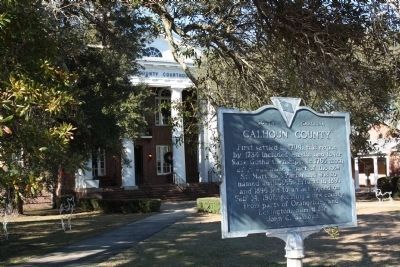
4. Calhoun County Marker and Courthouse
Significance
Calhoun County Courthouse was built to serve as the first courthouse of the new Calhoun County. The county, named for John C. Calhoun, renowned South Carolina statesman, had been formed after seventeen years of concerted effort by the residents of St. Matthews and its immediate surroundings. The act established the county and established a commission to provide for a courthouse and jail. The town of St. Matthews, designated the county seat, donated $20,000 toward construction costs for the public buildings and Mr. E.F. Buyck and Mr. M. Jarecky donated the construction site. (Source: National Register nomination form.)
— Submitted February 10, 2011, by Brian Scott of Anderson, South Carolina.
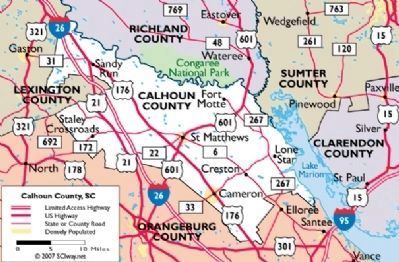
Photographed by SCIway.net
5. Calhoun County Map
Credits. This page was last revised on January 25, 2026. It was originally submitted on January 24, 2009, by Mickey Ocean of Greenville County, South Carolina. This page has been viewed 2,039 times since then and 58 times this year. Last updated on December 31, 2009, by Mike Stroud of Bluffton, South Carolina. Photos: 1. submitted on January 24, 2009, by Mickey Ocean of Greenville County, South Carolina. 2. submitted on December 30, 2009, by Mike Stroud of Bluffton, South Carolina. 3. submitted on January 26, 2009, by Kevin W. of Stafford, Virginia. 4. submitted on December 29, 2009, by Mike Stroud of Bluffton, South Carolina. 5. submitted on February 13, 2011, by Brian Scott of Anderson, South Carolina. • Kevin W. was the editor who published this page.
