Sevier in Sevier County, Utah — The American Mountains (Southwest)
Basic History
Photographed by Tom Bosse, July 27, 2024
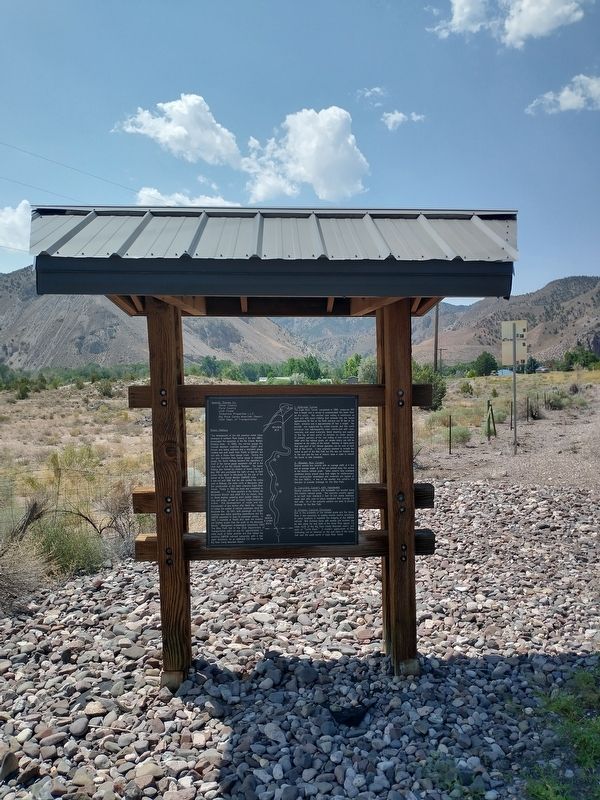
1. Basic History Marker
Basic History
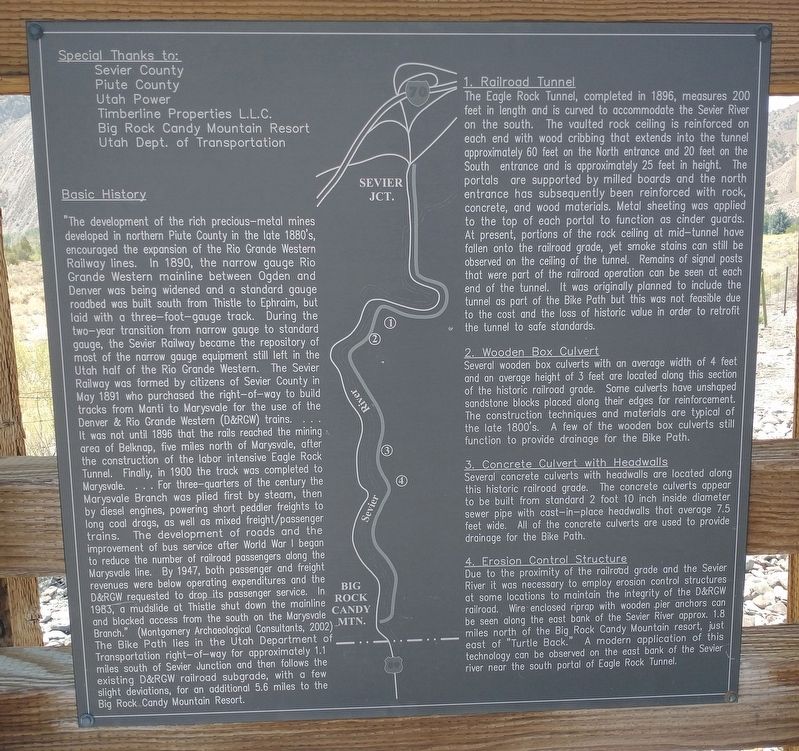
"The development of the rich precious-metal mines developed in northern Piute County in the late 1880's, encouraged the expansion of the Rio Grande Western Railway lines. In 1890, the narrow gauge Rio Grande Western mainline between Ogden and Denver was being widened and a standard gauge roadbed was built south from Thistle to Ephraim, but laid with a three-foot-gauge track. During the two-year transition from narrow gauge to standard gauge, the Sevier Railway became the repository of most of the narrow gauge equipment still left in the Utah half of the Rio Grande Western. The Sevier Railway was formed by citizens of Sevier County in May 1891 who purchased the right-of-way to build tracks from Manti to Marysvale for the use of the Denver & Rio Grande Western (D&RGW) trains. It was not until 1896 that the rails reached the mining area of Belknap, five miles north of Marysvale, after the construction of the labor intensive Eagle Rock Tunnel. Finally, in 1900 the track was completed to Marysvale. For three-quarters of the century the Marysvale Branch was plied first by steam, then by diesel engines, powering
this page online
1. Railroad Tunnel
The Eagle Rock Tunnel, completed in 1896, measures 200 feet in length and is curved to accommodate the Sevier River on the south. The vaulted rock ceiling is reinforced on each end with wood cribbing that extends into the tunnel approximately 60 feet on the North entrance and 20 feet on the South entrance and is
Photographed by Tom Bosse, July 27, 2024
2. Basic History Marker
2. Wooden Box Culvert
Several wooden box culverts with an average width of 4 feet and an average height of 3 feet are located along this section of the historic railroad grade. Some culverts have unshaped sandstone blocks placed along their edges for reinforcement. The construction techniques and materials are typical of the late 1800's. A few of the wooden box culverts still function to provide drainage for the Bike Path.
Photographed by Tom Bosse, July 27, 2024
3. Basic History Marker
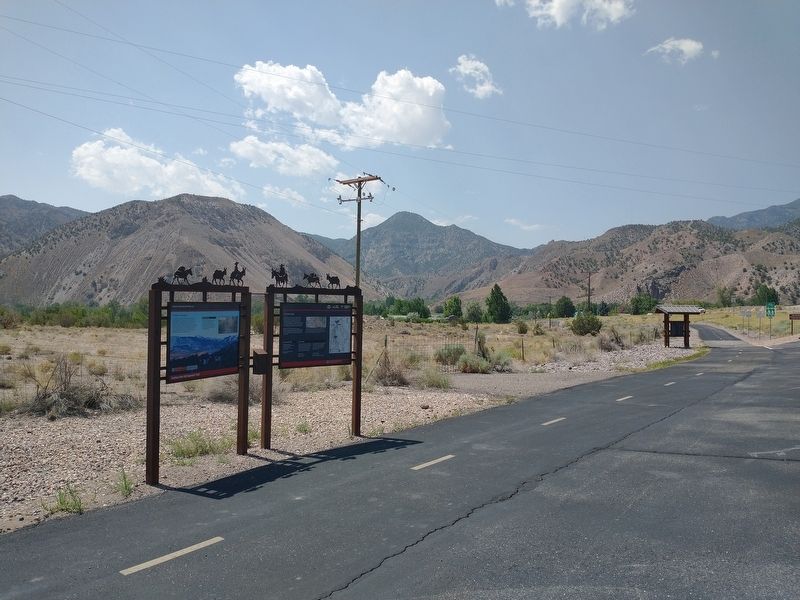
Marker is on the far right in the distance.
3. Concrete Culvert with Headwalls
Several concrete culverts with headwalls are located along this historic railroad grade. The concrete culverts appear to be built from standard 2 foot 10 inch inside diameter sewer pipe with cast-in-place headwalls that average 7.5 feet wide. All of the concrete culverts are used to provide drainage for the Bike Path.
4. Erosion Control Structure
Due to the proximity of the railroad grade and the Sevier River it was necessary to employ erosion control structures at some locations to maintain the integrity of the D&RGW railroad. Wire enclosed riprap with wooden pier anchors can. be seen along the east bank of the Sevier River approx. 1.8 miles north of the Big Rock Candy Mountain resort, just east of "Turtle Back." A modern application of this technology can be observed on the east bank of the Sevier river near the south portal of Eagle Rock Tunnel.
Special Thanks to:
Sevier County
Piute County
Utah Power
Timberline Properties L.L.C.
Big Rock Candy Mountain Resort
Utah Dept. of Transportation
Topics. This historical marker is listed in this topic list: Railroads & Streetcars. A significant historical month for this entry is May 1891.
Location. 38° 35.325′ N,
Photographed by Tom Bosse, July 27, 2024
4. Basic History Marker

Regionally, this marker is in the Central Utah Valleys. It is also in the American Mountain West and on the Colorado Plateau. Globally, it is in North America, the Western Hemisphere, the Western World, and the Anglosphere. Historically, it finds itself in what was once New Spain and also Mexico’s Alta California.
Other nearby markers. At least 8 other markers are within 9 miles of this marker, measured as the crow flies: Explore the Old Spanish Trail (within shouting distance of this marker); Hit the Trail! (within shouting distance of this marker); The Legend of the Indian Blanket (approx. 2.8 miles away); Town of Joseph and Pioneer Log Cabin (approx. 3½ miles away); Pioneering Utah (approx. 3.6 miles away); Fort Alma (later Monroe) 1864-1867 (approx. 8 miles away); Camp Alma Relic Hall (approx. 8 miles away); Elsinore (approx. 9 miles away). Touch for a list and map of all markers in Sevier.
Credits. This page was last revised on November 12, 2024. It was originally submitted on November 10, 2024, by Tom Bosse of Jefferson City, Tennessee. This page has been viewed 205 times since then and 35 times this year. Photos: 1, 2, 3, 4. submitted on November 10, 2024, by Tom Bosse of Jefferson City, Tennessee. • Andrew Ruppenstein was the editor who published this page.
