
Sevran in Seine-Saint-Denis, Île-de-France, France — Western Europe
Louis Blesy

Photographed by Andrew Ruppenstein, November 3, 2024
1. Louis Blesy Marker

Louis BLESY
1910 - 2004
Louis Blésy dessine des motifs décoratifs dans le bâtiment (ornemaniste) avant de s'engager dans la résistance sous le pseudonyme de «colonel Granville». Militant communiste depuis 1932, il participe à la création de la soupe populaire. A la fin de la guerre, Louis Blésy travaille au cabinet du ministre de la Défense. Devenu sevranais en 1956, il prend la direction de plusieurs établissements d'accueil et de soins, venant en aide aux enfants, victimes des guerres.
Louis Blésy designed decorative motifs for buildings (ornamentalist) before joining the resistance under the pseudonym "Colonel Granville". A communist activist since 1932, he participated in the creation of a soup kitchen. At the end of the war, Louis Blésy worked in the office of the Minister of Defense. Having become a Sevranais in 1956, he took over the management of several reception and care establishments, helping children who were victims of war.
Erected by Ville de Sevran.
Topics. This
this page online
Location. 48° 56.321′ N, 2° 31.703′ E. Marker is in Sevran, Île-de-France, in Seine-Saint-Denis. It is on Rue Roger le Maner, on the left when traveling north. Touch for map. Marker is at or near this postal address: 10 Rue Roger le Maner, Sevran, Île-de-France 93270, France. Touch for directions.

Regionally, it is in the North Atlantic Region, Europe, the European Union, Atlantic Europe, the Schengen Area, Western Europe, a coastal Mediterranean country, and the Western World. Historically, it finds itself in what was once a French colony and also the Roman Empire.
Other nearby markers. At least 8 other markers are within walking distance of this marker: Résistance à Sevran / Resistance in Sevran (here, next to this marker); Alfred Victor Levy (a few steps from this marker); Auguste Crétier (within shouting distance of this marker); Roger le Maner (within shouting distance of this marker); Sevran Municipal Memorial (within shouting distance of this marker); a different marker also named Auguste Crétier (within shouting distance of this marker); Louis Armand (about 90 meters away, measured in a direct line); Gaston Bussière (about 150 meters away). Touch for a list and map of all markers in Sevran.
Also see . . .
1. Louis Blésy (QRpedia, in French). The QR code on the marker leads to a short blurb, which is effectively the same as the overview paragraph in the Wikipedia article on him (in translation):
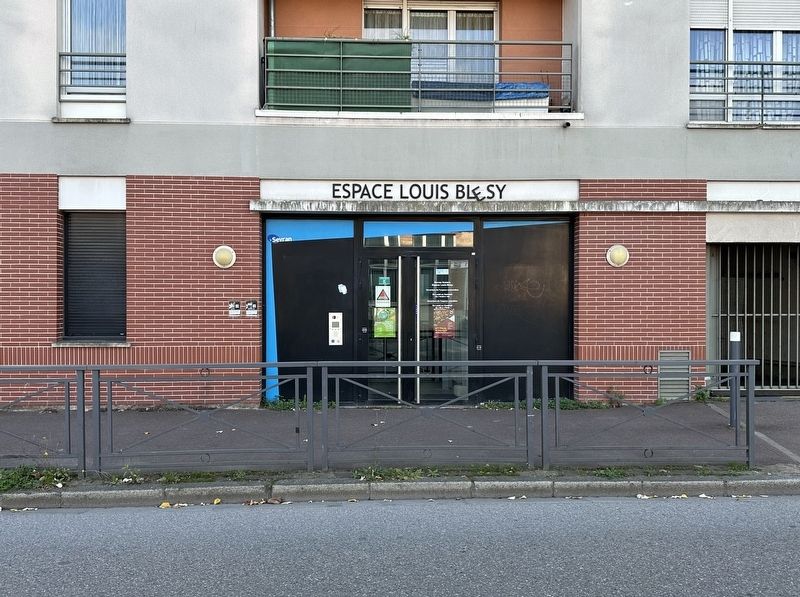
Louis(Submitted on November 12, 2024.)Blésy was a French resistance fighter, Companion of the Liberation, born in Béziers on July 26, 1910 and died in Aulnay-sous-Bois on June 7, 2004.Photographed by Andrew Ruppenstein, November 3, 20242. Louis Blesy Marker - wide viewThe marker for Louis Blesy ís one of the two that are visible here just to the left of the door.
2. Louis Blésy (Wikipedia, in French). His resistance activities (in translation):
…After the mobilization order, he was assigned to the 6th RTM in September 1939. After fierce fighting in the North, wounded in Lomme and hospitalized in Lille, he was taken prisoner on May 25, 1940. After several attempts, he escaped from Germany on February 19, 1941. His wife, wanted by the Vichy regime, took refuge in Gironde: Louis Blésy joined her and both passed through the free zone between Longan and La Réole.(Submitted on November 12, 2024.)
Demobilized in Montpellier, Louis Blésy joined the resistance in March 1941. He founded an independent team responsible for operations in factories and stations.
In January 1942, he joined the Front National movement and became its representative for Hérault in March 1942, then for Aude, Tarn, Aveyron at the end of 1942. In 1943, he was chosen to lead the military leadership of the French francs-tireurs and partisans of Aude, Tarn, Aveyron and Hérault (region R5). Having gone underground, he carried out numerous operations: he took part in the attack on clothing depots in Mazamet, in the sabotage of the Bédarieux-Béziers line, led reprisals in Montpellier against police superintendent Pierre Marty (1900-1948) and recovered weapons.
In 1944, the general staff of the southern zone of the FTPF appointed him commander of region R2. He took command of six departments and mounted large-scale sabotage operations: ambushes of convoys in Aix, Pertuis and Draguignan, attacks on the Chave prison in Marseille and the Sisteron fortress.
In May 1944, Louis Blésy, known as Colonel Granville, was in total command of the Alpes-de-Haute-Provence, where six thousand FFI were engaged. He participated in the liberation of Marseille from 23 to 27 August 1944 and supervised all operations to supply the population. He placed the FFI units at the disposal of General de Montsabert to fight the last pockets of German resistance in Marseille.
Credits. This page was last revised on November 12, 2024. It was originally submitted on November 12, 2024, by Andrew Ruppenstein of Lamorinda, California. This page has been viewed 193 times since then and 36 times this year. Photos: 1, 2. submitted on November 12, 2024, by Andrew Ruppenstein of Lamorinda, California.
