Newmarket in Rockingham County, New Hampshire — The American Northeast (New England)
Newmarket Manufacturing Company c. 1823-1934

Photographed by Duane and Tracy Marsteller, October 1, 2024
1. Newmarket Manufacturing Company c. 1823-1934 Marker
In 1823, businessmen from Salem, Mass., bought property along the Lamprey River to build Newmarket's first mill. They chose granite for its durability. The No. 1 Mill of the Newmarket Mfg. Co. was completed at a cost of $11,197.94, and Main Street was moved from the river's edge to its current location. When the cupola burned in 1858, the mill's top two floors were torn off, and a bell tower was added to No. 2 Mill.
No. 2 Mill | 1825
Using water power and more than 4,000 spindles, No. 2 Mill produced cotton textiles, turning out about 160,000 yards a week by 1869. Supplies were delivered to the mills by small packet boats and tall-masted schooners, including the Helen Mar, the North America and the Pembroke, which freighted cotton from New Orleans to Boston for 62.5 cents per 100 pounds.
No. 3 Mill | 1827
This will was built from granite quarried on Durham Point. The machinery, installed in 1829, included 1,034 spindles.
No. 4 Mill | 1869
Unlike the first three mills, which were built with granite blocks, No. 4 was constructed from smaller trap rock left behind in the quarries after building
this page online
No. 5 Mill | 1881
Originally only two stories high and constructed from brick secured from local brickyards, No. 5 Mill, like its predecessors, started with a few looms weaving unbleached cotton shirting and sheeting. Eventually, these cotton goods were valued at more than $1 million per year.
No. 6 Mill | 1892
No. 6 Mill (not pictured) was added as an extension to the south end of No. 5 and, like the others (except No. 7 and No. 8 Mills) was powered by mater.
No. 7 Mill | 1901
The last example in town of 20th-century weave shed construction, No. 7 Mill was a three-story brick structure (now demolished) built in the No. 3 Mill yard to help increase the company's weaving capacity.
No. 8 Mill | 1917
Known as “The Great Weave Shed,” No. 8 Mill was once the largest single textile room in the world, covering five acres. To make way for the mill, dozens of houses were relocated to neighboring streets using winches, cables, and teams of great horses. Until it closed in 1934, the mill produced silk casket
Photographed by Duane and Tracy Marsteller, October 1, 2024
2. Newmarket Manufacturing Company c. 1823-1934 Marker
End of a Era | 1934
In 1934, after more than a century of operation, the mills fell silent. Following several years of labor unrest, the Newmarket Manufacturing Company declared abandonment of 256 buildings lieu of paying taxes – including all the mills, the worker housing and the 14-acre mill yard. The era of pounding looms and water-powered industrialization on the banks of the Lamprey had come to an end.
Artist | R.P. Hale
Erected 2020 by Newmarket Main Street Corporation. (Marker Number 36.)
Topics and series. This historical marker is listed in these topic lists: Architecture • Industry & Commerce. In addition, it is included in the New Hampshire, Newmarket Downtown Walking Tour series list. A significant historical year for this entry is 1824.
Location. 43° 4.861′ N, 70° 56.105′ W. Marker is in Newmarket, New Hampshire, in Rockingham County. It is at the intersection of Main Street (New Hampshire Route 108) and Weaver Street, on the right when traveling

R.P. Hale; via Newmarket Main Street Corporation, June 7, 2022
3. Marker detail

Regionally, this marker is on New Hampshire’s Seacoast. It is also in the American Northeast, in New England, and on the Eastern Seaboard. Globally, it is in the North Atlantic Region, North America, the Western Hemisphere, the Western World, and the Anglosphere. Historically, it finds itself in what was once one of the original Thirteen Colonies.
Other nearby markers. At least 8 other markers are within walking distance of this marker: No. 1 Mill (within shouting distance of this marker); John Webster Hall (within shouting distance of this marker); No. 2 Mill (within shouting distance of this marker); No. 4 Mill (about 300 feet away, measured in a direct line); Brooks Block (about 400 feet away); Branscomb's Tavern (about 500 feet away); Kingman Building (about 500 feet away); Newmarket, NH Memorial Pavilion (about 600 feet away). Touch for a list and map of all markers in Newmarket.
Also see . . . Site No. 36. Mill Overlook.

Photographed by Duane and Tracy Marsteller, October 1, 2024
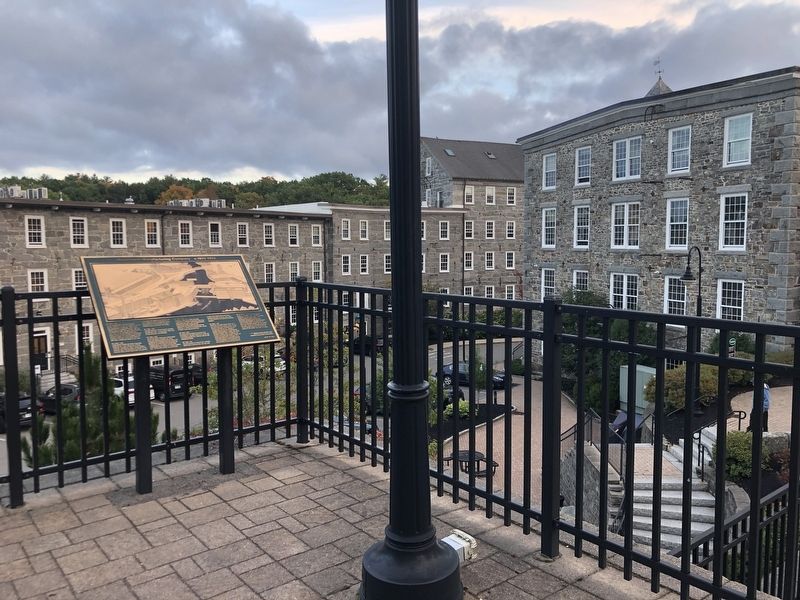
4. View from overlook
Portions of Mill No. 5 (left), Mill No. 2 (center) and Mill No. 1 (right) are visible.
Credits. This page was last revised on November 14, 2024. It was originally submitted on November 13, 2024, by Duane and Tracy Marsteller of Murfreesboro, Tennessee. This page has been viewed 384 times since then and 142 times this year. Photos: 1, 2, 3, 4. submitted on November 13, 2024, by Duane and Tracy Marsteller of Murfreesboro, Tennessee.
