
Edam in Edam-Volendam, North Holland, Netherlands — Northwestern Europe
Edams Museum
Photographed by Andrew Ruppenstein, October 27, 2024
1. Edams Museum Marker

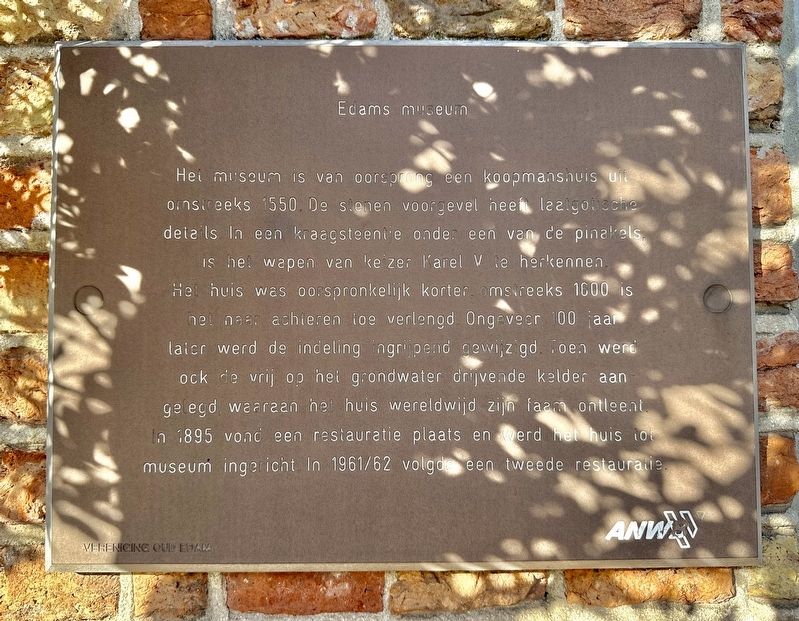
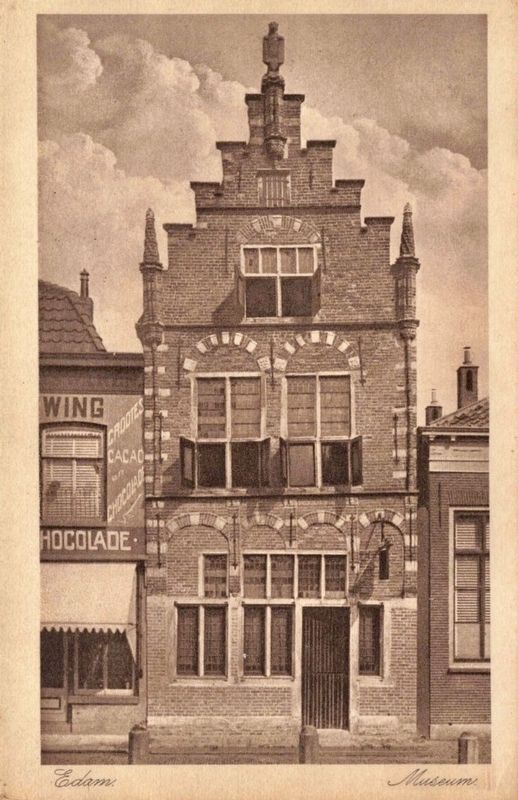
The Museum is originally a merchant's house from around 1550. The stone facade has late Gothic details. The coat of arms of Emperor Charles V can be recognized in a corbel under one of the pinnacles. The house was originally shorter, around 1600 it was extended to the rear. About 100 years later the layout was drastically changed. At that time the cellar, which floats freely on the groundwater, was also constructed, which gave the house its worldwide fame. In 1895 a restoration took place and the house was converted into a museum. A second restoration followed in 1961/62.
Erected by Vereniging
this page online
Topics. This historical marker is listed in this topic list: Notable Buildings. A significant historical year for this entry is 1550.
Location. 52° 30.759′ N, 5° 2.943′ E. Marker is in Edam, Noord-Holland (North Holland), in Edam-Volendam. It is on Damplein, on the left when traveling east. Touch for map. Marker is at or near this postal address: Damplein 8, Edam, Noord-Holland 1135 XN, Netherlands. Touch for directions.

Regionally, it is in Europe, the European Union, Atlantic Europe, the Benelux Low Countries, the Schengen Area, Western Europe, and the Western World. Historically, it finds itself in what was once the Roman Empire and specifically also the Holy Roman Empire.
Other nearby markers. At least 8 other markers are within walking distance of this marker: Damsluis (within shouting distance of this marker); Het Huis met de Zwaan / The House with the Swan (within shouting distance of this marker); Evangelisch-Lutherse Kerk / Lutheran Church (within shouting distance of this marker); Doopsgezinde Vermaning / Mennonite Meeting House (about 120 meters away, measured in a direct line); Lise Leijser

Photographed by Andrew Ruppenstein, October 27, 2024
2. Edams Museum and Marker
The marker is visible here on the left side of the building, partly obscured by the little tree.
Also see . . . Edam Museum (Edam Museum). Excerpts:
Edam city council purchased the then very neglected building in 1893. The well-known Pierre Cuypers, architect of Amsterdam Central Station and of the Rijksmuseum, was appointed to lead the restoration. The restoration was completed in 1895, and the building became the first museum in Edam.(Submitted on November 16, 2024.)
A second restoration took place in the 1950s. Carried out this time by the chief architect for the conservation of monuments, Kees Roogaards. The ‘medieval’-looking decorations, including pinnacles on the stepped gable, implemented by Cuypers, were removed and the building was restored to its ’original’ appearance. By the beginning of the 21st century the building was once again in need of restoration, having subsided considerably, and essential underpinning of the foundations was carried out.
The floating cellar is a famous feature of Edam Museum. It is a loose container whichfloats on the groundwater. Due to ebb and flow of the sea (Edam museum is located on Dam Square, where there used to be a (sea) lock) the Zuiderzee influenced the level of the groundwater level. Because the basement moved with the water, it never flooded. Floating cellars are not unique. Many were to be found in Edam and especially in Amsterdam. However, the floating cellar in Edam Museum is the only one in the Netherlands which is publicly accessible and therefore unique!Photographed by Fa. V.J. Lipkema, circa 19233. Edams Museum
There is an amusing legend about this cellar. It is said that one of the owners of the property was captain who had the cellar built because he missed the sea so much. The floating cellar enabled him to feel the movement of the water and the noise of the sea whenever he was in the basement.
Credits. This page was last revised on November 16, 2024. It was originally submitted on November 16, 2024, by Andrew Ruppenstein of Lamorinda, California. This page has been viewed 104 times since then and 9 times this year. Photos: 1, 2, 3. submitted on November 16, 2024, by Andrew Ruppenstein of Lamorinda, California.
