Tilton-Northfield in Belknap County, New Hampshire — The American Northeast (New England)
Charles E. Tilton's Legacy

Photographed by Duane and Tracy Marsteller, October 2, 2024
1. Charles E. Tilton's Legacy Marker (older paint job)
Native Charles E. Tilton shaped his hometown through his many gifts of monuments, buildings and parks – places that make the community special today. After moving to the West Coast in 1850, Tilton acquired extraordinary wealth through his trading company and investments. The citizens of Sanbornton Bridge voted to name their new town “Tilton” in his family's honor after NH Governor Onslow Stearns approved the town's division from Sanbornton June 30, 1869.
Erected 2018 by New Hampshire Division of Historical Resources • New Hampshire Department of Transportation. (Marker Number 262.)
Topics and series. This historical marker is listed in these topic lists: Charity & Public Work • Industry & Commerce • Political Subdivisions. In addition, it is included in the New Hampshire Historical Highway Markers series list. A significant historical date for this entry is June 30, 1869.
Location. 43° 26.587′ N, 71° 35.683′ W. Marker is in Tilton, New Hampshire, in Belknap County. It is in Tilton-Northfield. It is at the intersection of West Main Street (U.S. 3) and Winter Street, on the right when traveling east on West Main Street.
this page online

Regionally, this marker is in the Lakes Region. It is also in the American Northeast and in New England. Globally, it is in North America, the Western Hemisphere, the Western World, and the Anglosphere. Historically, it finds itself in what was once one of the original Thirteen Colonies.
Other nearby markers. At least 8 other markers are within walking distance of this marker: The Tilton Mills (within shouting distance of this marker); The Town of Tilton (within shouting distance of this marker); The Winnipesaukee River (within shouting distance of this marker); Soldiers' Monument (within shouting distance of this marker); Northfield WWI Memorial (about 600 feet away, measured in a direct line); Tilton WWI Memorial (approx. 0.3 miles away); In Grateful Tribute (approx. 0.4 miles away); Northfield Veteran's Memorial (approx. 0.7 miles away). Touch for a list and map of all markers in Tilton.
Also see . . .
1. Charles Tilton Loved Statues And Put Them All Over Town.
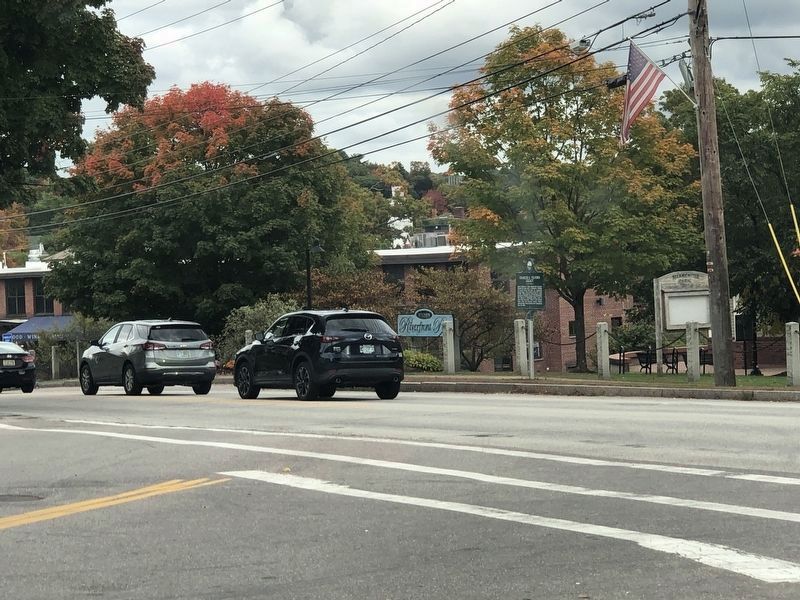
Photographed by Duane and Tracy Marsteller, October 2, 2024
2. Charles E. Tilton's Legacy Marker
2. Charles E. Tilton. Obituary published in the November, 1901 issue of The Granite Monthly. (via Google Books) (Submitted on November 18, 2024, by Duane and Tracy Marsteller of Murfreesboro, Tennessee.)
3. Charles E. Tilton Mansion (PDF). National Register of Historic Places nomination for the mansion, which Tilton began building in 1861 and now is the library of a private boarding and day school on the mansion grounds. (Prepared by Justine B. Gengras, of Tilton School; via National Park Service) (Submitted on November 18, 2024, by Duane and Tracy Marsteller of Murfreesboro, Tennessee.)

History of Sanbornton, New Hampshire, Rev. M.T. Runnels; via Google Books (Public Domain), circa 1882
3. Charles Elliott Tilton (1827-1901)
He made his fortune by selling goods and services to California-bound gold-seekers, then invested in real estate, banking and railroads in the Pacific Northwest. He spent summers in his hometown before returning full-time in 1879. He lavished his wealth on his hometown, building its town hall, constructing a veterans home, bringing electricity and the railroad, and building and improving parks. He also placed as many as 150 statues around the town, of which only a handful remain.
Credits. This page was last revised on March 10, 2026. It was originally submitted on November 18, 2024, by Duane and Tracy Marsteller of Murfreesboro, Tennessee. This page has been viewed 1,140 times since then and 242 times this year. Photos: 1, 2, 3. submitted on November 18, 2024, by Duane and Tracy Marsteller of Murfreesboro, Tennessee.
Editor’s want-list for this marker. Clear in-focus closeup of currently painted marker. • Can you help?
