
Port Perry in Durham Region, Ontario — Central Canada (North America)
The 1884 Port Perry Fire
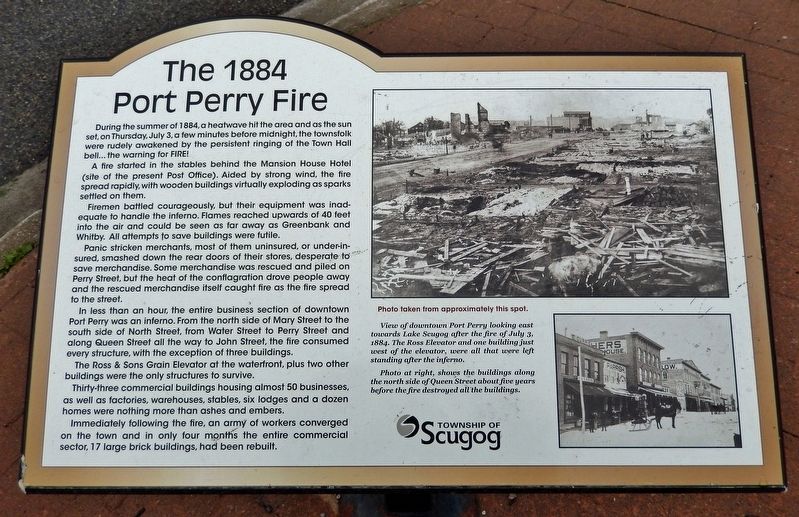
Photographed by Cosmos Mariner, June 2, 2024
1. The 1884 Port Perry Fire Marker
During the summer of 1884, a heatwave hit the area and as the sun set, on Thursday, July 3, a few minutes before midnight, the townsfolk were rudely awakened by the persistent ringing of the Town Hall bell... the warning for FIRE!
A fire started in the stables behind the Mansion House Hotel (site of the present Post Office). Aided by strong wind, the fire spread rapidly, with wooden buildings virtually exploding as sparks settled on them.
Firemen battled courageously, but their equipment was inadequate to handle the inferno. Flames reached upwards of 40 feet into the air and could be seen as far away as Greenbank and Whitby. All attempts to save buildings were futile.
Panic stricken merchants, most of them uninsured, or under-insured, smashed down the rear doors of their stores, desperate to save merchandise. Some merchandise was rescued and piled on Perry Street, but the heat of the conflagration drove people away and the rescued merchandise itself caught fire as the fire spread to the street.
In less than an hour, the entire business section of downtown Port Perry was an inferno. From the north side of Mary Street to
this page online
The Ross & Sons Grain Elevator at the waterfront, plus two other buildings were the only structures to survive.
Thirty-three commercial buildings housing almost 50 businesses, as well as factories, warehouses, stables, six lodges and a dozen homes were nothing more than ashes and embers.
Immediately following the fire, an army of workers converged on the town and in only four months the entire commercial sector, 17 large brick buildings, had been rebuilt.
Erected by Township of Scugog.
Topics. This historical marker is listed in these topic lists: Architecture • Disasters. A significant historical date for this entry is July 3, 1884.
Location. 44° 6.245′ N, 78° 56.745′ W. Marker is in Port Perry, Ontario, in Durham Region. It is at the intersection of Queen Street and John Street, on the right when traveling east on Queen Street. Touch for map. Marker is in this post office area: Port Perry ON L9L 1B7, Canada. Touch for directions.

Regionally,

2. Marker detail: Photo taken from approximately this spot
View of downtown Port Perry looking east towards Lake Scugog after the fire of July 3, 1884. The Ross Elevator and one building just west of the elevator, were all that were left standing after the inferno.
Other nearby markers. At least 8 other markers are within walking distance of this marker: Scugog War Memorial Library (within shouting distance of this marker); Port Perry Lawn Bowling Club (within shouting distance of this marker); Dr. Orr Graham (within shouting distance of this marker); Elias Williams Family (within shouting distance of this marker); The Jessop Block (about 90 meters away, measured in a direct line); The Courtice Block (about 120 meters away); The Harrington Block (about 120 meters away); John W. Davis Block (about 120 meters away). Touch for a list and map of all markers in Port Perry.
Also see . . . Fire of 1884 Levels Town in Less Than 4 Hours.

3. Marker detail: Queen Street Before the Fire
Buildings along the north side of Queen Street about five years before the fire destroyed all the buildings.
(By Paul Arculus) Excerpt: The only consolation was that the tragedy wasn't accompanied by death. Today, the upper floors of the downtown core are almost entirely occupied by apartment dwellers. At the time of the fire, the upper floors were occupied by the street level businesses or rented out to other businesses. Fortunately, the contents of 26 vaults in various buildings were found to be undamaged in spite of the intense heat.(Submitted on November 22, 2024, by Cosmos Mariner of Cape Canaveral, Florida.)The tragedy of the 1884 fire was largely an economic one. Dreams of financial success and entire life savings were lost. For those on the north side of Queen Street who were just beginning to get themselves re-established after the 1883 fire, the tragedy was even more devastating. This second fire was too much for W.B. McGaw. He had run the Walker House for Dan Ireland, and the hotel had been destroyed in the 1883 fire. Rather than stay in Port Perry and re-invest in its future, in October 1884, he moved to Bowmanville and invested in a hotel there. Fortunately for Port Perry his case was the exception.
The Victorian age was one of optimism and hope. The people who lived in it had a resiliency and determination.
They had heard from their parents, of an earlier age when nothing but hardship and disease prevailed. Some of the older citizens could relate those experiences firsthand. If they could survive the perils of pioneer life, they could rebuild their lives again; and so they did. The townsfolk rallied.Photographed by Cosmos Mariner, June 2, 20244. The 1884 Port Perry Fire MarkerLooking east along Queen Street through downtown Port Perry.

Credits. This page was last revised on November 22, 2024. It was originally submitted on November 21, 2024, by Cosmos Mariner of Cape Canaveral, Florida. This page has been viewed 302 times since then and 40 times this year. Photos: 1, 2, 3, 4. submitted on November 22, 2024, by Cosmos Mariner of Cape Canaveral, Florida.
