St. Juliaan in Langemark-Poelkapelle in West-Vlaanderen, Flanders, Belgium — Northwestern Europe
The Second Battle of Ypres
(22 April - 25 May 1915)
Photographed by Steve Stoessel, November 11, 2024
1. The Second Battle of Ypres Marker
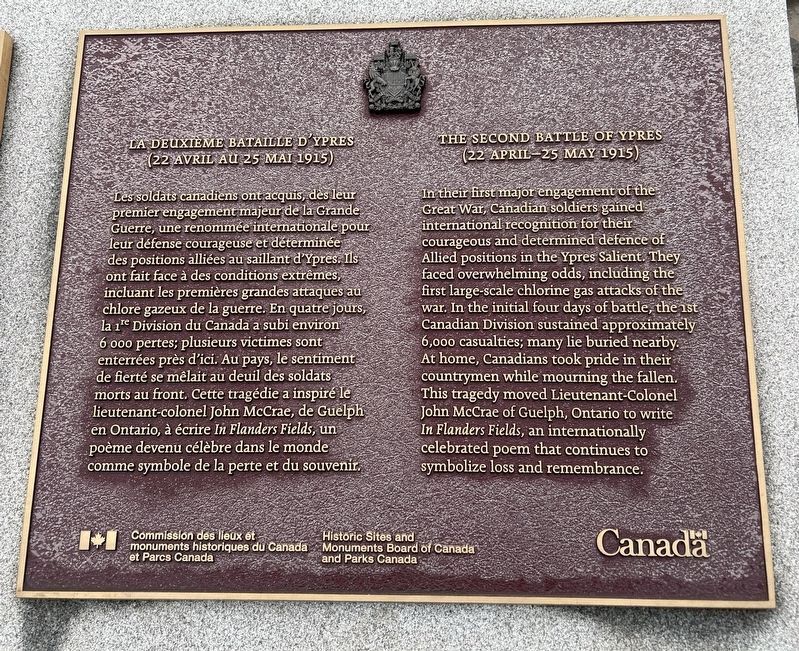
In their first major engagement of the Great War, Canadian soldiers gained international recognition for their courageous and determined defence of Allied positions in the Ypres Salient. They faced overwhelming odds, including the first large scale chlorine gas attacks of the war. In the initial four days of battle, the 1st Canadian Division sustained approximately 6,000 casualties; many lie buried nearby. At home, Canadians took pride in their countrymen while mourning the fallen. This tragedy moved Lieutenant-Colonel John McCrae of Guelph, Ontario to write In Flanders Fields, an internationally celebrated poem that continues to symbolize loss and remembrance.
[français
Les soldats canadiens ont acquis, des leur premier engagement majeur de la Grande Guerre, une renommée internationale pour leur défense courageuse et déterminée des positions alliées au saillant d'Ypres. Ils ont fait face à des conditions extrêmes, incluant les premières grandes attaques au chlore gazeux de la guerre. En quatre jours, la 1e Division du Canada a subi environ 6 000 pertes; plusieurs victimes sont enterrées près d'ici. Au pays, le sentiment
this page online
[Deutsch]
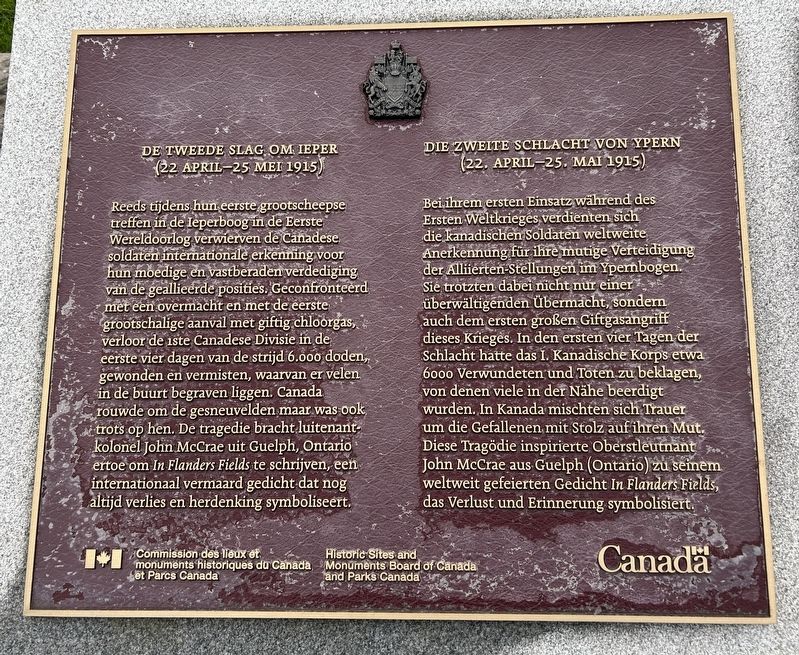
Bei ihrem ersten Einsatz während des Ersten Weltkrieges verdienten sich die kanadischen Soldaten weltweite Anerkennung für ihre mutige Verteidigung der Alliierten-Stellungen im Ypembogen. Sie trotzten dabei nicht nur einer überwältigenden übermacht, sondern auch dem ersten großen Giftgasangriff dieses Krieges. In den ersten vier Tagen der Schlacht hatte das I. Kanadische Korps etwa 6000 Verwundeten und Toten zu beklagen, von denen viele in der Nähe beerdigt wurden. In Kanada mischten sich Trauer um die Gefallenen mit Stolz auf ihren Mut. Diese Tragodie inspirierte Oberstleutnant John McCrae aus Guelph (Ontario) zu seinem weltweit gefeierten Gedicht In Flanders Fields, das Verlust und Erinnerung symbolisiert.
[Nederland]
Reeds tijdens hun eerste grootscheepse treffen in de leperboog in de Eerste Wereldoorlog verwierven de Canadese soldaten internationale erkenning voor
Photographed by Steve Stoessel, November 11, 2024
2. The Second Battle of Ypres Marker
Erected by Historic Sites and Monuments Board of Canada.
Topics and series. This memorial is listed in this topic list: War, World I. In addition, it is included in the Canada, Historic Sites and Monuments Board, and the In Flanders Fields series lists. A significant historical month for this entry is May 1915.
Location. 50° 53.956′ N, 2° 56.445′ E. Memorial is in Langemark-Poelkapelle, Vlaanderen (Flanders), in West-Vlaanderen. It is in St. Juliaan. It is at the intersection of Brugseweg (National Route 313) and Zonnebekestraat, on the left when traveling south on Brugseweg.
Photographed by Steve Stoessel, November 11, 2024
3. The Second Battle of Ypres Marker

Regionally, it is in Europe, the European Union, Atlantic Europe, the Benelux Low Countries, the Schengen Area, Western Europe, and the Western World. Historically, it finds itself in what was once the Roman Empire and specifically also the Holy Roman Empire.
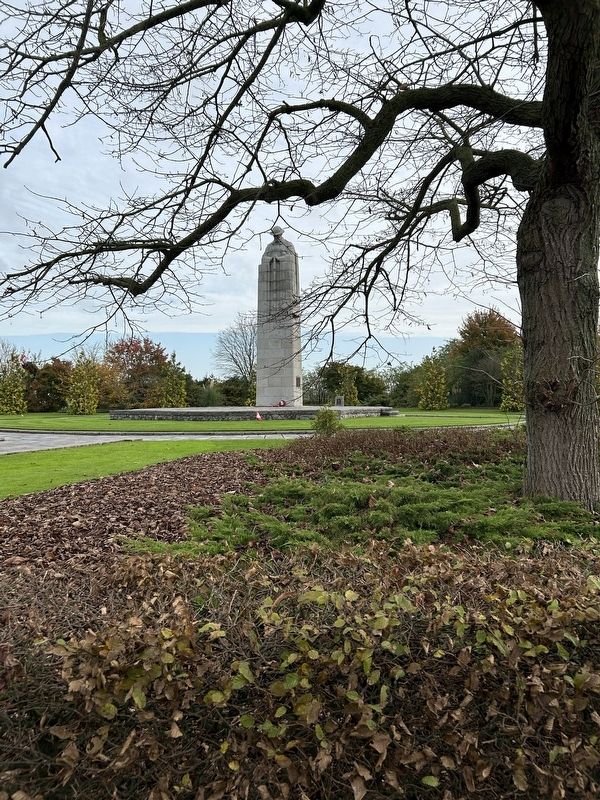
Other nearby markers. At least 8 other markers are within 3 kilometers of this marker, measured as the crow flies: The Brooding Soldier (within shouting distance of this marker); Canada (within shouting distance of this marker); Guynemer (approx. 2.3 kilometers away); Tank Memorial Ypres Salient (approx. 2.3 kilometers away); Tank Memorial (approx. 2.3 kilometers away); a different marker also named Guynemer (approx. 2.4 kilometers away); Langemark German Military Cemetery (approx. 2.9 kilometers away); Langemark (approx. 3 kilometers away). Touch for a list and map of all markers in Langemark-Poelkapelle.
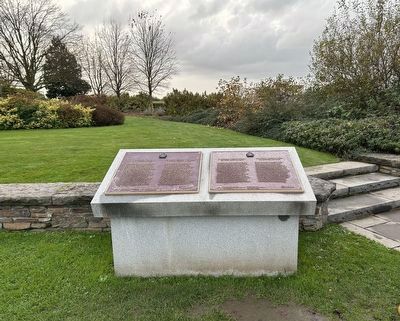
More about this memorial. The plaques are located to the rear of the monument
Also see . . .
1. second Battle of Ypres (Wikipedia).
Photographed by Steve Stoessel, November 11, 2024
4. The Second Battle of Ypres Marker
During the First World War, the Second Battle of Ypres was fought from 22 April – 25 May 1915 for control of the tactically important high ground to the east and south of the Flemish town of Ypres in western Belgium. The First Battle of Ypres had been fought the previous autumn. The Second Battle of Ypres was the first mass use by Germany of poison gas on the Western Front.(Submitted on November 22, 2024, by Steve Stoessel of Niskayuna, New York.)
2. In Flanders Fields (Wikipedia).
In Flanders fields, the poppies blow
Between the crosses, row on row,
Scarce heard amid the guns below.
We are the Dead. Short days ago
We lived, felt dawn, saw sunset glow,
Loved and were loved, and now we lie,
In Flanders fields.
Take up our quarrel with the foe:
To you from failing hands we throw
The torch; be yours to hold it high.
If ye break faith with us who die
We shall not sleep, though poppies grow
In Flanders fields.
Credits. This page was last revised on July 7, 2025. It was originally submitted on November 22, 2024, by Steve Stoessel of Niskayuna, New York. This page has been viewed 275 times since then and 28 times this year. Photos: 1, 2, 3, 4. submitted on November 22, 2024, by Steve Stoessel of Niskayuna, New York.
