Schießhaus in Bayreuth, Bavaria, Germany — Central Europe
Drei Schweizer/Three Swiss: Sulzer, Müller, Ott-Usteri
Walk of Wagner

Photographed by James Hulse, October 2, 2024
1. Drei Schweizer/Three Swiss: Sulzer, Müller, Ott-Usteri Marker

Wagner wurde, nachdem er 1849 glücklich das politische Exil erreicht hatte, in der Schweiz wie ein alter Freund willkommen geheißen. Die Schweiz war damals die erste Zufluchtsstätte aller europäischen Revolutionäre. Doch bedurfte auch ein Wagrver der Hilfe treue: Mitarbeiter, die ihm die Ankunft in Zürich leicht machten. Joharin Jakob Sulzer gehörte quasi zu Wagners Lebensrettern, da er die Schulden de's Flüchtlings verwaltete. und damit als Wagners Finarızminister das Opfer auf sich nahm, den monetären Haushalt des Genies so gut wie möglich in Ordnung zu halten. Außerdem stellte er ihm seine Wohnung für gesellige Zusammenkünfte und künstlerische performances zur Verfügung und regte Wagner an, die Ouvertüre zu Glucks Iphigenie in Aulis zu dirigieren. Die Kardinalschrift Oper und Drama geht auf Gespräche zurück, die der musikalisch nicht praktizierende Staatsvat gern mit ihm führte.
Der Musiker Alexander Müller sorgte ain Anfang von Wagners Schweizer Zeit dafür, dass Wagner einen Pass ausgehändigt bekam und somit legal in der Schweiz leben und arbeiten konnte. Danach gab Hans Conrad Ott-Usteri, der
this page online
Bildunterschriften
Links: Ein Lebensretter: der Staatsschreiber Sulzer (Lithographie von Erich Correns, 1843). Mitte: Er vermittelte den unverzichtbaren Pass: Alexander Müller (Lithographie von Georg Adolf Grimminger, 1875). Rechts: Ein Kaufmann mit höheren interessen: Hans Conrad Ott-Usteri.
After successfully escaping into political exile in 1849, Richard Wagner was welcomed in Switzerland as if he were an old friend. At that time, Switzerland served as the first refuge for European revolutionaries. Even so, Wagner needed the support of loyal helpers to ease his arrival in Zurich. Johann Jakob Sulzer was instrumental, almost like a savior for Wagner, managing the refugee's debts. Acting as Wagner's "finance minister," Sulzer took on the burden of organizing the genius's financial affairs to the best of his ability. Additionally, he offered his home for social gatherings and artistic performances,

Photographed by James Hulse, October 2, 2024
2. Drei Schweizer/Three Swiss: Sulzer, Müller, Ott-Usteri Marker
The musician Alexander Müller ensured that Wagner received a passport early during his Swiss residency, allowing him to live and work there legally. Later, Hans Conrad Ott-Usteri, president of the General Music Society, frequently provided Wagner opportunities to collaborate with Zurich musicians, enabling performances of The Flying Dutchman and Tannhäuser.
Captions
Left: A lifesaver: the state secretary Sulzer (Lithograph by Erich Correns, 1843). Center: He provided the indispensable passport: Alexander Müller (Lithograph by Georg Adolf Grimminger, 1875). Right: A merchant with higher interests: Hans Conrad Ott-Usteri.
Erected by Bayreuth Da steckt Wagner drinl.
Topics. This historical marker is listed in this topic list: Arts, Letters, Music. A significant historical year for this entry is 1849.
Location. Marker has been permanently removed. It was located near 49° 56.637′ N, 11° 34.689′ E. Marker was in Bayreuth, Bayern (Bavaria). It was in Schießhaus. It was on Opernstraße just north of Badstraße, on the right when traveling north. The marker is located at the front of the building. Touch for map. Marker was at or near this postal address: Opernstraße 6, Bayreuth BY 95444, Germany.
We have been informed that this marker is no longer there and will not be replaced. This page is an archival view of what was.
Regionally, this marker was in German Franconia. Globally, it was in Europe, the European Union, Atlantic Europe, Central Europe, the Schengen Area, Western Europe, and the Western World. Historically, it found itself in what was once the Holy Roman Empire and also the former West


Photographed by James Hulse, October 2, 2024
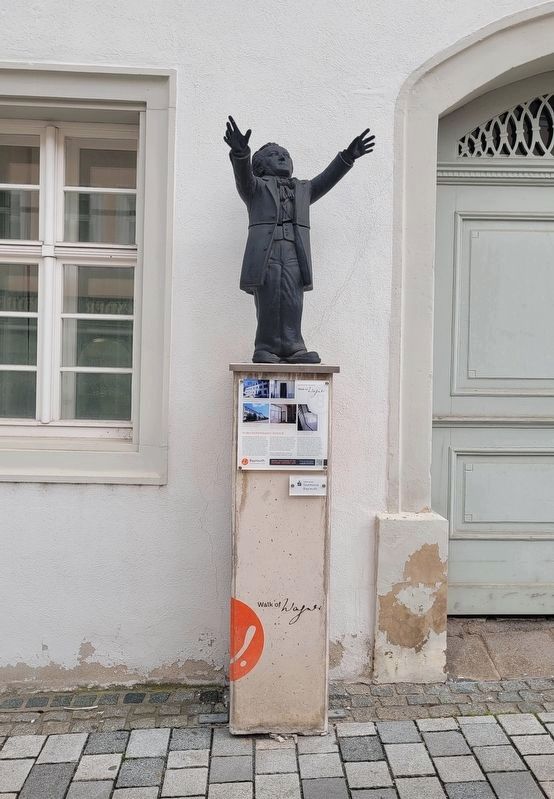
3. The view of the marker along the street
Other nearby markers. At least 8 other markers are within walking distance of this location: In den Escherhäusern: Zürich II / In the Escherhäuser: Zürich II (here, next to this marker); Georg Paul Finck Haus (within shouting distance of this marker); Anton Bruckner (within shouting distance of this marker); Sternplatz (within shouting distance of this marker); Schlosskirche / Palace Church (within shouting distance of this marker); Si Deus Cum Nobis, Quis Contra Nos. / If God is with us, who is against us? (within shouting distance of this marker); Ehemaliges Redoutenhaus / Former Assembly and Ballroom Hall (within shouting distance of this marker); a different marker also named Schlosskirche / Palace Church (within shouting distance of this marker). Touch for a list and map of all markers in Bayreuth.
Also see . . . Richard Wagner. Wikipedia
Wilhelm Richard Wagner (22 May 1813 – 13 February 1883) was a German composer, theatre director, essayist, and conductor who is chiefly known for his operas (or, as some of his mature works were later known, "music dramas"). Unlike most opera composers, Wagner wrote both the libretto and the music for each of his stage works. Initially establishing his reputation as a composer of works in the romantic vein of Carl Maria von Weber and Giacomo Meyerbeer, Wagner revolutionised opera through his concept of the Gesamtkunstwerk ("total work of art"), by which he sought to synthesise the poetic, visual, musical and dramatic arts, with music subsidiary to drama. The drama was to be presented as a continuously sung narrative, without conventional operatic structures like arias and recitatives. He described this vision in a series of essays published between 1849 and 1852. Wagner realised these ideas most fully in the first half of the 16-hour, four-opera cycle Der Ring(Submitted on November 26, 2024, by James Hulse of Medina, Texas.)des Nibelungen (The Ring of the Nibelung, also known simply as The Ring).Photographed by James Hulse, May 29, 20254. The marker was replaced with a new different marker
Credits. This page was last revised on June 15, 2025. It was originally submitted on November 23, 2024, by James Hulse of Medina, Texas. This page has been viewed 146 times since then and 10 times this year. Photos: 1, 2, 3. submitted on November 26, 2024, by James Hulse of Medina, Texas. 4. submitted on June 15, 2025, by James Hulse of Medina, Texas.
