
Casteau in Hainaut, Wallonia, Belgium — Northwestern Europe
The Great War
Men, Armys and Peace
⎯⎯⎯
La Grande Guerre
Corps, Armes et Paix
| — | The Battle of Mons / La Bataille de Mons | — |
Photographed by Steve Stoessel, November 19, 2024
1. The Battle of Mons / La Bataille fe Mons Marker

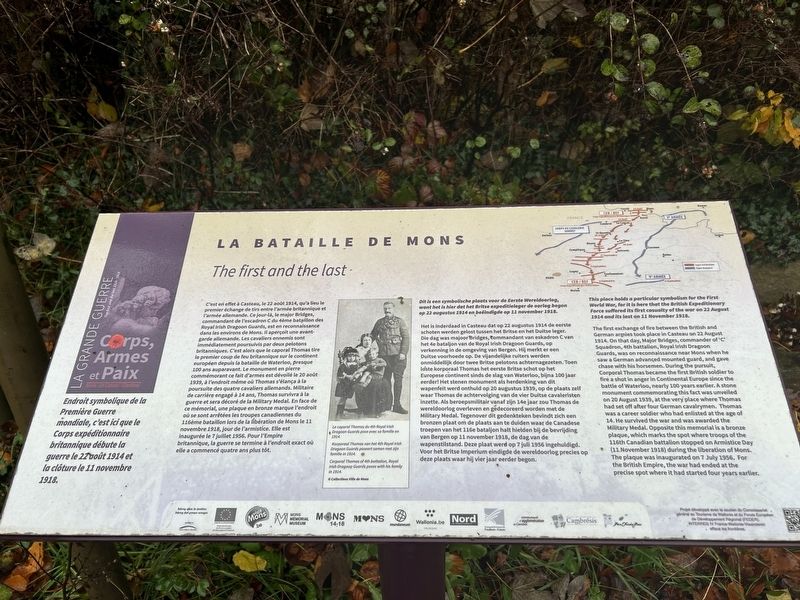
Endroit symbolique de la Première Guerre mondiale, C'est ici que le Corps expéditionnaire britannique debute la guerre le 27 août 1914 et la clôture le 11 novembre 1918.
The first and the last
This place holds a particular symbolism for the First World War, for it is here that the British Expeditionary Force suffered its first casualty of the war on 22 August 1914 and its last on 11 November 1918.
The first exchange of fire between the British and German armies took place in Casteau on 22 August 1914. On that day, Major Bridges, commander of 'C' Squadron, 4th battalion, Royal Irish Dragoon Guards, was on reconnaissance near Mons when he saw a German advanced mounted guard, and gave chase with his horsemen. During the pursuit, Corporal Thomas became the first British soldier to fire a shot in anger in Continental Europe since the battle of Waterloo, nearly 100 years earlier. A stone monument commemorating this fact was unveiled on 20 August 1939, at the very place where Thomas had set off after four German cavalrymen. Thomas was a career soldier who had enlisted at the age of 14. He survived the war and was awarded the Military Medal. Opposite this memorial is a bronze plaque, which marks the spot where troops of the 116th Canadian battalion stopped on Armistice Day (11 November 1918) during the liberation of Mons. The plaque was inaugurated on 7 July 1956. For the British Empire, the war had ended at the precise spot where it had started four years earlier.
C'est en effet à Casteau, le 22 août 1914, qu'a lieu le premier échange de tirs entre l'armée britannique et l'armée allemande. Ce jour-là, le major Bridges, commandant de l'escadron C du 4ème bataillon des Royal Irish Dragoon Guards, est en reconnaissance dans les environs de Mons. Il aperçoit une avant-garde allemande. Les cavaliers ennemis sont immédiatement poursuivis par deux pelotons britanniques. C'est alors que le caporal Thomas tire le premier coup de feu britannique sur le continent européen depuis la bataille de Waterloo, presque 100 ans auparavant. Le monument en pierre commémorant ce fait d'armes est dévoilé le 20 aout 1939, à l'endroit même où Thomas s'élança à la poursuite des quatre cavaliers allemands. Militaire de carrière engagé à 14 ans, Thomas survivra à la guerre et sera décoré de la Military Medal. En face de ce mémorial, une plaque en bronze marque l'endroit où se sont arrêtées les troupes canadiennes du 116ème bataillon lors de la libération de Mons le 11 novembre 1918, jour de l'armistice, Elle est inaugurée le 7 juillet 1956. Pour l'Empire britannique, la guerre se termine à l'endroit exact où elle a commencé quatre ans plus tôt.
Dit is een symbolische plaats voor de Eerste Wereldoorlog, want het is hier dat het Britse expeditieleger de oorlog begon op 22 augustus 1914 en beäindigde op 11 november 1918. Het is inderdaad in Casteau dat op 22 augustus 1914 de eerste schoten werden gelost tussen het Britse en het Duitse leger. Die dag was major Bridges, tommandant van eskadron C van het 4e bataljon van de Royal Irish Dragoon Guards, op verkenning in de omgeving van Bergen. Hij merkt er een Duitse voorhoede op. De vijandelijke ruiters werden onmiddellijk door twee Britse pelotons achternagezeten. Toen loste korporaal Thomas het eerste Britse schot op het Europese continent sinds de slag van Waterloo, bijna 100 jaar eerder! Het stenen monument als herdenking van dit wapenfeit werd onthuld op 20 augustus 1939, op de plaats zelf waar Thomas de achtervolging van de vier Duitse cavaleristen inzette. Als beroepsmilitair vanaf zijn 14e jaar zou Thomas de wereldoorlog overleven en gedecoreerd worden met de Military Medal. Tegenover dit gedenkteken bevindt zich een bronzen plaat om de plaats aan te duiden waar de Canadese troepen van het 116e bataljon halt hielden bij de bevrijding van Bergen op 11 november 1918, de dag van de wapenstilstand. Deze plaat were op 7 juli 1956 ingehuldigd. Voor het Britse Imperium eindigde de wereldoorlog precies op deze plaats waar hij vier jaar eerder begon.
[photo caption]
Corporal Thomas of 4th battalion, Royal Irish Dragoon Guards poses with his family in 1914.
Erected by Commissariat
this page online
Topics. This historical marker is listed in this topic list: War, World I. A significant historical date for this entry is July 7, 1956.
Location. 50° 30.303′ N, 3° 59.871′ E. Marker is in Casteau, Région Wallonne (Wallonia), in Hainaut. It is at the intersection of Chaussée de Bruxelles (National Route 6) and Chemin Vert, on the right when traveling south on Chaussée de Bruxelles. Touch for map. Marker is at or near this postal address: Chau de Bruxelles, Casteau, Région Wallonne 7061, Belgium. Touch for directions.

Regionally, it is in Europe, the European Union, Atlantic Europe, the Benelux Low Countries, the Schengen Area, Western Europe, and the Western World. Historically, it finds itself in what was once the Roman Empire and specifically also the Holy Roman Empire.
Other nearby markers. At least 8 other markers are within 6 kilometers of this marker, measured as the crow flies: The First Shots (here, next to this marker); a different marker also named The Great War / La Grande Guerre (approx. 4.5 kilometers away); To Our Heroes (approx. 4.5 kilometers

Photographed by Steve Stoessel, November 19, 2024
2. The Great War / La Grande Guerre Marker
Also see . . . Battle of Mons (Wikipedia).
The Battle of Mons was the first major action of the British Expeditionary Force (BEF) in the First World War. It was a subsidiary action of the Battle of the Frontiers, in which the Allies clashed with Germany on the French borders. At Mons, the British Army attempted to hold the line of the Mons–Condé Canal against the advancing German 1st Army.(Submitted on November 25, 2024, by Steve Stoessel of Niskayuna, New York.)

Photographed by Steve Stoessel, November 19, 2024
3. The Great War / La Grande Guerre Marker

Photographed by Steve Stoessel, November 19, 2024
4. The Great War / La Grande Guerre Marker
Photographed by Steve Stoessel, November 19, 2024
5. The Great War / La Grande Guerre Marker
Credits. This page was last revised on February 3, 2025. It was originally submitted on November 24, 2024, by Steve Stoessel of Niskayuna, New York. This page has been viewed 180 times since then and 21 times this year. Photos: 1. submitted on November 24, 2024, by Steve Stoessel of Niskayuna, New York. 2, 3, 4, 5. submitted on November 25, 2024, by Steve Stoessel of Niskayuna, New York.
