
Nimy in Hainaut, Wallonia, Belgium — Northwestern Europe
The Great War
Men, Armies and Peace
⎯⎯⎯
La Grande Guerre
Corps, Arme et Paix
| — | The Battle of Mons / La Bataille de Mons | — |
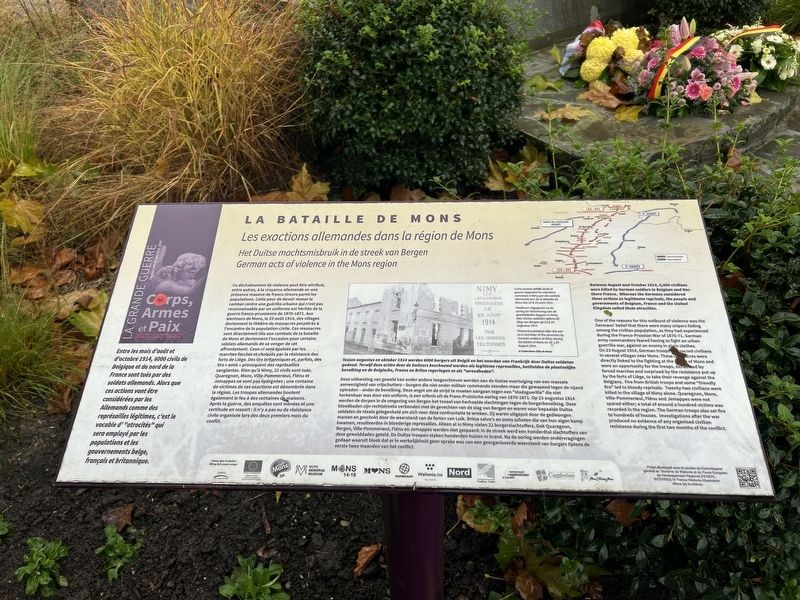
Photographed by Steve Stoessel, November 19, 2024
1. The Great War / La Grande Guerre Marker

German acts of violence in the Mons region
Between August and October 1914, 6,000 civilians were killed by German soldiers in Belgium and Northern France. Whereas the Germans considered these actions as legitimate reprisals, the people and governments of Belgium, France and the United Kingdom called them atrocities.
One of the reasons for this outburst of violence was the Germans' belief that there were many snipers hiding among the civilian population, as they had experienced during the Franco-Prussian War of 1870-71. German army commanders feared having to fight an urban guerrilla war, against an enemy in plain clothes. On 23 August 1914, German troops massacred civilians in several villages near Mons. These massacres were directly linked to the fighting at the Battle of Mons and were an opportunity for the troops, exhausted by forced marches and surprised by the resistance put up by the forts of Liège, to take their revenge against the Belgians. Fire from British troops and some "friendly fire" led to bloody reprisals. Twenty-two civilians were killed in the village of Nimy alone. Quaregnon, Mons, Ville-Pommerœul,
this page online
Les exactions allemandes dans la région de Mons
Entre les mois d'aout et d'octobre 1914, 6000 civils de Belgique et du nord de la France sont tués par des soldats allemands. Alors que ces actions vont tre considérées par les Allemands comme des représailles légitimes, c'est le vocable d' "atrocités" qui sera employé par les populations et les gouvernements belge, français et britannique.
Ce déchaînement de violence peut être attribué, entre autres, à la croyance allemande en une présence massive de francs-tireurs parmi les populations. Cette peur de devoir mener le combat contre une guérilla urbaine qui n'est pas reconnaissable par un uniforme est héritée de la guerre franco-prussienne de 1870-1871. Aux alentours de Mons, le 23 août 1914, des villages deviennent le théâtre de massacres perpétrés à l'encontre de la population civile. Ces massacres sont directement liés aux combats de la bataille de Mons et deviennent l'occasion pour certains soldats allemands de se venger de cet affrontement. Ceux-ci sont épuisés par les marches forcées et choqués par la résistance des forts de Liège. Des tirs britanniques et, parfois, des tirs « amis » provoquent des représailles sanglantes. Rien qu'à Nimy, 22 civils sont tués. Quaregnon, Mons, Ville-Pommeroul, Flénu et Jemappes ne sont pas épargnées; une centaine de victimes de ces exactions est dénombrée dans la région. Les troupes allemandes boutent également le feu à des centaines de maisons. Après la guerre, des enquêtes sont menées et une certitude en ressort: il n'y a pas eu de résistance civile organisée lors des deux premiers mois du conflit.
Het Duitse machtsmisbruik in de streek van Bergen
Tussen augustus en oktober 1914 werden 6000 burgers uit Belgie en het noorden van Frankrijk door Duitse soldater gedood. Terwijl deze acties door de Duitsers beschoud werden als legitieme represailles, betitelden de plaatselijk bevolking en de Belgische, Franse en Britse regeringen ze als "wreedheden".
Deze uitbarsting van geweld kan onder andere toegeschreven worden an de Duitse overtuiging van een massale aanwezigheid van vrijschutters - burgers die niet onder militair commando stonden maar die gewapend tegen de vija optraden - onder de bevolking. Deze angst om de strijd te moeten aangaan tegen een "stadsguerilla" die niet herkenbaar was door een uniform, is een erfenis uit de Frans-Pruisische oorlog van 1870-1871. Op 23 augustus 1914 werden de dorpen in de omgeving van Bergen het toneel van herhaalde slachtingen tegen de burgerbevolking. Deze bloedbaden zijn rechtstreeks verbonden met de gevechten van de slag van Bergen en waren voor bepaalde Duitse soldaten de ideale gelegenheid om zich voor deze confrontatie te wreken. Zij waren uitgeput door de gedwongen marsen en geschokt door de weerstand van de forten van Luik. Britse salvo's en soms schoten die van hun eigen kamp kwamen, resulteerden in bloederige represailles. Alleen al in Nimy vielen 22 burgerslachtoffers. Ook Quaregnon, Bergen, Ville-Pommerœul, Flénu en Jemappes werden niet gespaard: in de streek werd een honderdtal slachtoffers va deze gewelddaden geteld. De Duitse tropen staken honderden huizen in brand. Na de orlog werden ondervraginger gedaan waaruit bleek dat er in werkelijkheid geen sprake was van een georganiseerde weerstand van burgers tijdens eerste twee maanden van het conflict.
Carte postale éditée après la guerre rappelant les exactions commises à Nimy par des soldats allemands lors de la Bataille de Mons des 23 & 24 août 1914.
Postkaart uitgegeven na de oorlog ter herinnering aan de gewelddaden begaan in Nimy door Duitse soldaten tijdens de Slag van Bergen op 23 & 24 augustus 1914.
Topics.

Photographed by Steve Stoessel, November 19, 2024
2. The Great War / La Grande Guerre Marker
Location. 50° 28.626′ N, 3° 57.151′ E. Marker is in Nimy, Région Wallonne (Wallonia), in Hainaut. It is at the intersection of Rue des Viaducs (National Route 6) and Rue de Moulin de Nimy on Rue des Viaducs. Marker is in the Grand Place in Nimy. Touch for map. Marker is in this post office area: Nimy, Région Wallonne 7020, Belgium. Touch for directions.

Regionally, it is in Europe, the European Union, Atlantic Europe, the Benelux Low Countries, the Schengen Area, Western Europe, and the Western World. Historically, it finds itself in what was once the Roman Empire and specifically also the Holy Roman Empire.
Other nearby markers. At least 8 other markers are within 3 kilometers of this marker, measured as the crow flies: To Our Heroes (a few steps from this marker); Palace of Justice/ Palais de Justice (approx. 2.4 kilometers away); In Gratitude (approx. 2.5 kilometers away); Mons Recaptured (approx. 2.5 kilometers away); Salon Baronne Betty Duesberg (approx. 2.5 kilometers away); 5th Royal Irish Lancers

Photographed by Steve Stoessel, November 19, 2024
3. The Great War / La Grande Guerre Marker
Also see . . . War Crimes in WW1 (Wikipedia). (Submitted on November 25, 2024, by Steve Stoessel of Niskayuna, New York.)
Credits. This page was last revised on July 16, 2026. It was originally submitted on November 25, 2024, by Steve Stoessel of Niskayuna, New York. This page has been viewed 152 times since then and 14 times this year. Photos: 1, 2, 3. submitted on November 25, 2024, by Steve Stoessel of Niskayuna, New York.
