North Central in Pasadena in Los Angeles County, California — The American West (Pacific Coastal)
Grace United Methodist Church
Photographed by Craig Baker, November 25, 2024
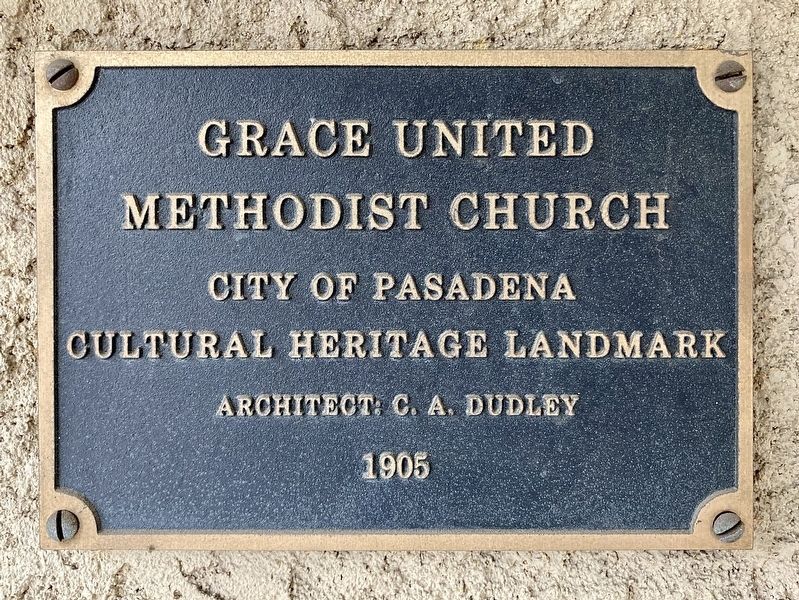
1. Grace United Methodist Church Marker
Grace United Methodist Church
City of Pasadena Cultural Heritage Landmark
Architect: C.A. Dudley
1905
Erected 1986 by City of Pasadena.
Topics. This historical marker is listed in these topic lists: Architecture • Religion & Religious Structures. A significant historical year for this entry is 1905.
Location. 34° 10.14′ N, 118° 8.903′ W. Marker is in Pasadena, California, in Los Angeles County. It is in North Central. It is at the intersection of Washington Boulevard and Iowa Avenue, on the right when traveling west on Washington Boulevard. Touch for map. Marker is at or near this postal address: 119 E Washington Blvd, Pasadena CA 91103, United States of America. Touch for directions.

Regionally, this marker is in Greater Los Angeles and in the Transverse Ranges. It is also on the American Pacific Coast. Globally, it is in North America, on the Ring of Fire, on the Pacific Rim, in the Western Hemisphere, in the Western World, and in the Anglosphere. Historically, it finds itself in what was once New Spain and also Mexico’s Alta California.
Other nearby markers. At least 8 other markers
this page online
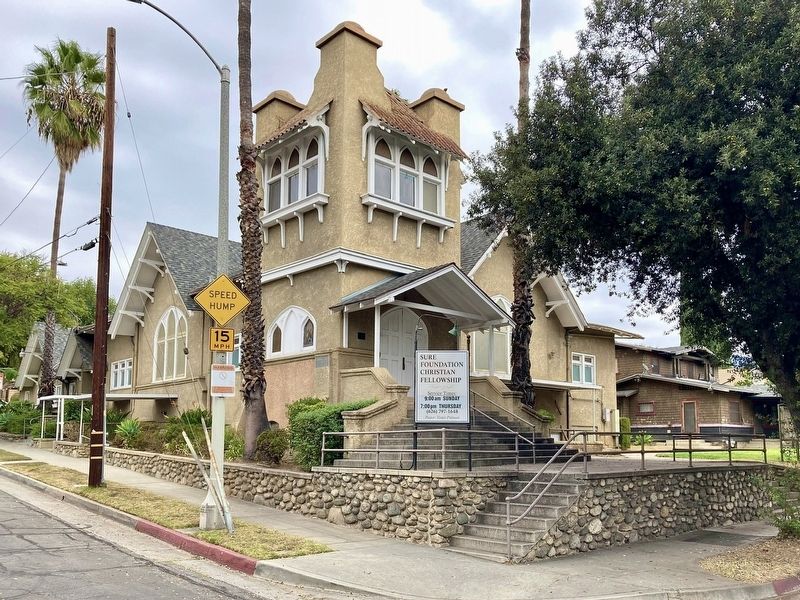
Regarding Grace United Methodist Church. The church combines the Victorian Gothic style with the Mission Revival to create a religious structure which creates a visual focal point on this residential street. The design takes full advantage of the corner siting by placing the tower on the south west property edge and using the street as the open space by which to view the structure in total.
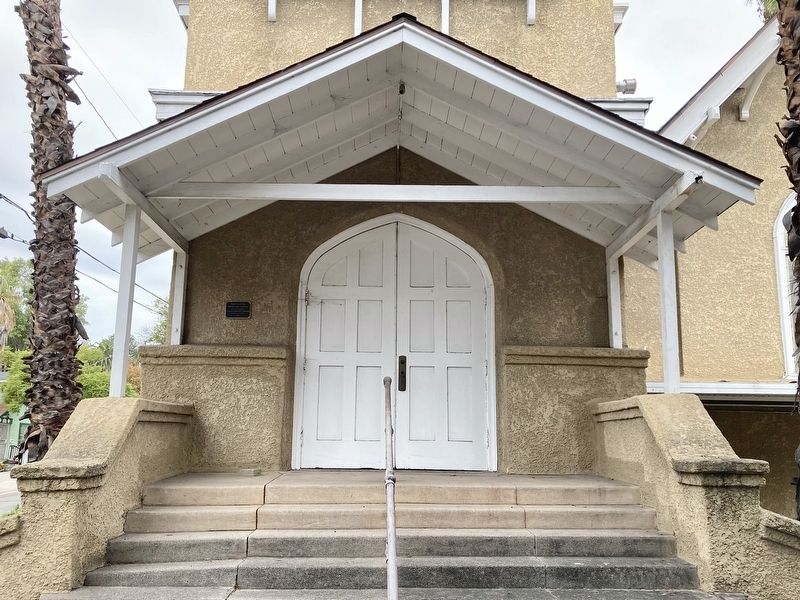
While the main body of the single story building has a cross-gabled roof, the two story tower has a tiled hipped roof with stepped projections on each corner. The gabled roof has overhanging eaves with prominent
Photographed by Craig Baker, November 25, 2024
2. Grace United Methodist Church Marker
Two gables on the Iowa façade further the hillside impression and help break the mass of the church into a more residential scale. A side entrance under the largest gable provides weekday entry into the social hall and offices.
The variety of roof forms is most evident on the east elevation. The tower roof, several conical roofs and a selection of
Photographed by Craig Baker, November 25, 2024
3. Grace United Methodist Church
In 1937 a kitchen and dining room addition was constructed at the rear of the building (northern elevation). Designed by noted architect Glenn Elwood Smith, the one story addition is designed in a compatible but distinct mode. The northern edge of the addition is distinguished by a gabled parapet with small gabled end pieces. A straight parapet continues the northern line. The vaulted roof is visible from the street. Entrance to the room known as Mizpah Hall, after the Sunday School that raised funds for its construction, is by a recessed open hall leading from Iowa under the straight line of the parapet. A large arched opening in the northern wall has been filled with plywood.
The social hall to the north of the sanctuary is named Parable Hall after the mural depicting parable stories which lines the octagonal tower in the center of the room. Two small rectangular windows on all but one side of the octagon provide
Photographed by Craig Baker, November 25, 2024
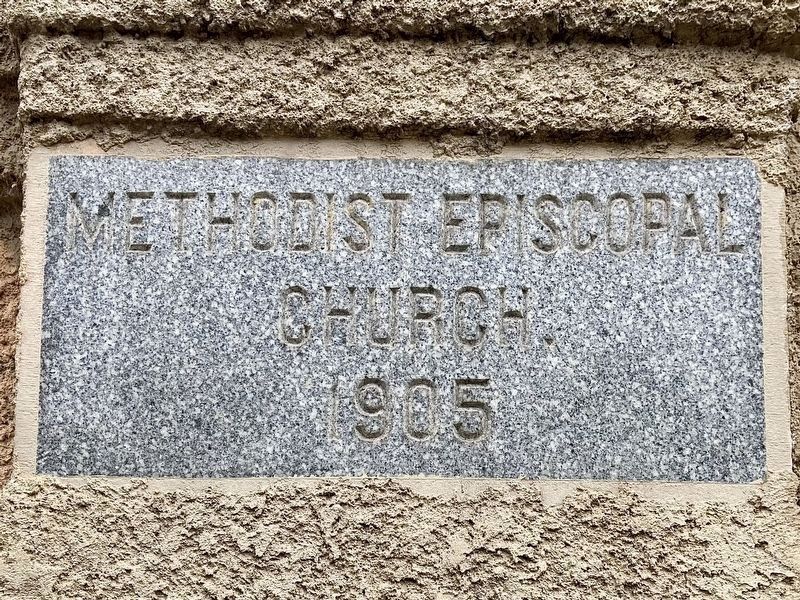
4. Cornerstone
Methodist Episcopal Church - 1905
The major alteration to the church structure has been the introduction of rough texture stucco. Originally the structure was surfaced with smooth stucco in keeping with the Mission Revival style. This resurfacing was unfortunate but did not considerably diminish the significance of the building. Aluminum awnings and canopies provide protection over several openings on the south and west facades. These would be easily removable.
The 1957 interior remodeling was largely concentrated in the pulpit and altar and sits amid the largely intact early 20th century interior.
-from City of Pasadena's component of the California Historical Resources Inventory Database
Credits. This page was last revised on November 29, 2024. It was originally submitted on November 25, 2024, by Craig Baker of Sylmar, California. This page has been viewed 258 times since then and 31 times this year. Photos: 1, 2, 3, 4. submitted on November 25, 2024, by Craig Baker of Sylmar, California.
