Stayner in Simcoe County, Ontario — Central Canada (North America)
The Founding of Stayner
Photographed by Cosmos Mariner, June 5, 2024
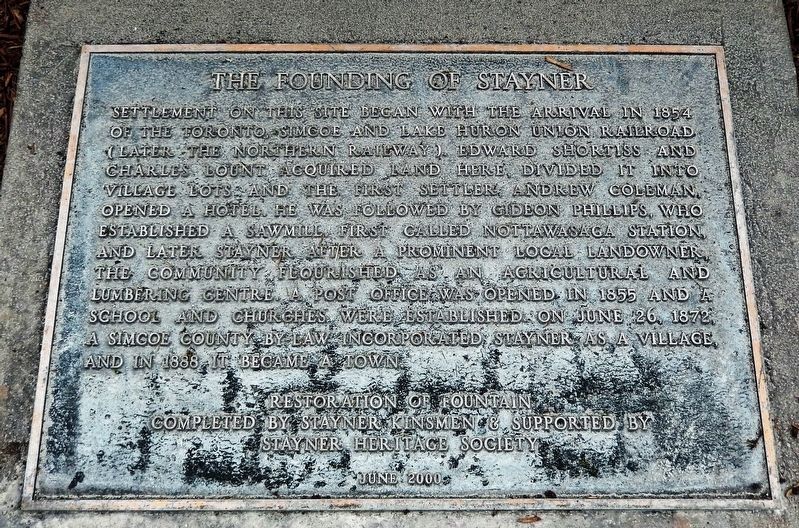
1. The Founding of Stayner Marker
Settlement on this site began with the arrival in 1854 of the Toronto, Simcoe and Lake Huron Union Railroad (later the Northern Railway). Edward Shortiss and Charles Lount acquired land here, divided it into village lots and the first settler, Andrew Coleman, opened a hotel. He was followed by Gideon Phillips who established a sawmill. First called Nottawasaga Station, and later Stayner after a prominent local landowner, the community flourished as an agricultural and lumbering centre. A post office was opened in 1855 and a school and churches were established. On June 26, 1872, a Simcoe County by-law incorporated Stayner as a village, and in 1888 it became a town.
completed by Stayner Kinsmen & Supported by
Stayner Heritage Society
June 2000
Erected 2000 by Stayner Kinsmen and the Stayner Heritage Society.
Topics. This historical marker is listed in these topic lists: Industry & Commerce • Railroads & Streetcars • Settlements & Settlers. A significant historical date for this entry is June 26, 1872.
Location. 44° 25.142′ N, 80° 5.531′ W. Marker is in Stayner, Ontario, in Simcoe County. It is at
this page online

Regionally, this marker is in Central Ontario Cottage Country and specifically in Georgian Bay Country. It is also in Central Canada. Globally, it is in North America, on the Great Lakes, in the Western Hemisphere, in the Western World, and in the Anglosphere. Historically, it finds itself in what was once a British colony, the Viceroyalty of New France, the Haudenosaunee (Iroquois) Confederacy, and Rupert’s Land.
Other nearby markers. At least 8 other markers are within 13 kilometers of this marker, measured as the crow flies: Stayner (formerly Nottawasaga Station) (approx. 0.4 kilometers away); The Muirhead Cabin (approx. 5.7 kilometers away); Schooner Town as a Naval Establishment (approx. 8.7 kilometers away); Schooner Town (approx. 8.7 kilometers

Photographed by Cosmos Mariner, June 5, 2024
2. The Founding of Stayner Marker
Looking southwest from Main Street; the marker is mounted on the base of the fountain, facing Main Street.
Related markers. Click here for a list of markers that are related to this marker. Stayner, Ontario
Credits. This page was last revised on October 4, 2025. It was originally submitted on November 25, 2024, by Cosmos Mariner of Cape Canaveral, Florida. This page has been viewed 364 times since then and 95 times this year. Photos: 1, 2. submitted on November 29, 2024, by Cosmos Mariner of Cape Canaveral, Florida.
