Bantheville in Meuse, Alsace, Lorraine, Champagne-Ardenne, France — Western Europe
Val Dunois Sector
⎯⎯⎯
Secteur du Val Dunois
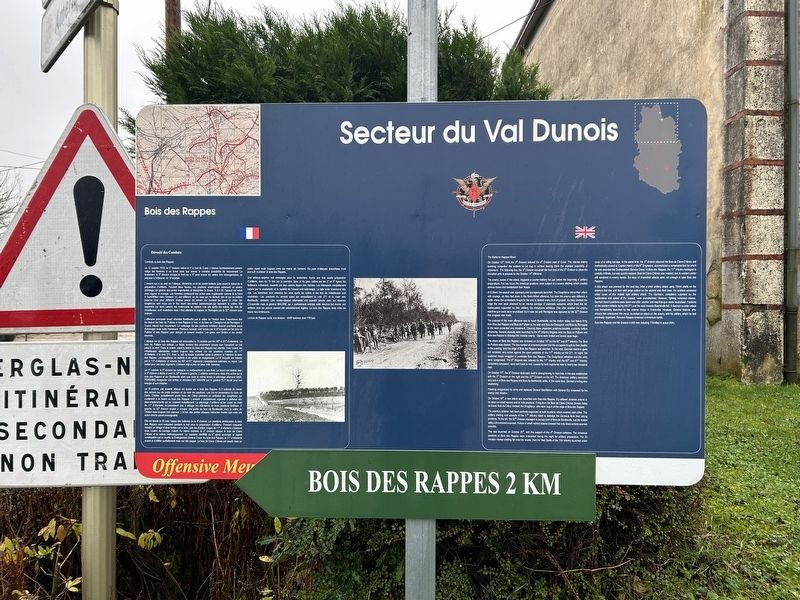
Photographed by Steve Stoessel, November 18, 2024
1. Val Dubois Sector / Secteur du Val Dunois Marker
The Battle for Rappes Wood
On October 12, 1918, the 5th Division relieved the 4th Division east of Cunel. The intense enemy bombing compelled the soldiers to be dug in without leaving them the slightest possibility of movement. The following day, the 3th Division occupied the front line of the 5th Division to allow the disrupted units to prepare for the October 14th offensive.
The enemy, aware of the attack, triggered a counter-battery fire just before the beginning of artillery preparations. For two hours the American positions were subject to a severe shelling which created serious losses and destabilized their troops.
At 8:30am, the assault was vigorously and courageously launched. The Doughboys drove their attack with courage, as they had done in the Saint-Mihiel offensive, but here the enemy was different; a battle where the combatants fought to the end to defend every inch of ground. As they climbed the ridge, the men were attacked by an intense barrage of automatic weapons which lined the hill. Inadequately supported by their artillery, the Americans withdrew. One after another the enemy machine-gun nests were
this page online
The purpose of the main offensive was to reach Banthevile via the Ardon valley, but heavy firing from Bois des Rappes and Bois da Pultière to the east and Bois de Chevignon and Bois de Romagne to the west prevented any movement. Clearing these important positions became a priority before advancing. Several assauls were launched by the 9th infantry Brigade onto the Bois de Pultère and Bois des Rappes to dislodge the invisible enemy. Gains were limited and losses were huge.
The attack on Bois des Rappes was renewed on October 15th by the 60th and 61th infantry. The Bois de Pubère was cleared. The low number of prisoners proved that the occupiers fought to their deaths. In the evening, only the edge of Bois des Rappes was reached. To the west, German machine-guns still remained very active against the open positions of the 11th infantry at Hill 271. At right, the scattered troops struggled to penetrate Bois des Rappes. The Doughboys withdrew and the units were reorganized. The 9th Brigade was relieved by the 11th infantry and the 60th
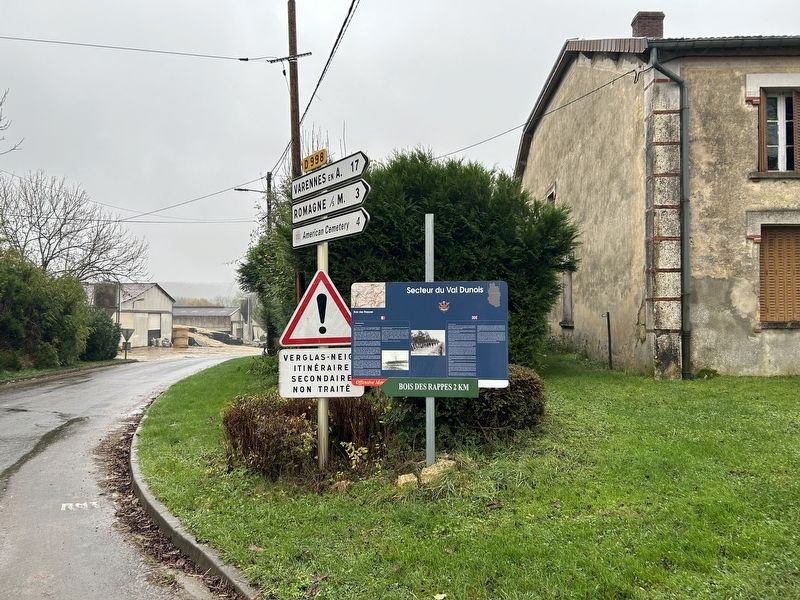
Photographed by Steve Stoessel, November 18, 2024
2. Val Dubois Sector / Secteur du Val Dunois Marker
On October 17th, the 5th Division dedicated itself to strengthening its front line. A link was established with the 3rd Division on the right and the 32nd Division on the left. The American artillery remained very active at Bois des Rappes and Bois de Bantheville while, at the same time, German shelling was weakening.
Pershing reorganized his army and replaced General MacMahon with General Ely renowned for his energy and initiative.
On October 18th, a new attack was launched onto Bois des Rappes. Ely ordered advance actions to be taken on small sectors and to hold positions. Firing from the Bois de Clairs-Chènes (known today as Grand Bois de Cléry) involved the Doughboys who were dug in at the edge of Bois des Rappes.
The enemy's defense had been perfectly organized at both locations which covered each other. The artillery shelling and assaults of the 11th Infantry failed to dislodge the Germans from their strong positions. To the left, the 32th Division managed to occupy part of Bois de Bantheville, but the Andon valley still remained exposed. Failure of small indirect attacks showed that only direct actions seemed possible.
This was launched on October 20th with the support of the 4th Division batteries. The American positions at Bois des Rappes were evacuated during the night for artillery preparation. For 50 minutes intense shelling fell onto the woods, then the Red Devils of the 11th Infantry launched under cover of a rolling barrage. At the same time, the 3rd Division attacked the Bois de Clairs-Chénes and methodically cleared it. Captain Hans of the 6th Engineers, accomplished a remarkable feat for which he was awarded the Distinguished Service Cross. Al Bois des Rappes, the 11th Infantry managed to partially infiltrate, but was quickly stopped: Bois de Clairs-Chênes was invaded, but its western sector still remained in enemy hands. Six days of diversified attacks were not enough to take Bois des Rappes.
A blitz attack was planned for the next day. After a short artillery attack using 75mm shells on the enemy's first line and then with large caliber on the second and third lines, the soldiers advanced under cover of this mobile light artillery attack. The Germans, completely surprised by the suddenness and speed of the assault, were overwhelmed. However, fighting remained intense. German trench positions were taken one afer another and machine-gun nests neutralized. Positions on the western hillside facing Hill 271 and the road towards Bantheville fell. A German counter-attack was immediately launched by the reserve troops in Acrevle. However, General Malone, who already had anticipated this move, launched an attack on the enemy with his artillery which he had previously organized. Bois des Rappes remained in American hands.
Bois des Rappes cost the Division 4,449 men including 779 killed in action (KIA).
Déroulé des Combats
Combats du bois des Rappes
Le 12 octobre 1918, la 5e division relève la 4e à l'est de Cunel. L'intense bombardement ennemi oblige les hommes à se terrer sans leur laisser la moindre possibilité de mouvement Le lendemain, la 3e division occupe le front de la 5e pour laisser les unités, très désorganisées, se préparer à l'offensive du 14 octobre.
L'ennemi qui a eu vent de l’attaque, déclenche un tir de contre-batterie juste avant le début de la préparation d'artillerie. Pendant deux heures, les positions américaines subissent un sévère pilonnage qui génère des pertes importantes et déstabilise la troupe. A 8 h 30, l'assaut est lancé avec vigueur et courage. Les hommes conduisent leur action avec impétuosité comme ils le firent à Saint-Mihiel mais l'ennemi, ici, est différent, un de ceux qui ne lâchent rien et qui se battent jusqu'au bout pour défendre chaque pouce de terrain. Au moment de gravir la crête, les doughboys sont reçus par le feu noumi des armes automatiques qui tapissent la colline. Mal supportes par leurs canons, les Américains se replient Les uns après les autres, les nids de mitrailleuses sont neutralisés mais il faut attendre la capture de Romagne par la 32e division pour avancer.
L'offensive principale devait atteindre Bantheville par la vallée de l'Andon mais l'importance des tirs depuis les bois de Pultière et des Rappes à l'est, et du bois de Chevignon et de Romagne, à l’ouest, interdit tout mouvement. Le nettoyage de ces positions fortifiées devient prioritaire avant d’envisager toute autre manoeuvre. Plusieurs assauts sont lancés par la 9e brigade sur les bois de Pulière et des Rappes pour déloger un ennemi invisible. Les gains sont imités et les pertes énormes.
L'attaque sur le bois des Rappes est renouvelée le 15 octobre par les 60e et 61e d'infanterie Le bois de Pultiére est nettoyé. Le faible nombre des prisonniers prouve que l'occupant se bat jusqu'à la mort Dans la soirée, seule la lisière du bois des Rappes est atteinte. Vers l'ouest, les mitrailleuses allemandes restent toujours très actives sur les positions ouvertes du 11e d'infanterie, a la cote 271. Avec la nuit, la troupe éparpillée peine à pénétrer à l'intérieur du bois des Rappes. Les doughboys se replient et les unités se réorganisent La 9e brigade est relevée par le 11e d'infanterie et renvoie les 60e et 61e régiments complètement exténués, au repos. Les pertes pour ces deux régiments s’élèvent déjà à près de deux mille hommes. Le 17 octobre, la 5e division se consacre au renforcement de son front. La liaison est étable avec la 3e division à droite et avec la 32e division à gauche. L'artillerie américaine reste très active sur le bois des Rappes et sur Bantheville alors que dans le même temps le pilonnage allemand faiblit. Pershing réorganise son armée et remplace McMahon par le général Ely réputé pour son énergie et son initiative.
Le 18 octobre, une nouvelle attaque est lancée sur le bois des Rappes. Ely ordonne de mener des actions sur de petits secteurs et de tenir les positions. Les tirs en provenance du bois de Clairs Chênes (actuellement grand bois de Cléry) prennent en enfilades les douglhboys qui s’enterrent à la lisière du bois des Rappes. L'ennemi a parfaitement organisé la défense des deux emplacements qui se couvent mutuellement Le pilonnage d'artillerie et les coups de main du 11 d'infanterie ne parviennent pas à déloger les Allemands de leurs positions fortifiées. A gauche, la 32e division réussit à occuper une parte du bois de Bantheville mais la vallée de (Andon reste toujours très exposée. L'échec des petites attaques indirectes montre que seule une action directe parait envisageable.
Topics. This historical marker is listed in this topic list: War, World I. A significant historical year for this entry is 1918.
Location. 49° 21.33′ N, 5° 5.536′ E. Marker is in Bantheville, Grand Est (Alsace, Lorraine, Champagne-Ardenne), in Meuse. It is at the intersection of Grand Est Route 15 and Rue du Val Dunois ( Route 998), on the left when traveling north on Grand Est Route 15. Touch for map. Marker is in this post office area: Bantheville, Grand Est 55110, France. Touch for directions.

Regionally, it is in the North Atlantic Region, Europe, the European Union, Atlantic Europe, the Schengen Area, Western Europe, a coastal Mediterranean country, and the Western World. Historically, it finds itself in what was once a French colony, the Roman Empire, and specifically the Holy Roman Empire.
Other nearby markers. At least 8 other markers are within 16 kilometers of this marker, measured as the crow flies: Bois Des Rappes (approx. 0.6 kilometers away); Meuse-Argonne American Cemetery (approx. 2.4 kilometers away); Romagne-Sous-Montfaucon (approx. 2.5 kilometers away); La nécropole nationale de Brieulles-sur-Meuse (approx. 6.1 kilometers away); 5th U.S. Division (approx. 8.8 kilometers away); Montfaucon American Monument (approx. 10 kilometers away); U.S. First Division Monument (approx. 10.2 kilometers away); Pennsylvania Memorial at Varennes en Argonne (approx. 15.1 kilometers away).
Also see . . .
1. Meuse-Argonne Offensive (Wikipedia). (Submitted on December 1, 2024, by Steve Stoessel of Niskayuna, New York.)
2. Lost Battlion (Wikipedia). (Submitted on December 1, 2024, by Steve Stoessel of Niskayuna, New York.)
Credits. This page was last revised on December 1, 2024. It was originally submitted on November 26, 2024, by Steve Stoessel of Niskayuna, New York. This page has been viewed 217 times since then and 42 times this year. Photos: 1, 2. submitted on November 26, 2024, by Steve Stoessel of Niskayuna, New York.
