Saint Stephens in Washington County, Alabama — The American South (East South Central)
The Tombigbee Settlements
(Sometimes called the 14th Colony)

Photographed by Billy Clemmons, November 26, 2024
1. THE TOMBIGBEE SETTLEMENTS Marker
Topics. This historical marker is listed in this topic list: Settlements & Settlers. A significant historical year for this entry is 1765.
Location. 31° 33.566′ N, 88° 2.07′ W. Marker is in Saint Stephens, Alabama, in Washington County. It is on Jim
this page online

Regionally, this marker is in the Mobile Bay area. It is also in the American South and specifically in the Deep South. Globally, it is in North America, a Gulf of Mexico state, the Western Hemisphere, the Western World, and the Anglosphere. Historically, it finds itself in what was once New Spain, the territory of the Mississippian Culture, one of the Confederate States of America, and the Antebellum South.
Other nearby markers. At least 8 other markers are within 7 miles of this marker, measured as the crow flies: Site of Old St. Stephens (approx. 0.3 miles away); St. Stephens (approx. 0.3 miles away); The St. Stephens Historical Commission (approx. 0.3 miles away); St. Stephens Courthouse and Masonic Lodge (approx. 1.8 miles away); Old St. Stephens Masonic Lodge No. 9 / St. Stephens Lodge (approx. 1.8 miles away); Upper Salt Works (approx. 4.6 miles away); The Taylor House (approx. 5.8 miles away); Bassetts Creek
Photographed by Mark Hilton, February 17, 2026
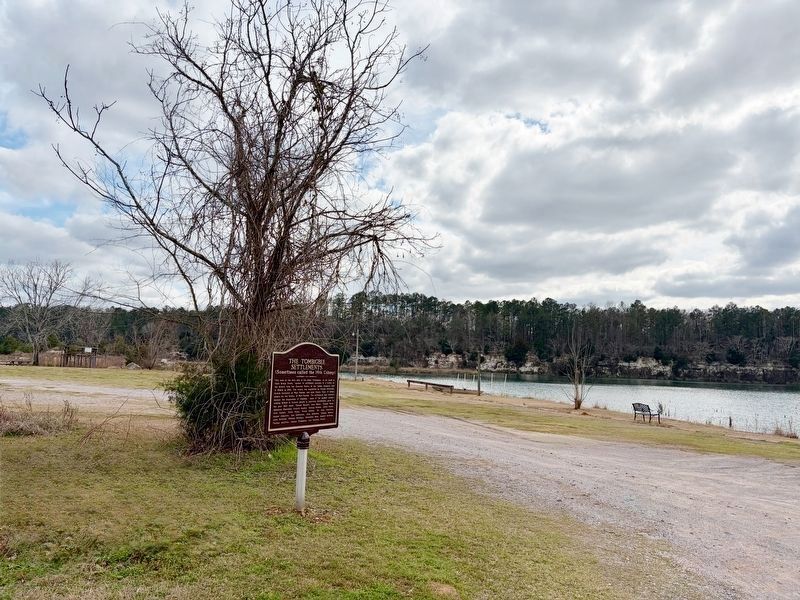
2. The Tombigbee Settlements Marker with Tombigbee River in background.
Credits. This page was last revised on February 17, 2026. It was originally submitted on November 27, 2024, by Billy Clemmons of Florence, Alabama. This page has been viewed 761 times since then and 112 times this year. Photos: 1. submitted on November 27, 2024, by Billy Clemmons of Florence, Alabama. 2. submitted on February 17, 2026, by Mark Hilton of Montgomery, Alabama. • James Hulse was the editor who published this page.
