Altstadt in Zürich, Switzerland — Central Europe (the Alps)
Zur Sul
Photographed by Andrew Ruppenstein, August 17, 2024
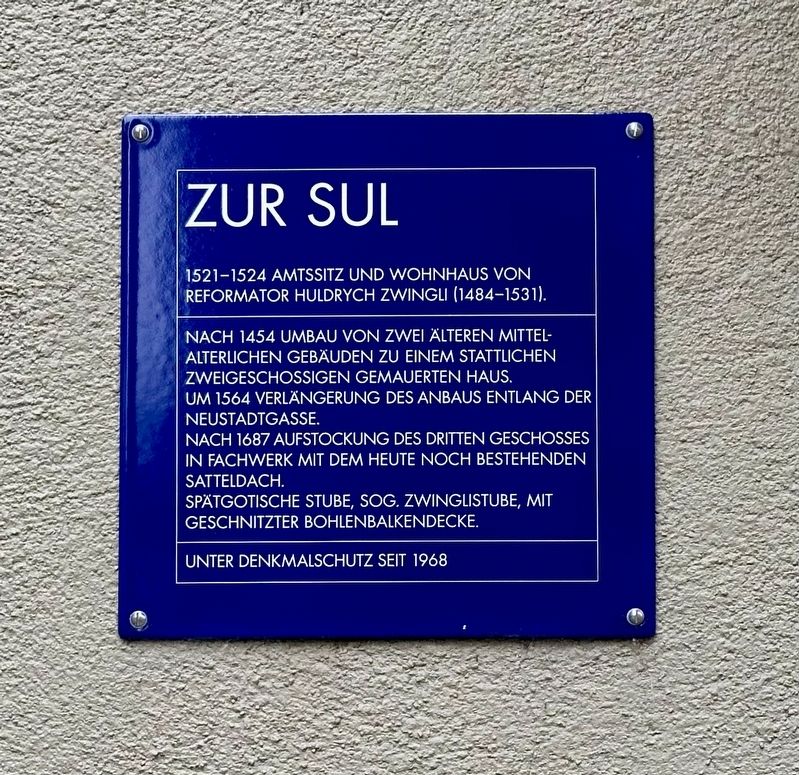
1. Zur Sul Marker

Nach 1454 umbau von zwei älteren mittelalterlichen Gebäuden zu einem stattlichen zweigeschossigen gemauerten Haus. Um 1564 Verlängerung des Anbaus entlang der Neustadtgasse.
Nach 1687 Aufstockung des dritten geschosses in Fachwerk mit dem heute noch bestehenden Satteldach.
Spätgotische Stube, sog. Zwinglistube, mit geschnitzter Bohlenbalkendecke.
Unter Denkmalschutz seit 1968
1521-1524 Official residence and home of reformer Huldrych Zwingli (1484-1531).
After 1454, two older medieval buildings were converted into a stately two-storey brick house. Around 1564, the extension was extended along Neustadtgasse. After 1687, the third floor was added in half-timbering with the gable roof that still exists today. Late Gothic room, so-called Zwingli room, with carved planked beam ceiling.
Listed as a historical monument since 1968
Topics and series. This historical marker is listed in these topic lists: Architecture • Religion & Religious Structures. In addition, it is included in the Zurich Blue Square
this page online
Location. 47° 22.203′ N, 8° 32.69′ E. Marker is in Zürich. It is in Altstadt. It is at the intersection of Kirchgasse and Neustadtgasse, on the right when traveling north on Kirchgasse. Touch for map. Marker is at or near this postal address: Kirchgasse 20, Zürich 8001, Switzerland. Touch for directions.

Regionally, it is in Europe, Central Europe, the Schengen Area, Western Europe, and the Western World. Historically, it finds itself in what was once the Roman Empire and specifically also the Holy Roman Empire.
Other nearby markers. At least 8 other markers are within walking distance of this marker: Haus zur Sul (here, next to this marker); Konrad von Mure, Johann Jakob Scheuchzer (a few steps from this marker); Grossmünsterkapelle (a few steps from this marker); Zwinglis Amtswohnung / Zwingli’s Official Residence (within shouting distance of this marker); Anna Bullinger-Adlischwyler (within shouting distance of this marker); Konstanzer-Haus (within shouting distance of this marker); Zum Kleinen Paradies (within shouting distance of this marker); Rosa Gutknecht (within

Photographed by Andrew Ruppenstein, August 17, 2024
2. Zur Sul House and Marker
Also see . . . Huldrych Zwingli (Wikipedia). Overview:
Huldrych or Ulrich Zwingli (1 January 1484 – 11 October 1531) was a Swiss Christian theologian, musician, and leader of the Reformation in Switzerland. Born during a time of emerging Swiss patriotism and increasing criticism of the Swiss mercenary system, he attended the University of Vienna and the University of Basel, a scholarly center of Renaissance humanism. He continued his studies while he served as a pastor in Glarus and later in Einsiedeln, where he was influenced by the writings of Erasmus.(Submitted on November 30, 2024.)
In 1519, Zwingli became the Leutpriester (people's priest) of the Grossmünster in Zürich where he began to preach ideas on reform of the Catholic Church. In his first public controversy in 1522, he attacked the custom of fasting during Lent. In his publications, he noted corruption in the ecclesiastical hierarchy, promoted clerical marriage, and attacked the use of images in places of worship. Among his most notable contributions to the Reformation was his expository preaching, starting in 1519, through the Gospel of Matthew, before eventually using Biblical exegesis to go through the entire New Testament, a radical departure from the Catholic mass. In 1525, he introduced a new communion liturgy to replace the Mass. He also clashed with the Anabaptists, which resulted in their persecution. Historians have debated whether or not he turned Zürich into a theocracy.
Credits. This page was last revised on November 30, 2024. It was originally submitted on November 30, 2024, by Andrew Ruppenstein of Lamorinda, California. This page has been viewed 155 times since then and 15 times this year. Photos: 1, 2. submitted on November 30, 2024, by Andrew Ruppenstein of Lamorinda, California.
