Woodland Hills in Los Angeles in Los Angeles County, California — The American West (Pacific Coastal)
Windmill - Tilting Blade
Halladay Design
Photographed by Craig Baker, November 28, 2024
1. Windmill · Tilting Blade Marker
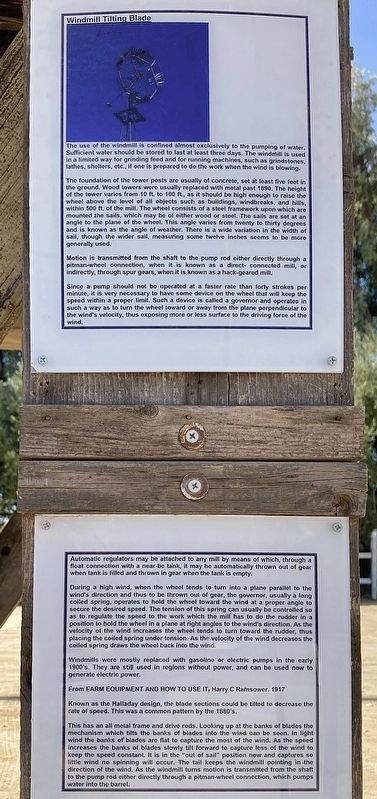
The use of the windmill is confined almost exclusively to the pumping of water. Sufficient water should be stored to last at least three days. The windmill is used in a limited way for grinding feed and for running machines, such as grindstones, lathes, shellers, etc., if one is prepared to do the work when the wind is blowing.
The foundation of the tower posts are usually of concrete, set at least five feet in the ground. Wood towers were usually replaced with metal past 1890. The height of the tower varies from 10 ft to 100 ft, as it should be high enough to raise the wheel above the level of all objects such as buildings, windbreaks, and hills within 500 ft. of the mill. The wheel consists of a steel framework upon which are mounted the sails, which may be of either wood or steel. The sails are set at an angle to the plane of the wheel. This angle varies from twenty to thirty degrees and is known as the angle of weather. There is a wide variation in the width of sail, though the wider sail, measuring some twelve inches seems to be more generally used.
Motion is transmitted from the shaft to the pump rod either directly through a pitman-wheel connection, when it is known as a direct connected mill, or indirectly, through spur gears, when it is known as a hack-geared mill.
Since a pump should not be operated at a faster rate than forty strokes per minute, it is very necessary to have some device on the wheel that will keep the speed within a proper limit. Such a device is called a governor and operates in such a way as to turn the wheel toward or away from the plane perpendicular to the wind's velocity, thus exposing more or less surface to the driving force of the wind.
Automatic regulators may be attached to any mill by means of which, through a float
this page online
During a high wind, when the wheel tends to turn into a plane parallel to the wind's direction and thus to be thrown out of gear, the governor, usually a long coiled spring, operates to hold the wheel toward the wind at a proper angle to secure the desired speed. The tension of this spring can usually be controlled so as to regulate the speed to the work which the mill has to do. As the velocity of the wind increases the wheel tends to turn toward the rudder, thus placing the coiled spring under tension. As the velocity of the wind decreases the colled spring draws the wheel back into the wind.
Windmills were mostly replaced with gasoline or electric pumps in the early 1900's. They are still used in regions without power, and can be used now to generate electric power.
- From FARM EQUIPMENT AND HOW TO USE IT, Harry C Ramsower, 1917.
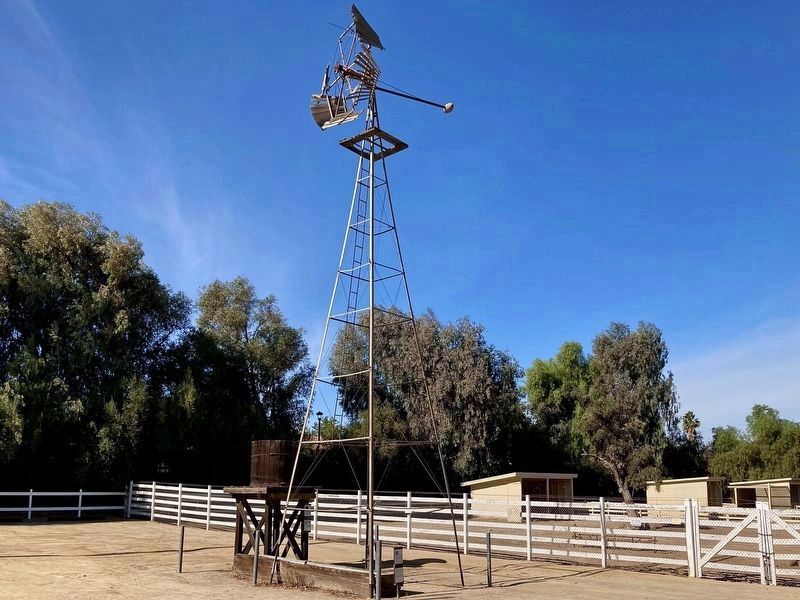
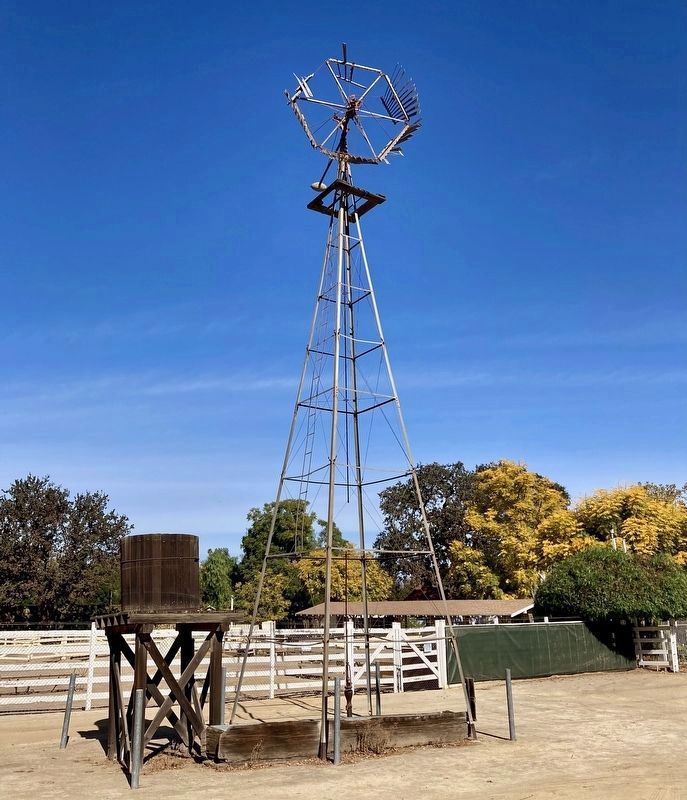
Known as the Halladay design, the blade sections could be tilted to decrease the rate of speed. This was a common pattern by the 1880's.
Photographed by Craig Baker, November 28, 2024
2. Aermotor Windmill Marker
The Aermotor windmill is not located here. It is next to the adobe.
This has an all metal frame and drive rods. Looking up at the banks of blades, the mechanism which tits the banks of blades into the wind can be seen. In light wind the banks of blades are flat to capture the most of the wind. As the speed increases the banks of blades slowly tilt forward to capture less of the wind to keep the speed constant. It is in the "out of sail" position now and captures so little wind no spinning will occur. The tail keeps the windmill pointing in the direction of the wind. As the windmill turns, motion is transmitted from the shaft to the pump rod directly through a pitman-wheel connection, which pumps water into the barrel.
Aermotor Windmill
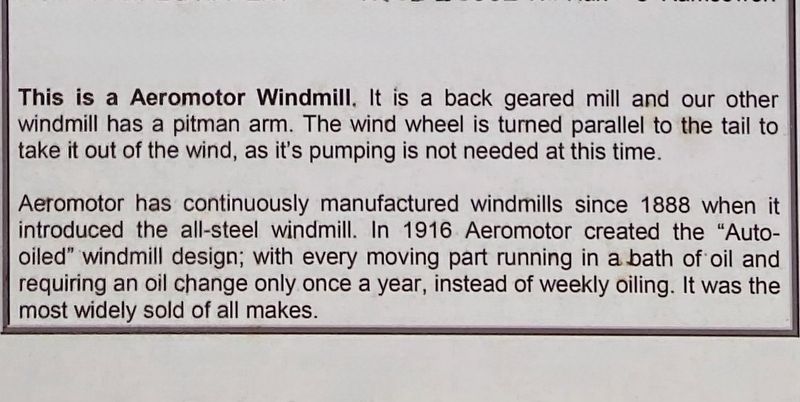
This is a Aermotor Windmill [located next to the adobe]. It is a back geared mill, and our other windmill has a pitman arm. The wind wheel is turned parallel to the tail to take it out of the wind, as it's pumping is not needed at this time.
Aermotor has continuously manufactured windmills since 1888 when it introduced the all-steel windmill. In 1916 Aermotor created the "Auto-oiled” windmill design; with every moving part running
Photographed by Craig Baker, November 28, 2024
3. Tilting Blade Windmill and Markers
Topics and series. This historical marker is listed in these topic lists: Industry & Commerce • Natural Resources. In addition, it is included in the Windmills series list.
Location. 34° 9.436′ N, 118° 38.438′ W. Marker is in Los Angeles, California, in Los Angeles County. It is in Woodland Hills. It can be reached from Calabasas Road west of Valley Circle Boulevard, on the right when traveling west. Located at the Leonis Adobe Museum, in the dirt parking lot. Touch for map. Marker is at or near this postal address: 23577 Calabasas Rd, Calabasas CA 91302, United States of America. Touch for directions.

Regionally, this marker is in The Valley (the San Fernando Valley) and in the Transverse Ranges. It is also on the American Pacific Coast. Globally, it is in North America, on the Ring of Fire, on the Pacific Rim, in the Western Hemisphere, in the Western World, and in the Anglosphere. Historically, it finds itself in what was once New
Photographed by Craig Baker, November 28, 2024
4. Tilting Blade Windmill
Other nearby markers. At least 8 other markers are within 2 miles of this marker, measured as the crow flies: Leonis Adobe (within shouting distance of this marker); Plummer House (about 300 feet away, measured in a direct line); Original El Camino Real Bell (about 600 feet away); Motion Picture History (approx. 0.4 miles away); Roddy McDowall Rose Garden (approx. 0.4 miles away); Los Angeles Pet Cemetery (approx. 0.6 miles away); The Rouse Residence (approx. 1.1 miles away); Park Moderne Fountain (approx. 1.3 miles away). Touch for a list and map of all markers in Los Angeles.
More about this marker. Both markers are located at the Tilting Blade Windmill. No markers are at the Aermotor Windmill.
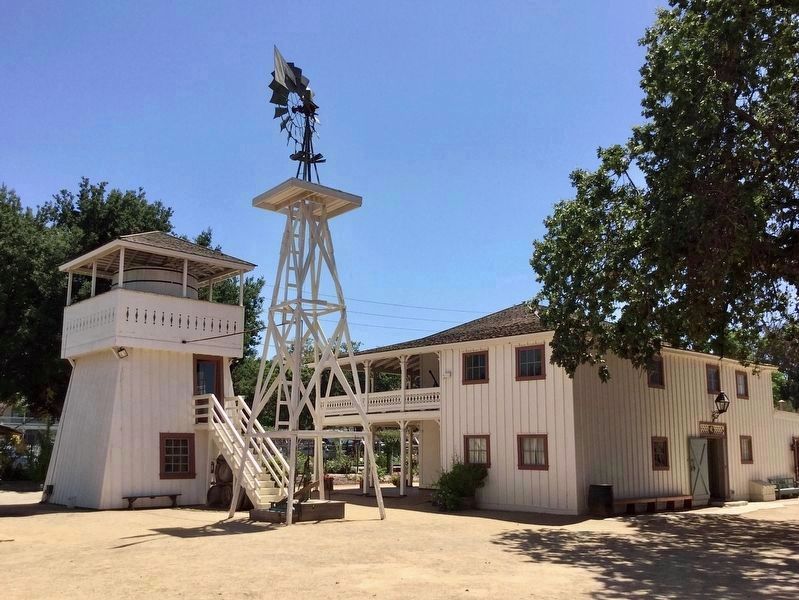
Photographed by Craig Baker, June 1, 2018
5. Aermotor Windmill, and the Leonis Adobe
The wind wheel is turned parallel to the tail to take it out of the wind.
Credits. This page was last revised on June 18, 2026. It was originally submitted on November 30, 2024, by Craig Baker of Sylmar, California. This page has been viewed 237 times since then and 34 times this year. Photos: 1, 2, 3, 4, 5. submitted on November 30, 2024, by Craig Baker of Sylmar, California.
