New Bedford in Bristol County, Massachusetts — The American Northeast (New England)
Paul Cuffee
Photographed by Barry Swackhamer, May 26, 2022
1. Paul Cuffee Panel
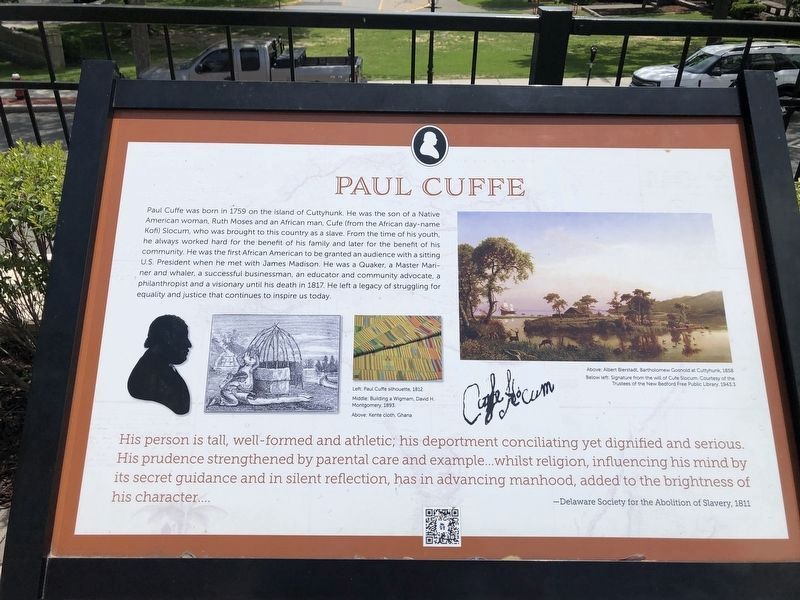
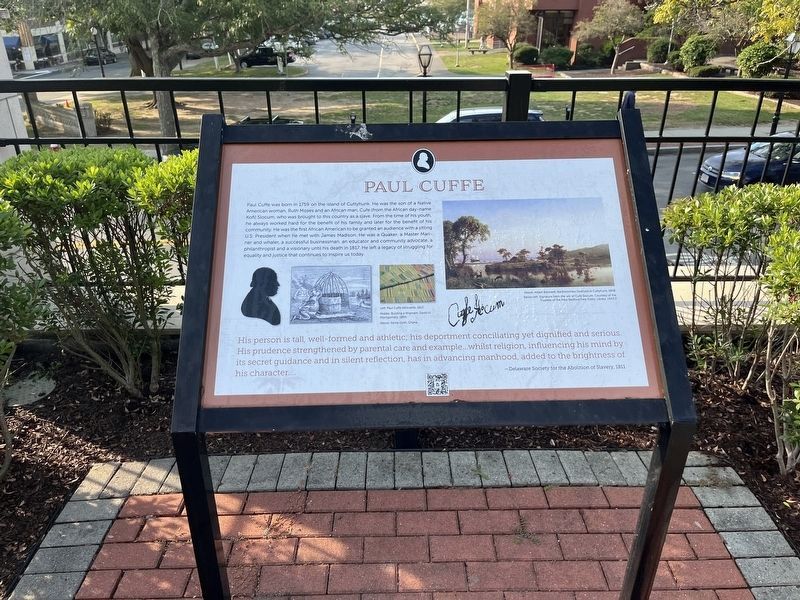
Captions: (lower left) Left: Paul Cuffee silhouette, 1812; Middle: Building a Wigmam. David H. Montgomery, 1893. Above: Kente cloth, Ghana; (middle-right) Above: Albert Bierstadt, Bartholomew Gosnold at Cuttyhunk, 1858; Below left: Signature for the will of Cufe Slocum, Courtesy of the Trustees of the New Bedford Free Public Library. 19433
Inscription.
Paul Cuffee. . (Six panels are treated as one, presented left to right) ,
Paul Cuffee . Paul Cuffe was born in 1759 on the island of Cuttyhunk. He was the son of a Native American woman, Ruth Moses and an African man, Cufe (from the African day-name Kofi) Slocum, who was brought to this country as a slave. From the time of his youth he always worked hard for the benefit of his family and later for the benefit of his community. He was the first African American to be granted an audience with sitting U.S. President when he met with James Madison. He was a Quaker, a Master Mariner and whaler, a successful businessman, an educator and community advocate, a philanthropist and a visionary until his death in 1877. He left a legacy of struggling for equality and justice that continues to inspire us today. , His person is tall, well-formed and athletic, his deportment conciliating yet dignified and serious . His prudence strengthened by parental care and example...whilst religion, influencing his side by its secret guidance and in silent reflection, has in advancing manhood, added to the brightness of his character.... --Delaware Society for the Abolition of Slavery, 1811 ,
Seafarer/Navigator . Paul and his crew, they were diligent and enterprising, and they had the honour of killing six of the seven whales, two of those fell by Paul's own hands.... -- Belfast Monthly, 1811 , Paul Cuffee was an accomplished navigator and whaler. At age 14, he entered as a common hand on a whaling voyage, sailing to the West Indies. During the Revolutionary War, he repeatedly ran a blockade from Dartmouth to Nantucket and Martha's Vineyard. He quickly learned the skill of navigation at a young age. Cuffee established his own boatyard and owned many whaling and merchant vessels with his business partner and bother-in-law. Michael Wainer. He engaged in the whaling trade beginning in 1789 and sailed to Europe and West Africa in order to trade and provide assistance to the people of West Africa.
Entrepreneur . After his father's death in 1772, he began on a path that would benefit his family and community. Cuffee alway worked with his family and in-laws in his business endeavors. Cuffee's entrepreneurship began with is delivering needed goods to Nantucket and Martha's Vineyard during the Revolutionary War. There were many setbacks initially, but he eventually built strong business relationships internationally as well as with highly respected African American and Quaker merchants up and down the East Coast. Paul Cuffee earned an impressive reputation as a person of honor and reliability. , Cuffee is owner and master of a fine ship. He is a man whom I suppose to be worth 20,000 dollars and a more extensive credit and reputation than any other in the township. --unidentified writer to a Pennsylvania Quaker, 1807 ,
Educator, Advocate, and Philanthropist . Paul Cuffee spent most of his life fighting for equality and worked with white and black abolitionists in the U.S. and England to end slavery. In 1780, Paul and his brother John petitioned the state ofMassachusetts for the right to vote, first with other free blacks and African Americans, then as Native Americans. This was instrumental in securing voting rights for free people of color in the state of Massachusetts in 1783. Cuffee also established a free, integrated school in Westport, one of the first in the country. He was a leader in the local Quaker community, joining the Acoaxel Quakers in 1808, and later contributed haft of the funds necessary to rebuild the Acoaxel (Westport) Friends Meeting House. His Quaker ideals drove his passion for fairness and equality. Cuffee provided financial assistance to his extended family, needy widows, and other community members. , I am of the African race. I feel myself interested for them, and if I am favored with a talent I think I am willing that they should be benefited thereby.... -- Paul Cuffee, 1806
Visionary . Paul Cuffee has a vision of brining commerce and hope to Sierra Leone. He believed that free and freed African Americans could find a home there and eventually, with industry and trade. West Africa would replace trade in human with trade in goods. Cuffee believed that if African societies achieved greater transatlantic civil and economic engagement, they would be on par with the United States and Europe. Many consider Cuffee to be one of the first Black Nationalists. His vision had support from Quaker communities and black and white abolitionists in the U.S. and England. He defined a vision of justice and racial equality to which may still aspire today. , If they can be permitted to get those articles through industry, it would help to make them more industrious...I think it may gradually wean them from being so strongly influenced with the slave trade, etc. -- Paul Cuffee, 1816
Living Legacy . ...to awaken and stimulate energy and ambition in the rising generation...that they may profit thereby... Horratio P. Howard, descendant, 1913 , Paul Cuffee's impact and legacy is local, national and international. He rose to prominence at a time when it was all but impossible for an African American or Native American man to do so. He had extensive community and family networks, and he was instrumental in changing laws that granted rights to people of color. In addition to schools that bear his name and exhibits in museum, Cuffee has many descendants that preserve his memory and legacy, his Native American and African heritage, and his role in local history. His descendants and admirers continue to highlight the historical impact of Paul Cuffee's early fight for social, political, and economic equality. , (T)he exertions of Paul Cuffee and his brother influenced permanently the welfare of the whole colored population of North America, -- Wilson Armistead
(Six panels are treated as one, presented left to right)
Paul Cuffee
Paul Cuffe was born in 1759 on the island of Cuttyhunk. He was the son of a Native American woman, Ruth Moses and an African man, Cufe (from the African day-name Kofi) Slocum, who was brought to this country as a slave. From the time of his youth he always worked hard for the benefit of his family and later for the benefit of his community. He was the first African American to be granted an audience with sitting U.S. President when he met with James Madison. He was a Quaker, a Master Mariner and whaler, a successful businessman, an educator and community advocate, a philanthropist and a visionary until his death in 1877. He left a legacy of struggling for equality and justice that continues to inspire us today.
His person is tall, well-formed and athletic, his deportment conciliating yet dignified and serious . His prudence strengthened by parental care and example...whilst religion, influencing his side by its secret guidance and in silent reflection, has in advancing manhood, added to the brightness of his character.... --Delaware Society for the Abolition of Slavery, 1811
Seafarer/Navigator
Paul and his crew, they were diligent and enterprising, and they had the honour of killing six of the seven whales, two of those fell by Paul's own hands.... -- Belfast Monthly, 1811
Paul Cuffee was an accomplished navigator and whaler. At age 14, he entered as a common hand on a whaling voyage, sailing to the West Indies. During the Revolutionary War, he repeatedly ran a blockade from Dartmouth to Nantucket and Martha's Vineyard. He quickly learned the skill of navigation at a young age. Cuffee established his own boatyard and owned many whaling and merchant vessels with his business partner and bother-in-law. Michael Wainer. He engaged in the whaling trade beginning in 1789 and sailed to Europe and West Africa in order to trade and provide assistance to the people of West Africa.
Entrepreneur
After his father's death in 1772, he began on a path that would benefit his family and community. Cuffee alway worked with his family and in-laws in his business endeavors. Cuffee's entrepreneurship began with is delivering needed goods to Nantucket and Martha's Vineyard during the Revolutionary War. There were many setbacks initially, but he eventually built strong business relationships internationally as well as with highly respected African American and Quaker merchants up and down the East Coast. Paul Cuffee earned an impressive reputation as a person of honor and reliability.
Cuffee is owner and master of a fine ship. He is a man whom I suppose to be worth 20,000 dollars and a more extensive credit and reputation than any other in the township. --unidentified writer to a Pennsylvania Quaker, 1807
Educator, Advocate, and Philanthropist
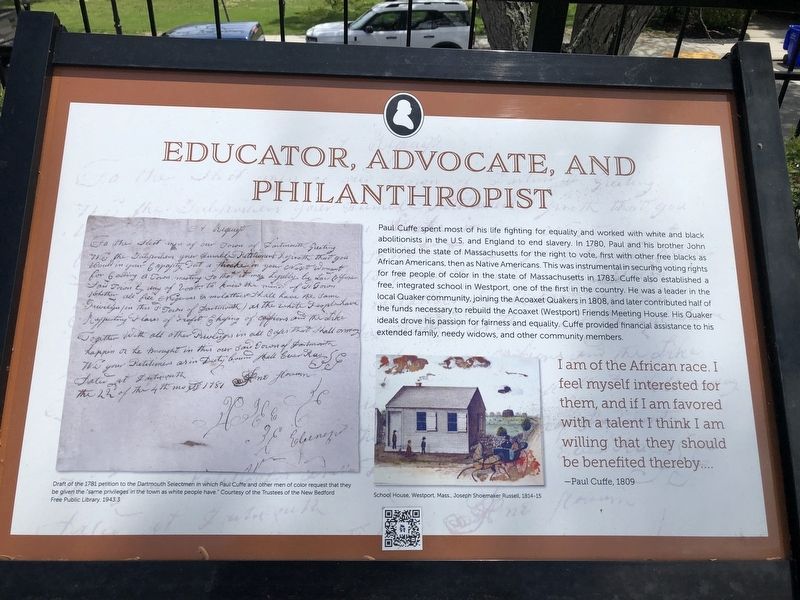
Paul Cuffee spent most of his life fighting for equality and worked with white and black abolitionists in the U.S. and England to end slavery. In 1780, Paul and his brother John petitioned the state ofMassachusetts for the right to vote, first with other free blacks and African Americans, then as Native Americans. This was instrumental in securing voting rights for free people of color in the state of Massachusetts in 1783. Cuffee also established a free, integrated school in Westport, one of the first in the country. He was a leader in the local Quaker community, joining the Acoaxel Quakers in 1808, and later contributed haft of the funds necessary to rebuild the Acoaxel (Westport) Friends Meeting House. His Quaker ideals drove his passion for fairness and equality. Cuffee provided financial assistance to his extended family, needy widows, and other community members.
I am of the African race. I feel myself interested for them, and if I am favored with a talent I think I am willing that they should be benefited thereby.... -- Paul Cuffee, 1806
Visionary
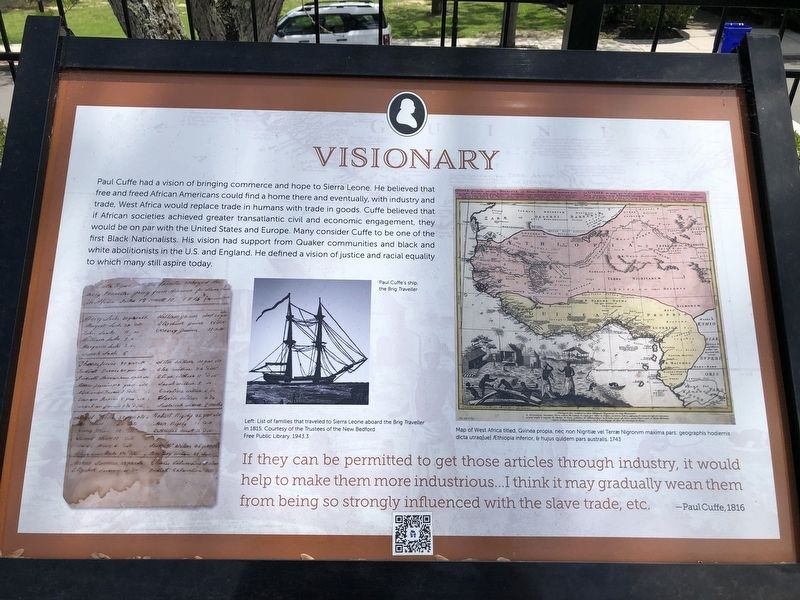
Paul Cuffee has a vision of brining commerce and hope to Sierra Leone. He believed that free and freed African Americans could find a home there and eventually, with industry and trade. West Africa would replace trade in human with trade in goods. Cuffee believed that if African societies achieved greater transatlantic civil and economic engagement, they would be on par with the United States and Europe. Many consider Cuffee to be one of the first Black Nationalists. His vision had support from Quaker communities and black and white abolitionists in the U.S. and England. He defined a vision of justice and racial equality to which may still aspire today.
If they can be permitted to get those articles through industry, it would help to make them more industrious...I think it may gradually wean them from being so strongly influenced with the slave trade, etc. -- Paul Cuffee, 1816
Living Legacy
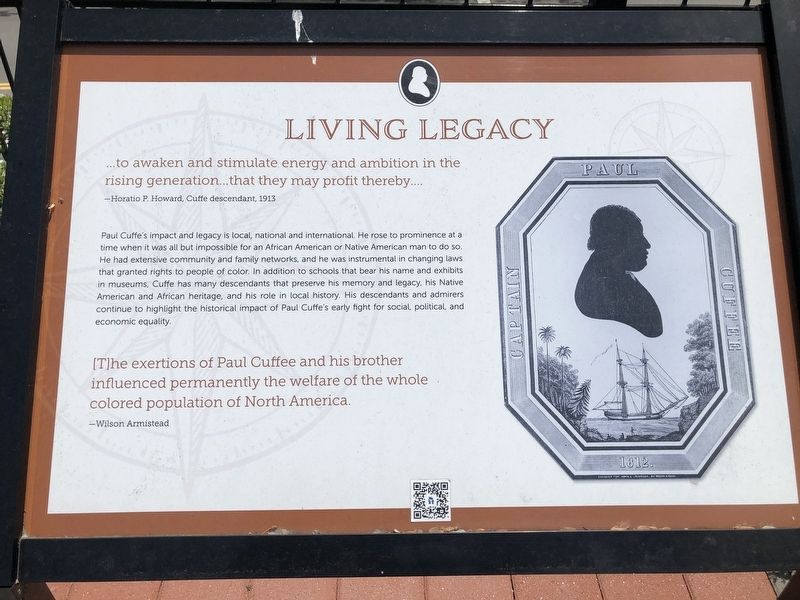
...to awaken and stimulate energy and ambition in the rising generation...that they may profit thereby... Horratio P. Howard, descendant, 1913
Paul Cuffee's impact and legacy is local, national and international. He rose to prominence at a time when it was all but impossible for an African American or Native American man to do so. He had extensive community and family networks, and he was instrumental in changing laws that granted rights to people of color. In addition to schools that bear his name and exhibits in museum, Cuffee has many descendants that preserve his memory and legacy, his Native American and African heritage, and his role in local history. His descendants and admirers continue to highlight the historical impact of Paul Cuffee's early fight for social, political, and economic equality.
(T)he exertions of Paul Cuffee and his brother influenced permanently the welfare of the whole colored population of North America, -- Wilson Armistead
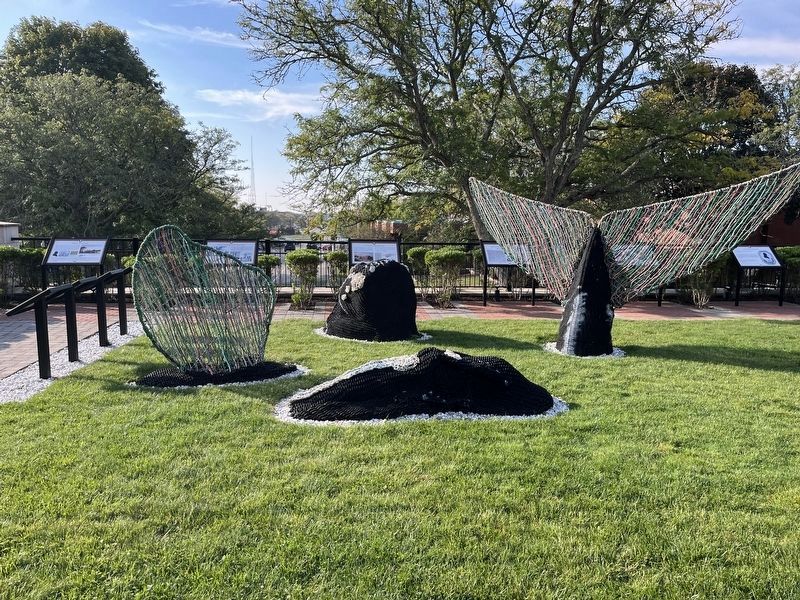
Location. 41° 38.077′ N, 70° 55.393′ W. Marker is in New Bedford, Massachusetts, in Bristol County. It is at the intersection of Johnny Cake Hill and Union Street on Johnny Cake Hill. This marker is located in Captain Paul Cuffee Park. Touch for map. Marker is at or near this postal address: 14 Johnny Cake Hill, New Bedford MA 02740, United States of America. Touch for directions.

Regionally, this marker is in the South Coast. It is also in the American Northeast, in New England, and on the Eastern Seaboard. Globally, it is in the North Atlantic Region, North America, the Western Hemisphere, the Western World, and the Anglosphere. Historically, it finds itself in what was once one of the original Thirteen Colonies.
Other nearby markers. At least 8 other markers are within walking distance of this marker: Twentieth-Century Whaling (here, next to this marker); Trial by Fire (here, next to this marker); Captain Paul Cuffe (here, next to this marker); a different marker also named
Photographed by Barry Swackhamer, May 26, 2022
2. Seafarer/Navigator Panel
Captions: Above, left: Map of Cuffee and Wainer family voyages, courtesy of Paul Cuffee Symposium Committee, 2017, Westport Historical Society, New Bedford Historical Society and Dartmouth Historical and Art Society.; Above middle: Compass used by Paul Cuffee; Above: The Brig Traveller
Also see . . . 1. Who Led the First Back-to-Africa Effort? -- The African Americans (PBS). "The person who spearheaded the first, black initiated back to Africa effort in U.S. history, according to the historian Donald R. Wright, was also the first free African American to visit the White House and have an audience with a sitting president. He was Paul Cuffee, a sea captain and an entrepreneur who was perhaps the wealthiest black American of his time."
The times were more complicated than I knew. (Submitted on December 3, 2024, by Barry Swackhamer of Brentwood, California.)
Captions: Left: New Bedford in 1807. Old Four Corners, William A.Walt, 1852-1857. The African American man in the corner has alway been rumored to be Paul Cuffee, however it is very unlikely that this image represents or was meant to represent Paul Cuffee. The image does show where Cuffee & Howard's store was located.; Middle: 1811 New Bedford Mercury Advertisement Cuffee and Howard store, owned by Paul Cuffee and his sons-in-law, and located here on the west-side of Water Street.l Above: Raymond Shaw, Cuffee's boatyard along the East Branch of Acoaksett River, 2016.
ship and cargo from Sierra Leone were seized by U.S. Customs in Newport, R.I. The War of 1812 was approaching, and Cuffe had violated the trade embargo of 1807. He went all the way to the White House to get his cargo back.
Cuffe met with President James Madison...Cuffe persuaded the president he broke the embargo unintentionally, and Madison ordered his cargo and ship returned."(Submitted on December 3, 2024, by Barry Swackhamer of Brentwood, California.)
Photographed by Barry Swackhamer, May 26, 2022
4. Educator, Advocate, and Philanthropist Panel
Captions: (left) Draft of the 1781 petition to the Dartmouth Selectmen in which Paul Cuffee and other men of color request that they be given the same privileges in the town as white people have.; (bottom-center) School House, Westport, Mass. Joseph Shoemaker Russell, 1814-15.
Photographed by Barry Swackhamer, May 26, 2022
5. Visionary Panel
Captions: (bottom-left) List of families that traveled to Sierra Leone aboard the Brig Traveller in 1815.; (bottom-center) Paul Cuffee's ship the Brig Traveler ; (map on right) Map of West Africa titled Gvinea propla nec non Nigritie vel Terrζ Nigrorvm maxima par geographis hodernis dicta utraq(ue) Ζthiopia inferior & hujus quidem para australis. 1743.
Photographed by Barry Swackhamer, May 26, 2022
6. Living Legacy
Photographed by Barry Swackhamer, May 26, 2022
7. Paul Cuffee Marker
Photographed by Adam Margolis, September 15, 2025
8. Paul Cuffee Marker
Photographed by Adam Margolis, September 15, 2025
9. Paul Cuffee Marker
Credits. This page was last revised on February 28, 2026. It was originally submitted on December 3, 2024, by Barry Swackhamer of Brentwood, California. This page has been viewed 309 times since then and 60 times this year. Photos:1, 2, 3, 4, 5, 6, 7. submitted on December 3, 2024, by Barry Swackhamer of Brentwood, California. 8, 9. submitted on November 28, 2025, by Adam Margolis of Mission Viejo, California.
