Schießhaus in Bayreuth, Bavaria, Germany — Central Europe
Zwei Intendanten
⎯⎯⎯
Two Directors: Lüttichau (mit Frau) und Bronsart von Schellendorf
Walk of Wagner
Photographed by James Hulse, October 2, 2024
1. Zwei Intendanten / Two Directors: Lüttichau (mit Frau) und Bronsart von Schellendorf Marker

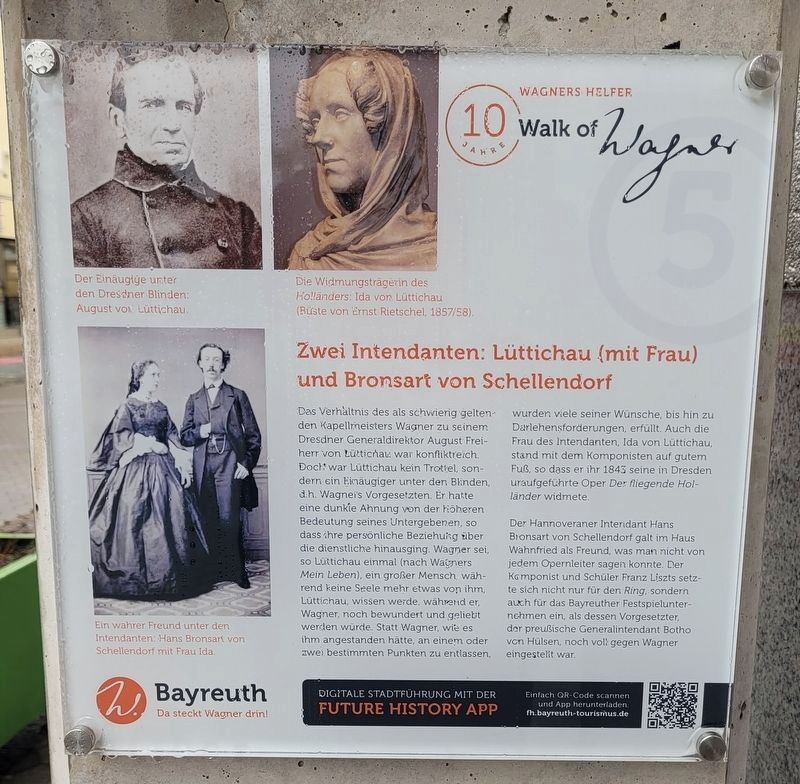
Das Verhältnis des als schwierig geltenden Kapellmeisters Wagner zu seinem Dresdner Generaldirektor August Freiherr von Lüttichau war konfliktreich. Doch war Lüttichau kein Trottel, sondern ein Einäugiger unter den Blinden, d.h. Wagnei's Vorgesetzten. Er hatte eine dunkle Ahnung von der höheren Bedeutung seines Untergebenen, so dass ihre persönliche Beziehung über die dienstliche hinausging. Wagner sei, so Lüttichau einmal (nach Wagners Mein Leben), ein großer Mensch, während keine Seele mehr etwas von ihm, Lüttichau, wissen werde, während er, Wagner, noch bewundert und geliebt werden würde. Statt Wagner, wie es ihm angestanden hätte, an einem oder zwei bestimmten Punkten zu entlassen, wurden viele seiner Wünsche, bis hin zu Darlehensforderungen, erfüllt. Auch die Frau des Intendanten, Ida von Lüttichau, stand mit dem Komponisten auf gutem Fuß, so dass er ihr 1843 seine in Dresden uraufgeführte Oper Der fliegende Holländer widmete.
Der Hannoveraner Interidant Hans Bronsart von Schellendorf galt im Haus Wahnfried als Freund, was man nicht von jedem Opernleiter sagen konnte. Der Kamponist und Schüler Franz
this page online
Bildunterschriften
(Foto Nr. 1) Der Einäugige unter den Dresdner Blinden: August von Lüttichau.
(Foto Nr. 2) Die Widmungsträgerin des Holländers: Ida von Lüttichau (Büste von Ernst Rietschel, 1857/58).
(Foto Nr. 3) Ein wahrer Freund unter den Intendanten: Hans Bronsart von Schellendorf mit Frau Ida.
Two directors: Lüttichau (with his wife) and Bronsart von Schellendorf
The relationship between the often difficult Music Director Wagner and his Dresden General Director August Freiherr von Lüttichau was fraught with conflict. However, Lüttichau was no fool; he was a "one-eyed man among the blind," meaning that, among Wagner's superiors, he had a certain awareness of the greater significance of his subordinate. Lüttichau had a vague sense of Wagner’s higher importance, so their personal relationship went beyond the professional. As Lüttichau once said (according to Wagner's Mein Leben), Wagner

Photographed by James Hulse, October 2, 2024
2. Zwei Intendanten / Two Directors: Lüttichau (mit Frau) und Bronsart von Schellendorf Marker
The Hanoverian intendant Hans Bronsart von Schellendorf was considered a friend at the Wahnfried household, which could not be said for every opera director. The composer and student of Franz Liszt not only advocated for The Ring, but also supported the Bayreuth Festival organization, even when its superior, the Prussian General Intendant Botho von Hülsen, was still hostile toward Wagner.
Captions
(Photo #1) The One-Eyed Among the Blind of Dresden: August von Lüttichau.
(Photo #2) The Dedicatee of the Dutchman: Ida von Lüttichau (Bust by Ernst Rietschel, 1857/58).
(Photo #3) A True Friend Among the Intendants: Hans Bronsart von Schellendorf with his wife Ida.
Erected by Bayreuth Da steckt Wagner drin!.
Topics. This historical marker is listed in this topic list: Arts, Letters, Music. A significant historical year for this entry is 1843.
Location. 49° 56.594′ N, 11° 34.723′ E. Marker is in Bayreuth, Bayern (Bavaria). It is in Schießhaus. It is on Richard-Wagner-Straße just east of Ludwigstraße, on the left when traveling east. The marker is located along the building. Touch for map. Marker is at or near this postal address: Richard-Wagner-Straße 5, Bayreuth BY 95444, Germany. Touch for directions.

Regionally, this marker is in German Franconia. Globally, it is in Europe, the European Union, Atlantic Europe, Central Europe, the Schengen Area, Western Europe,
Photographed by James Hulse, October 2, 2024
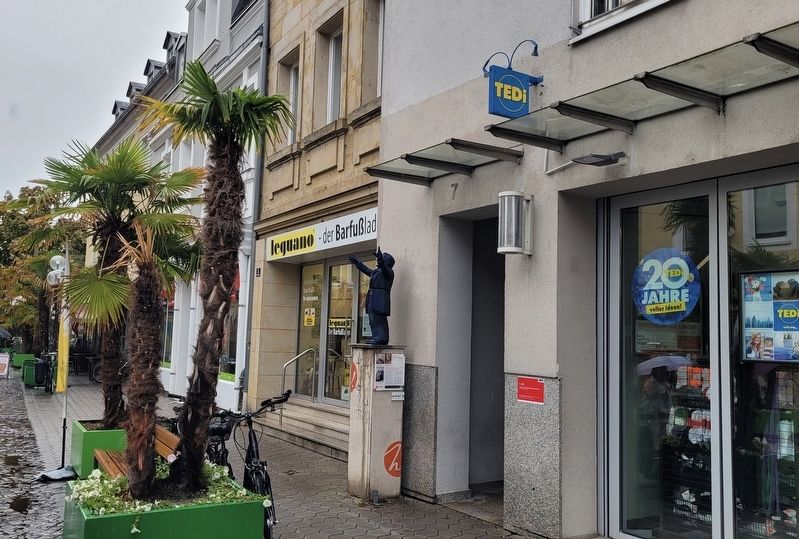
3. The view of the marker along the street
Other nearby markers. At least 8 other markers are within walking distance of this marker: Jean Paul und die Sonne / Jean Paul and the Hotel Sonne (a few steps from this marker); Vom Neumarkt zum Palais: Dresden / From Neumarkt to the Palace: Dresden (within shouting distance of this marker); Sternplatz (within shouting distance of this marker); In den Escherhäusern: Zürich II / In the Escherhäuser: Zürich II (about 90 meters away); Georg Paul Finck Haus (about 120 meters away); Eine widerliche Ausdünstung von Schnaps und Spiritus: Riga (about 120 meters away); Anton Bruckner (about 120 meters away); City Wall (about 120 meters away). Touch for a list and map of all markers in Bayreuth.
Other markers no longer nearby. Drei Schweizer/Three Swiss: Sulzer, Müller, Ott-Usteri (was about 90 meters away, measured in a direct line but has been permanently removed); Mehrere Komponisten: Meyerbeer Bruckner und die Strauß-Kapelle (was about 120 meters away but has been permanently removed).
Also see . . . Richard Wagner. Wikipedia
Wilhelm Richard Wagner (22 May 1813 – 13 February 1883) was a German composer, theatre director, essayist, and conductor who is chiefly known for his operas (or, as some of his mature works were later known, "music dramas"). Unlike most opera composers, Wagner wrote both the libretto and the music for each of his stage works. Initially establishing his reputation as a composer of works in the romantic vein of Carl Maria von Weber and Giacomo Meyerbeer, Wagner revolutionised opera through his concept of the Gesamtkunstwerk ("total work of art"), by which he sought to synthesise the poetic, visual, musical and dramatic arts, with music subsidiary to drama.(Submitted on December 5, 2024, by James Hulse of Medina, Texas.)
Credits. This page was last revised on December 5, 2024. It was originally submitted on December 4, 2024, by James Hulse of Medina, Texas. This page has been viewed 89 times since then and 4 times this year. Photos: 1, 2, 3. submitted on December 5, 2024, by James Hulse of Medina, Texas.
