Ashtabula in Ashtabula County, Ohio — The American Midwest (Great Lakes)
Site of the 1876 Train & Bridge Disaster

Photographed by Duane and Tracy Marsteller, October 6, 2024
1. Site of the 1876 Train & Bridge Disaster Marker
The Approach
The Lake Shore and Michigan Southern luxury passenger train, “The Pacific Express #5,” had left Buffalo, New York, loaded with happy celebrating passengers, many returning from visiting relatives over the Christmas holiday. The passengers included prominent businessmen, a newlywed couple, children and a young famous hymn writer and his wife, Philip and Lucy Bliss, travelling to Chicago to host meetings with Dwight L. Moody, evangelist. The lead engine, “Socrates” was hooked up to a second engine, “Columbia”, to help get through the deep snow, up to five feet in some places.
The all-iron bridge, contracted to be built by Amasa Stone, Cleveland businessman and president of the Lake Shore and Michigan Southern Railroad. Stone had built two smaller all-iron Howe truss bridges testing his concepts, but the Ashtabula Bridge would be much longer and heavier, raising concerns even before it was built. Seeing these concerns unresolved,
this page online
The Accident
The bridge had been in place for 11 years without an accident. But this day would be different. As the 13 car train approached the all iron bridge, they were within yards of the Ashtabula Train Depot. They were so close. At 7:28 p.m., the two locomotives were nearing the end of the bridge when lead engineer, Dan McGuire, heard a loud crack. Looking back, he could see the upward lights of the Columbia engine as it and the cars behind it fell into the gorge 70 feet below. McGuire grabbed the throttle and pulled it wide open, safely reaching the other side.
The second locomotive, Columbia, held onto the Socrates coupling for an instant, then broke loose, first hitting the west bridge abutment then crashing on top of the first
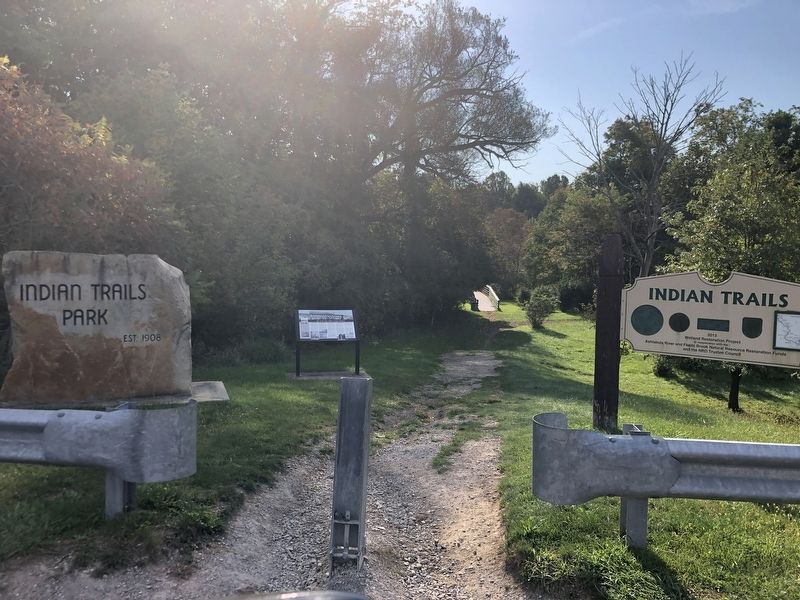
Photographed by Duane and Tracy Marsteller, October 6, 2024
2. Site of the 1876 Train & Bridge Disaster Marker
The Agony
Those living near the accident heard the crashing of the cars as one by one they fell on top of each other or landed in the snow and ice. As rescuers from the community approached the scene, they could hear the screams. The all wood cars used wood burning stoves for heat with lighting provided by oil lamps hung from the ceiling and walls. This combination created an instant inferno. Fires had started at the east and west ends of the accident. Small at first, the flames quickly grew to consume everything in its path.
Rescuers who had slid down the snowy hillsides begged the firemen to apply their water pump on the scene and fill their water buckets. But for reasons never clarified, the order was not given by the fire chief, G.A. Knapp, to apply water.
One young, single woman from Rippon, Wisconsin, Marion Shepard, quickly earned the title of “Angel of the Accident.” She was one of the very few who were unharmed. She got out of her passenger car and helped pull others out, even
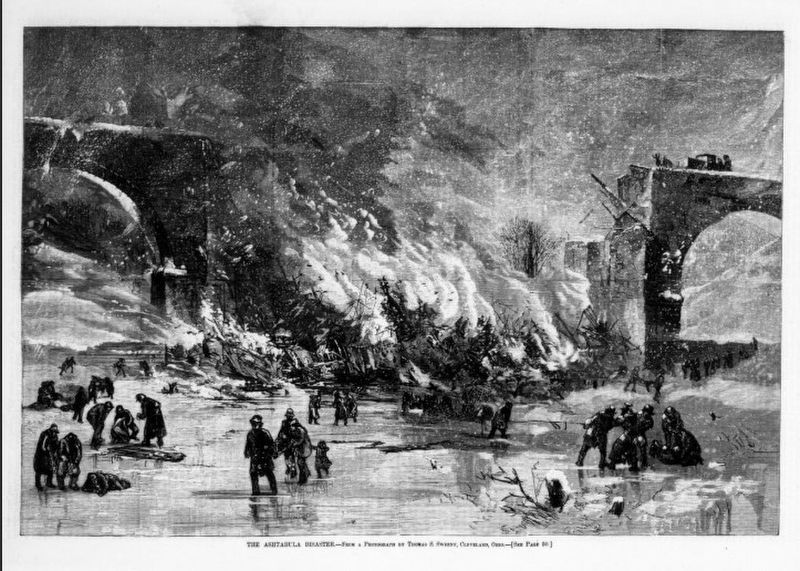
Harper's Weekly (January 20, 1877) via Internet Archive (Public Domain)
3. Woodcut Depicting the Disaster Scene
With winds at 20-50 miles an hour, thirty two inches of snow and temperatures between 17-20 degrees, the wind chill has been estimated at as much as 36 below zero down in the gorge. The victims either died from freezing, burning, drowning or crushing.
Those rescued were taken to the Eagle Hotel, the Ashtabula Hotel, bars and private homes. The body parts were put together in boxes. Identification continued for months as families wrote descriptions of their loved one to the coroner of Ashtabula.
Doctors arrived by train from Cleveland several hours later. Two babies were born that night. Among the dead were the newlyweds returning from their Niagara Falls honeymoon, Philip and Lucy Bliss, and Mary R. Birchard, first cousin to United States President-elect, Rutherford B. Hayes and many others.
The Aftermath
An inquest was held immediately with the blame of the bridge
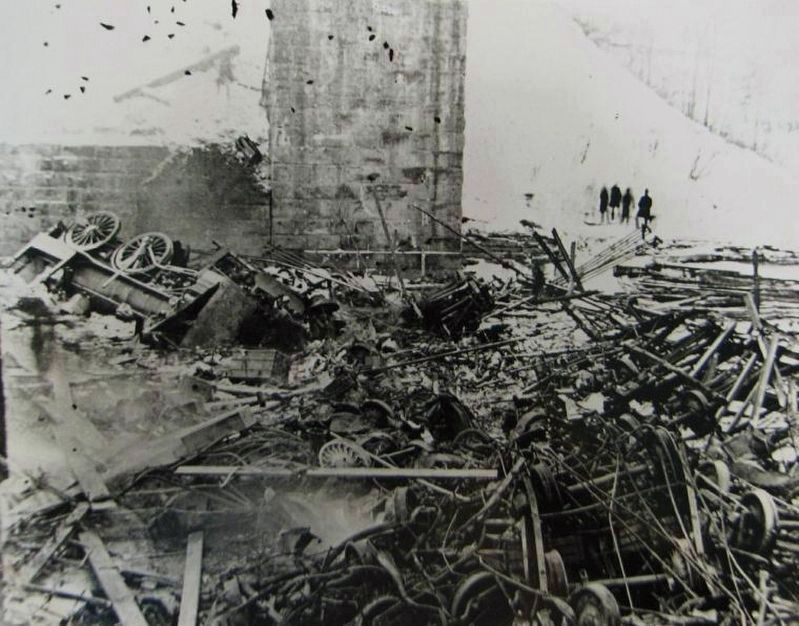
J.M. Greene (Public Domain), December 30, 1876
4. Wreckage of the Pacific Express #5
The locomotive “Columbia” lies amid the crushed and charred remains of the 13-car passenger train.
Charles Collins, railroad engineer, testified to the Ohio Legislative Committee that he felt the bridge was experimental. He was extremely distraught over the community's accusations. Several days after testifying, he was found dead in Cleveland at his home.
Although at first declared a suicide, his body was exhumed a year and a half later and after examination, it was declared a murder by the medical team. The subsequent detective work never uncovered the murderer.
Without a local hospital, homes and businesses took in the injured and dying. The community saw the need of a local hospital and in 1882 the first crude small hospital became the forerunner of today's Ashtabula County Medical Center, located not far from the disaster site. An historical state marker is located at the southernmost point of the hospital parking lot on Lake Ave. In the James Smith garden in front of the hospital entrance is a kiosk which tells the story of the disaster. On display on the lower floor of the Hubbard House Underground Railroad Museum
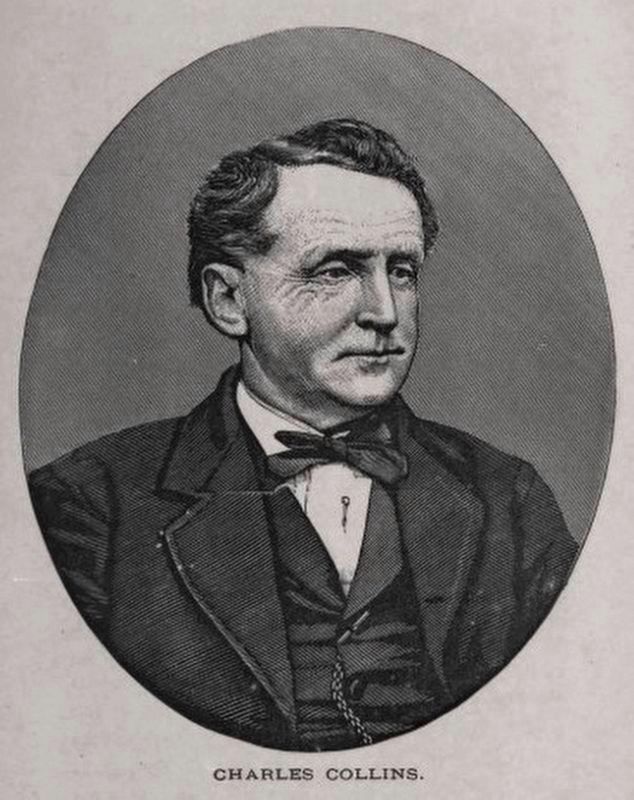
The Ashtabula Disaster, Rev. Stephen D. Peet (1877) via Internet Archive (Public Domain)
5. Charles Collins
In 1895, nineteen years after the disaster, a large monument was dedicated to mark the grave of the remains of the unrecognized dead. It is located in Chestnut Grove Cemetery off Main Ave. at the end of Grove St. Nearby is the large mausoleum of Charles Collins.
The Accountability
Ashtabula's fire chief, G.A. Knapp, was fired. The new chief turned the fire company into a highly trained fire protection company. New railroad safety measures were implemented. Cast iron components in bridge construction were never used again. In 1877, national bridge building standards and tests were created and regular bridge inspections were performed. In 1893, the “Safety Appliance Act” was passed by Congress mandating triple valve air brakes on all trains as well as an improved knuckle coupler.
Most states passed anti-stove laws forcing railroads to convert to steam heat and get rid of the stoves that caused so many fires after crashes.
As of 2014, two books have been written on the Ashtabula disaster. A local pastor at the time of the accident,
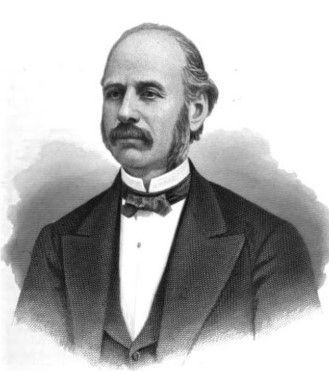
Magazine of Western History, December 1885; via Google Books (Public Domain)
6. Amasa Stone, Jr.
In 2003, a team of local historians and writers contributed new information and under the editorship of Dr. Thomas Corts, wrote “Bliss/Tragedy: The Ashtabula Railway-Bridge Accident of 1876 and the loss of P.P. Bliss”. As of 2014 it was in its third printing.
A large number of disaster artifacts have been uncovered by local hunters including David Tobias who has an extensive collection often on display which includes pocket watches, jewelry, buttons, parts of purses, gold and silver coins and parts of the train.
The depot in which family and friends waited on the night of the disaster has been replaced with the present one. The bridge you can see closest to this spot is a new bridge placed on the original abutments. Trains still pass in regular intervals throughout the day and the sound of their approach continues to remind those who hear it of the horror that awaited those on board the “Pacific Express #5” as they crossed the deep gorge that fateful night of December 29, 1876.
Topics. This historical marker is listed in these topic lists: Bridges & Viaducts • Disasters • Railroads & Streetcars. A significant historical date for this entry is December 29, 1876.
Location. 41° 52.977′ N, 80° 47.621′ W. Marker is in Ashtabula, Ohio, in Ashtabula County. It is on East 24th Street 0.2 miles east of Harbor Avenue, on the left when traveling south. Marker is located at the Indian Trails Park trailhead. Touch for map. Marker is at or near this postal address: 115 E 24th St, Ashtabula OH 44004, United States of America. Touch for directions.

Regionally, this marker is on the Lake Erie Shore and in the Western Reserve. It is also in the American Midwest. Globally, it is in North America, on the Great Lakes, in the Western Hemisphere, in the Western World, and in the Anglosphere. Historically, it finds itself in what was once the Haudenosaunee (Iroquois) Confederacy, the territory of the Mississippian Culture, and the Northwest Territory.
Other nearby markers. At least 8 other markers are within 2 miles of this marker, measured as the crow flies: Ashtabula Train Disaster (approx. ¼ mile away); Mother of Sorrows Church (approx. one mile away); First Presbyterian Church of Ashtabula, Ohio (approx. 1.1 miles away); 1147 (approx. 1.2 miles away); 1116 (approx. 1.2 miles away); 1123 (approx. 1.2 miles away); 1135 (approx. 1.2 miles away); 1104 (approx. 1.2 miles away). Touch for a list and map of all markers in Ashtabula.
Also see . . . The Ashtabula Disaster. Digitized copy of Rev. Stephen Peet's 1877 book on the catastrophe. (via Internet Archive) (Submitted on December 4, 2024, by Duane and Tracy Marsteller of Murfreesboro, Tennessee.)
Credits. This page was last revised on December 4, 2024. It was originally submitted on December 4, 2024, by Duane and Tracy Marsteller of Murfreesboro, Tennessee. This page has been viewed 567 times since then and 141 times this year. Photos: 1, 2, 3, 4, 5, 6. submitted on December 4, 2024, by Duane and Tracy Marsteller of Murfreesboro, Tennessee.
