Schießhaus in Bayreuth, Bavaria, Germany — Central Europe
Mehrere Komponisten: Meyerbeer Bruckner und die Strauß-Kapelle
Several composers: Meyerbeer Bruckner and the Strauss Chapel
Photographed by James Hulse, October 2, 2024
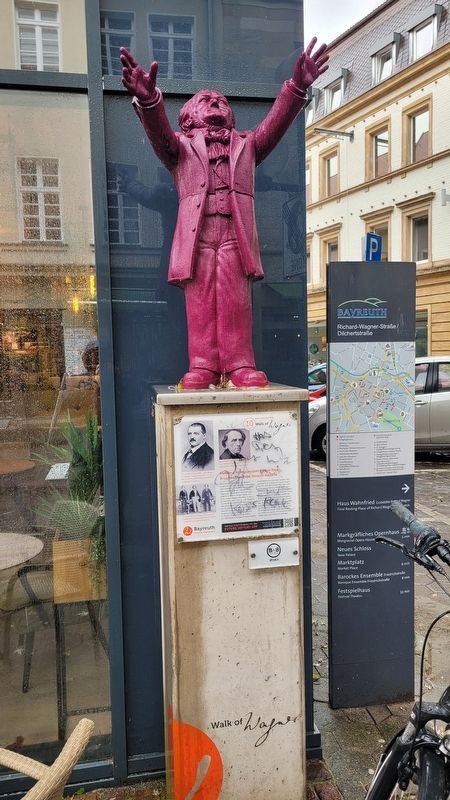
1. Mehrere Komponisten: Meyerbeer Bruckner und die Strauß-Kapelle Marker

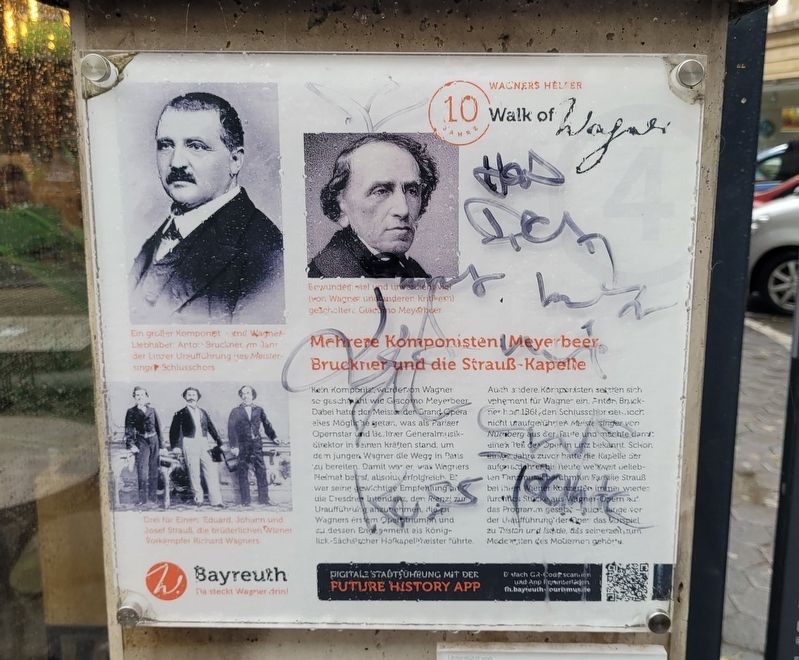
Kein Komponist, wurde von Wagner so geschadet wie Giacomo Meyerbeer. Dabei hatte der Meister der Grand Opera alles Mögliche getan, was als Pariser Opernstar und Berliner Generalmusikdirektor in seinen Kräften stand, um dem jungen Wagner die Wege in Paris zu bereiten. Damit war er, was Wagners Heimat betraf, als Solist erfolgreich. Er war seine gewichtige Empfehlung für die Dresdner Intendanz, den Rienzi zur Uraufführung anzunehmen, die zu Wagners erstem Operntriumph und zu dessen Engagement als Königlich-Sächsischer Hofkapellmeister führte.
Auch andere Komponisten setzten sich vehement für Wagner ein. Anton Bruckner hielt 1836 den Schlusschor des noch nicht uraufgeführten Meistersinger von Nürnberg aus der Partitur und machte damit einen len der Oper in Linz bekannt. Schon einie Jahre zuvor hatte die Kapelle der aufgen omdohrer er bis heute we weit Beliebten Tanzmusik bertuhmton Familie Strauß bei ihren Wiener Konzerten immer wieder furchtles Stücke aus Wagner-Opern auf das Programm gesetz auch lange vor der Uraufführung der Oper das Vorspiel zu Tristan und Isolde, das seinerzeit, zum Modernsten des Musikdramas
this page online
Bildunterschriften
(Foto Nr. 1) Ein großer Komponist und Wagner-Liebhaber: Anton Bruckner, im Jahr der Linzer Uraufführung des Meistersinger-Schlusschors.
(Foto Nr. 2) Drei für Einen: Eduard, Johann und Josef Strauß, die brüderlichen Wiener Vorkämpfer Richard Wagners.
(Foto Nr. 3) Bewundert viel und unverdient viel (von Wagner und anderen Kritikern) gescholtener Giacomo Meyerbeer.
Several composers: Meyerbeer Bruckner and the Strauss Chapel
No composer suffered as much harm from Wagner as Giacomo Meyerbeer. Yet the master of Grand Opera did everything in his power, as a Parisian opera star and Berlin General Music Director, to pave the way for the young Wagner in Paris. In relation to Wagner's homeland, he was successful as a soloist. It was his influential recommendation to the Dresden Intendancy to stage Rienzi that led to Wagner's first operatic triumph and his appointment as Royal Saxon Court Conductor.
Other composers also advocated vehemently for Wagner. In 1836, Anton Bruckner took the final chorus of the not-yet-premiered Meistersinger von Nürnberg from the score and made a part
Photographed by James Hulse, October 2, 2024
2. Mehrere Komponisten: Meyerbeer Bruckner und die Strauß-Kapelle Marker
Captions
(Photo #1) A great composer and Wagner enthusiast: Anton Bruckner, in the year of the Linz premiere of the Meistersinger final chorus.
(Photo #2) Three for one: Eduard, Johann, and Josef Strauss, the brotherly Viennese champions of Richard Wagner.
(Photo #3) Much admired and, undeservedly, much criticized (by Wagner and other critics): Giacomo Meyerbeer.
Erected by Bayreuth Da steckt Wagner drinl.
Topics. This historical marker is listed in this topic list: Arts, Letters, Music. A significant historical year for this entry is 1836.
Location. Marker has been permanently removed. It was located near 49° 56.567′ N, 11° 34.81′ E. Marker was in Bayreuth, Bayern (Bavaria). It was in Schießhaus. It was at the intersection of Richard-Wagner-Straße and Dilchertstraße, on the right when traveling east on Richard-Wagner-Straße. Touch for map. Marker was at or near this postal address: Richard-Wagner-Straße 19, Bayreuth BY 95444, Germany.
We have been informed that this marker is no longer there and will not be replaced. This page is an archival view of what was.
Regionally, this marker was in German Franconia. Globally, it was in Europe, the European Union, Atlantic Europe, Central Europe, the Schengen Area, Western Europe, and the Western World. Historically, it found itself in what was once the Holy Roman Empire and also the former West Germany.

Other nearby markers. At least 8 other markers are within
Photographed by James Hulse, October 2, 2024
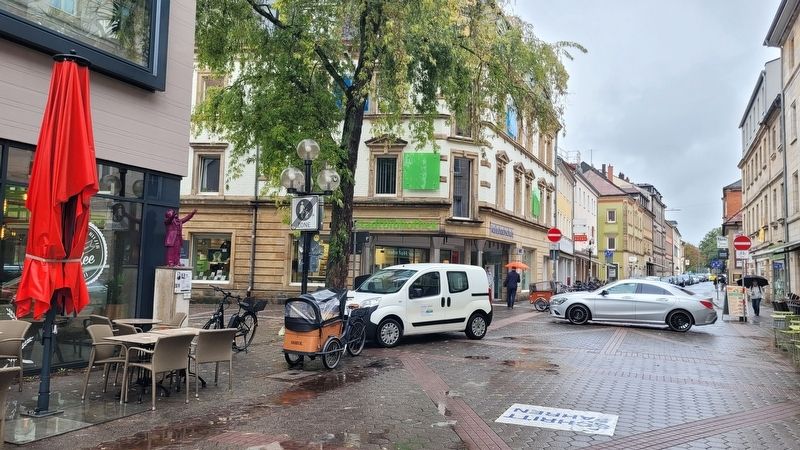
3. The view of the marker from the street
Another marker is no longer nearby. Drei Schweizer/Three Swiss: Sulzer, Müller, Ott-Usteri (was about 180 meters away but has been permanently removed).
Photographed by James Hulse, May 29, 2025
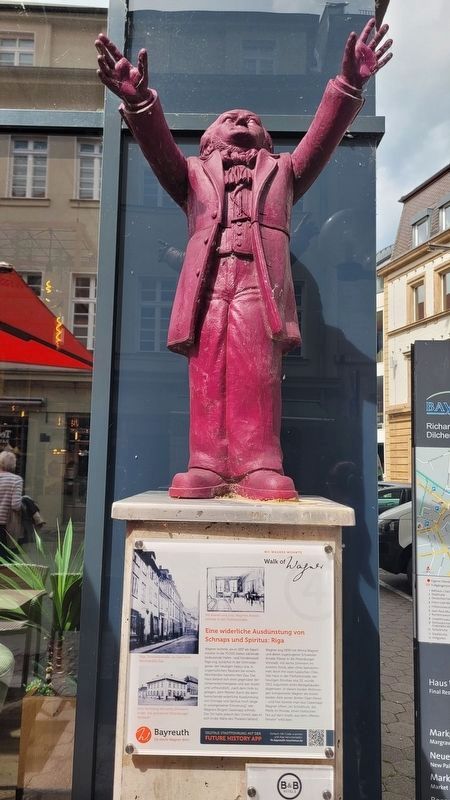
4. Marker replaced with new different marker
Credits. This page was last revised on June 16, 2025. It was originally submitted on December 4, 2024, by James Hulse of Medina, Texas. This page has been viewed 117 times since then and 31 times this year. Photos: 1, 2, 3. submitted on December 13, 2024, by James Hulse of Medina, Texas. 4. submitted on June 16, 2025, by James Hulse of Medina, Texas.
