
Weesp in Amsterdam, North Holland, Netherlands — Northwestern Europe
“Ze waren gewoon ineens weg”
⎯⎯⎯
“They were just suddenly gone”
Photographed by Andrew Ruppenstein, October 26, 2024
1. “Ze waren gewoon ineens weg” / “They were just suddenly gone” Marker

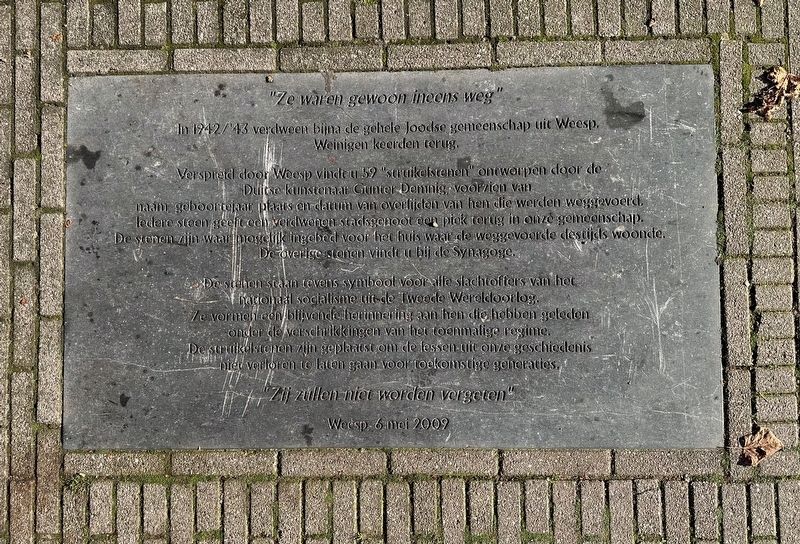
In 1942/43 verdween bijna de gehele Joodse gemeenschap uit Weesp. Weinigen keerden terug.
Verspreid door Weesp vindt u 59 "struikelstenen" oneworpen door de Duitse kunstenaar Gunter Demnig, voorzien van naam, geboortejaar, plaats en datum van overlijden van hen die werden weggevoerd. Iedere steen geeft een verdwenen stadsgenoot den plek terug in onze gemeenschap. De stenen zijn waar mogelijk ingebed voor het huis waar de weggevoerde destijds woonde. De overige stenen vindt u bij de Synagoge.
De stenen staan tevens symbool voor alle slachtoffers van het nationaal socialisme uit de Tweede Wereldoorlog. Ze vormen een blijvende herinnering aan hen die hebben geleden onder de verschrikkingen van het toenmalige regime. De struikelstenen zijn geplaatst om de lessen uit onze geschiedenis niet verloren te laten gaan voor toekomstige generaties.
“Zij zullen niet worden vergeten”
(English translation:)
“They were just suddenly gone”
In 1942-43 almost the entire Jewish community disappeared from Weesp. Few returned.
Spread throughout Weesp you will find 59 "stumbling
this page online
The stones also symbolize all victims of National Socialism during the Second World War. They are a lasting reminder of those who suffered under the horrors of the regime at the time. The stumbling stones were placed so that the lessons of our history will not be lost to future generations.
“They will not be forgotten”
Erected 2009.
Topics and series. This memorial is listed in this topic list: War, World II. In addition, it is included in the Stolpersteine, and the The Holocaust series lists. A significant historical date for this entry is April 29, 1942.
Location. 52° 18.49′ N, 5° 2.496′ E. Memorial is in Weesp, Noord-Holland (North Holland), in Amsterdam. It is on Nieuwstraat, on the right when traveling north. Touch for map. Memorial
Photographed by Andrew Ruppenstein, October 26, 2024
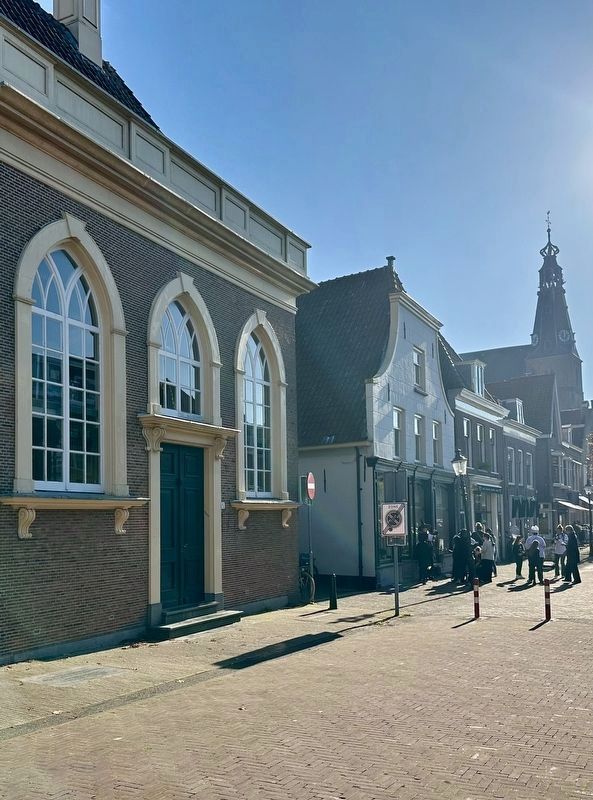
2. ““They were just suddenly gone” Marker - wide view, looking south on Nieuwstraat
The marker is visible here, set in the pavement just to the left of the entrance of the Weesp Synagogue. Thirteen stolpersteins are also (barely) visible, set in the the pavement directly in front of the door. Despite the name, they are actually made of bronze, and so their coloration generally makes them difficult to see from any distance.

Regionally, it is in Europe, the European Union, Atlantic Europe, the Benelux Low Countries, the Schengen Area, Western Europe, and the Western World. Historically, it finds itself in what was once the Holy Roman Empire.
Other nearby markers. At least 8 other markers are within walking distance of this marker: Joseph Mozes Rood (here, next to this marker); Moses Salomon Rood (here, next to this marker); Philip Simon de Vries (here, next to this marker); Rachel Philip de Vries (here, next to this marker); Barend Brilleslijper (here, next to this marker); Sara Brilleslijper-Boot (here, next to this marker); Levie Brilleslijper (here, next to this marker); Louise Brilleslijper-de Magtige (here, next to this marker). Touch for a list and map of all markers in Weesp.
Also see . . . The Synagogue in Weesp and Masorti Almere-Weesp (Masorti Almere-Weesp). Excerpt:
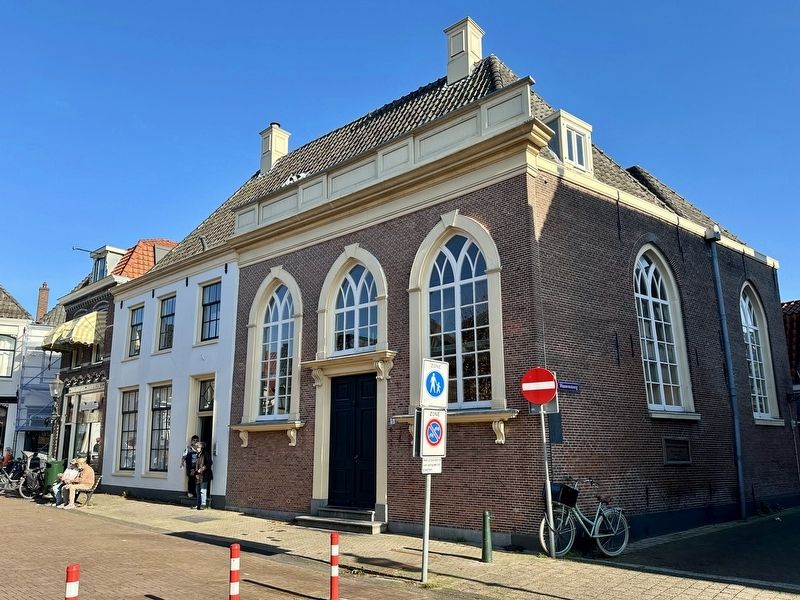
On 29 April 1942, all the Jews in Weesp were ordered to relocate to Amsterdam to await transport to Westerbork, the Dutch transit camp to(Submitted on December 4, 2024.)the extermination camps. Mr. Bouhuijs, headmaster of a local primary school, was the only person in town to raise his voice against the deportation and as a result he lost his job.Photographed by Andrew Ruppenstein, October 26, 20243. Weesp Synagogue and marker
After the war ended in 1945, only six people from the Weesp Jewish community survived. They returned to Weesp briefly but settled elsewhere….
Additional keywords. struikelsteen
Credits. This page was last revised on December 4, 2024. It was originally submitted on December 4, 2024, by Andrew Ruppenstein of Lamorinda, California. This page has been viewed 93 times since then and 6 times this year. Photos: 1, 2, 3. submitted on December 4, 2024, by Andrew Ruppenstein of Lamorinda, California.
