
Sentrum in Oslo, Norway — Northern Europe (a Nordic Country in Scandinavia)
Svaret 1891-1906
⎯⎯⎯
The Answer, 1891-1906
Photographed by Andrew Ruppenstein, July 11, 2024
1. Svaret 1891-1906 / The Answer, 1891-1906 Marker

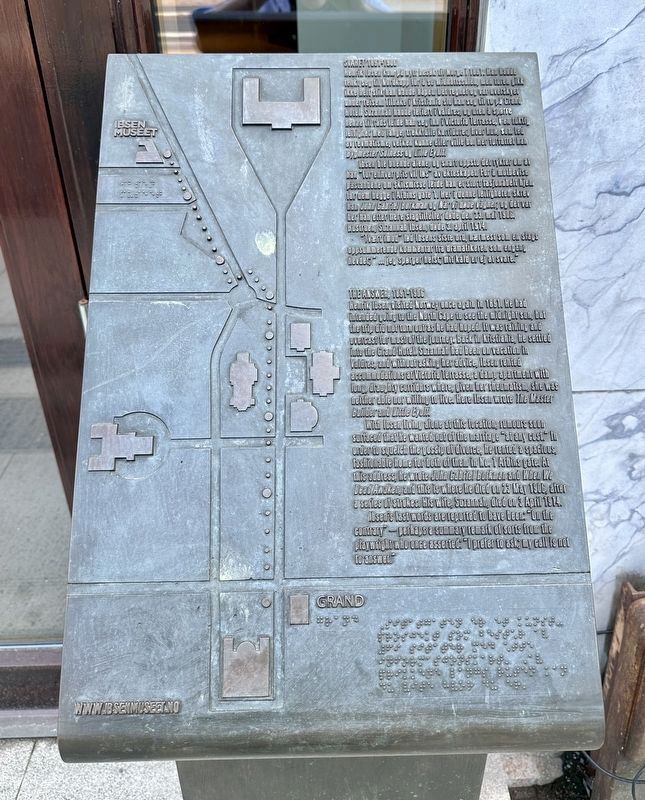
Henrik Ibsen kom på nytt besøk til Norge i 1891. Han hadde tenkt seg til Nordkapp for å se midnattssolen, men turen gikk ikke helt slik han hadde håpet. Det regnet og var overskyet under reisen. Tilbake i Kristiania slo han seg til to på Grand Hotel. Suzannah hadde feriert i Valdres, og uten å spørre henne til råds leide han seg inn i Victoria Terrasse, i en fuktig leilighet med lange, trekkfulle korridorer, hvor hun, som led av revmatisme, verken kunne eller ville bo. Her forfattet han Bygmester Solness og Lille Evolf.
Ibsen ble boende alene, og snart oppsto det rykter om at han "for enhver pris vil løs" av ekteskapet. For å motbevise påstandene om skilsmisse leide han et stort fasjonabelt hjem for dem begge i Arbins gate 1. Her i denne leiligheten skrev han John Gabriel Borkman og När vi døde vågner, og det var her han etter flere slagtilfeller døde den 23. mai 1906. Hustruen, Suzannah Ibsen, døde 3. april 1914.
"Tvært imod led Ibsens siste ord, nærmest som en slags oppsummerende kommentar fra dramatikeren som engang hevdet; "... jeg spørger helst, mit kald er ej at svare.”
Henrik
this page online
With Ibsen living alone at this location, rumours soon surfaced that he wanted out of the marriage "at any cost.” In order to squelch the gossip of divorce, he rented a spacious, fashionable home for both of them in No. 1 Arbins gate. At this address, he wrote John Gabriel Berkman and When We Dead Awaken, and this is where he died on 23 May 1906, after a series of strokes. His wife, Suzannah, died on 3 April 1914.
Ibsen's last words are reported to have been: "On the Contrary perhaps a summary remark of sorts from the playwright who once asserted: "I prefer to ask; my

Photographed by Andrew Ruppenstein, July 11, 2024
2. Svaret 1891-1906 / The Answer, 1891-1906 Marker - wide view
Erected by Ibsen Museet.
Topics. This historical marker is listed in this topic list: Arts, Letters, Music. A significant historical date for this entry is May 23, 1906.
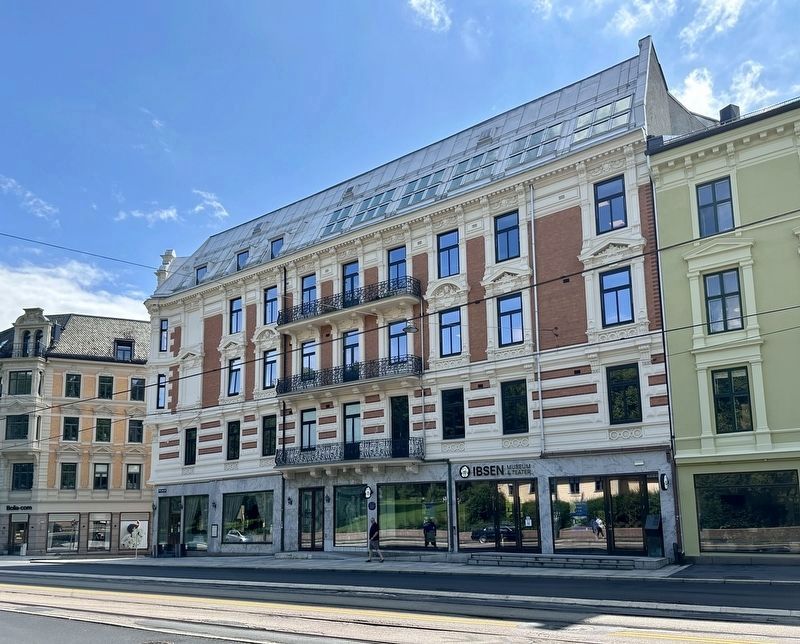
Location. 59° 54.911′ N, 10° 43.61′ E. Marker is in Oslo. It is in Sentrum. It is on Henrik Ibsens gate, on the right when traveling east. The marker is out in front of the Ibsen Museum and Theatre. It is the last of 8 Ibsen-related markers running from the National Theatre to this location. Touch for map. Marker is at or near this postal address: Henrik Ibsens gate 26, Oslo 0255, Norway. Touch for directions.

Regionally, it is in the North Atlantic Region, on the Atlantic Arc, in Europe, in Atlantic Europe, in Scandinavia, in the Nordic Countries, in the Schengen Area, and in the Western World.
Other nearby markers. At least 8 other markers are within walking distance of this marker: Henrik Ibsen (a few steps from this marker); Slottsparken / Palace Park (within shouting distance of this marker); Oslo Sjømannsforening / Oslo Seamen’s Association (about 90 meters away, measured in a direct line); Harriet Backer (about 120 meters away); Bombeangrep / Bomb Attack
Photographed by Andrew Ruppenstein, July 11, 2024
3. Svaret 1891-1906 / The Answer, 1891-1906 Marker - wider view
Also see . . . Henrik Ibsen (Wikipedia). Overview:
Henrik Johan Ibsen (20 March 1828 – 23 May 1906) was a Norwegian playwright and theatre director. As one of the founders of modernism in theatre, Ibsen is often referred to as "the father of realism" and the most influential playwright of the 19th century, as well of one of the most influential playwrights in Western literature more generally. His major works include Brand, Peer Gynt, Emperor and Galilean, A Doll's House, Ghosts, An Enemy of the People, The Wild Duck, Rosmersholm, Hedda Gabler, The Master Builder, and When We Dead Awaken. Ibsen is the most frequently performed dramatist in the world after Shakespeare, and A Doll's House was the world's most performed play in 2006.(Submitted on December 4, 2024.)
Credits. This page was last revised on December 4, 2024. It was originally submitted on December 4, 2024, by Andrew Ruppenstein of Lamorinda, California. This page has been viewed 115 times since then and 18 times this year. Photos: 1, 2, 3. submitted on December 4, 2024, by Andrew Ruppenstein of Lamorinda, California.
