Schießhaus in Bayreuth, Bavaria, Germany — Central Europe
Storchenhaus
⎯⎯⎯
Stork House
Photographed by James Hulse, October 2, 2024
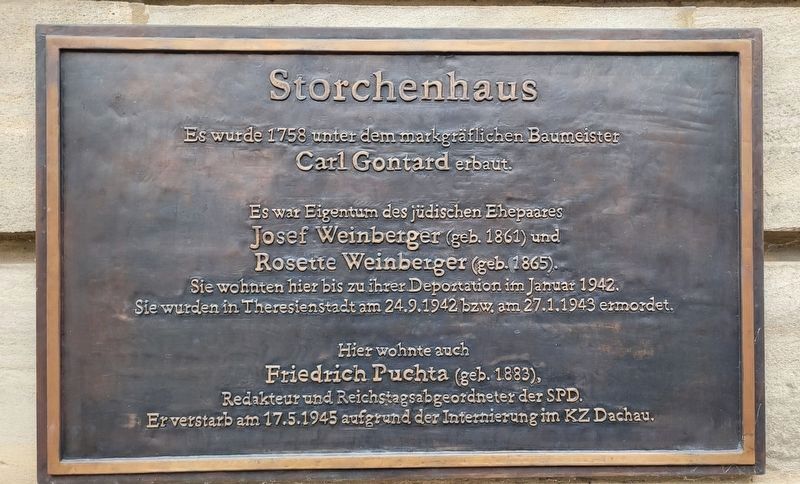
1. Storchenhaus / Stork House Marker

Es wurde 1758 unter dem markgräflichen Baumeister Carl Gontard erbaut.
Es war Eigentum des jüdischen Ehepaares Josef Weinberger (geb. 1861) und Rosette Weinberger (geb. 1865). Sie wohnten hier bis zu ihrer Deportation im Januar 1942. Sie wurden in Theresienstadt am 24.9.1942 bzw. am 27.1.1943 ermordet.
Hier wohnte auch Friedrich Puchta (geb. 1883), Redakteur und Reichstagsabgeordneter der SPD. Er verstarb am 17.5.1945 aufgrund der Internierung im KZ Dachau.
It was built in 1758 under the Margrave's master builder Carl Gontard.
It was owned by the Jewish couple Josef Weinberger (born 1861) and Rosette Weinberger (born 1865). They lived here until their deportation in January 1942. They were murdered in Theresienstadt on September 24, 1942 and January 27, 1943 respectively.
Friedrich Puchta (born 1883), editor and member of the Reichstag for the SPD, also lived here. He died on May 17, 1945 due to internment in the Dachau concentration camp.
Topics. This historical marker is listed in this topic list: War, World II. A significant historical month for this entry is January 1942.
Location. 49° 56.488′ N,
this page online

Regionally, this marker is in German Franconia. Globally, it is in Europe, the European Union, Atlantic Europe, Central Europe, the Schengen Area, Western Europe, and the Western World. Historically, it finds itself in what was once the Holy Roman Empire and also the former West Germany.
Other nearby markers. At least 8 other markers are within walking distance of this marker: Italienischer Bau / Italian Building (within shouting distance of this marker); Neues Schloss Bayreuth / New Palace Bayreuth (about 120 meters away, measured in a direct line); Ein großer Freund und Helfer: Franz Liszt / A Great Friend and Helper: Franz Liszt (about 180 meters away); Stadtkirche Heilig Dreifaltigkeit / Holy Trinity City Church (about 210 meters away); a different marker also named Stadtkirche Heilig Dreifaltigkeit / Holy Trinity City Church
Photographed by James Hulse, October 2, 2024
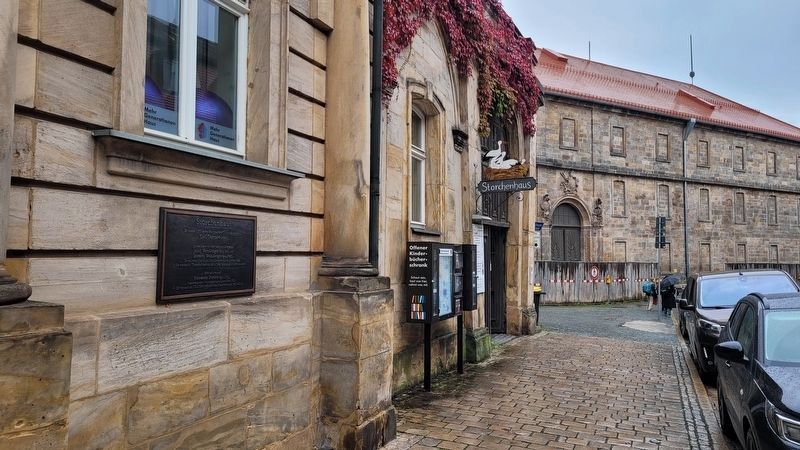
2. The view of the Marker along the building
Also see . . . Theresienstadt. Holocaust Encyclopedia
Beginning in 1942, SS authorities deported Jews from Theresienstadt to other ghettos, concentration camps, and killing centers in Nazi-occupied eastern Europe. German authorities either murdered the Jews upon their arrival in the ghettos of Riga, Warsaw, Lodz, Minsk, and Bialystok, or deported them further to killing centers. Transports also left Theresienstadt directly for the extermination camps of Auschwitz, Majdanek, and Treblinka. In the ghetto itself, tens of thousands of people died, mostly from disease or starvation. In 1942, the death rate within the ghetto was so high that the Germans built—to the south of the ghetto—a crematorium capable of handling almost 200 bodies a day. Of the approximately 140,000 Jews transferred to Theresienstadt, nearly 90,000 were deported to points further east and almost certain death. Roughly 33,000 died in Theresienstadt itself.(Submitted on December 5, 2024, by James Hulse of Medina, Texas.)
Credits. This page was last revised on December 5, 2024. It was originally submitted on December 4, 2024, by James Hulse of Medina, Texas. This page has been viewed 121 times since then and 21 times this year. Photos: 1, 2. submitted on December 5, 2024, by James Hulse of Medina, Texas.
