Rothenburg ob der Tauber in Ansbach, Bavaria, Germany — Central Europe
Blasiuskapelle und Pogromstein
⎯⎯⎯
Blasius Chapel and Memorial Stone

Photographed by James Hulse, October 4, 2024
1. Blasiuskapelle und Pogromstein / Blasius Chapel and Memorial Stone Marker

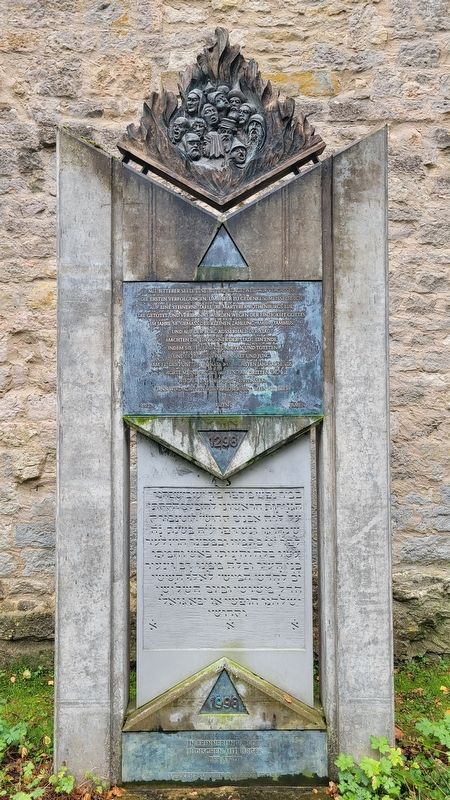
Das Denkmal erinnert an das sogenannte „Rintfleisch-Pogrom". Dieses Pogrom löschte im Juli 1298 nahezu die gesamte jüdische Gemeinde Rothenburgs aus. Mit dem Vorwurf eines angeblichen jüdischen „Hostienfrevels" zog ein verarmter Röttinger Metzger oder Scharfrichter namens „Rintfleisch" durch Franken, um Juden zu ermorden. 450 jüdische Bürger aus Rothenburg suchten auf der enemaligen Stauferburg Zuflucht. Jüdische Kinder und Erwachsene wurden von ihren christlichen Nachbarn erschlagen und verbrannt.
Ein Überlebender verfasste das hebräische Klagelied „Mit bitterer Seele eine bittere Klage...". Der Rothenburger Künstler Peter Nedwal gestaltete mit diesen Zeilen 1998 das Denkmal. Die Fundamente der Blasiuskapelle enthalten noch originale Teile der alten Stauferburg. Im Innenraum erinnert ein Gefallenendenkmal an die Toten der Weltkriege. Genannt werden auch zwei jüdische Rothenburger, die im Ersten Weltkrieg gefallen sind: Hans Löwenthal und Moritz Gottlob.
This stone commemorates the so-called 'Rintfleisch-Pogrom' which almost extinguished the entire Jewish community in July 1298. Under the
this page online
A survivor wrote the Hebrew lament: With a bitter soul a bitter lament..., with which lines, the Rothenburg artist Peter Nedwal inscribed this monument in 1998. The foundations of the chapel St. Blasius still contain original parts of the old Staufer castle. Inside a memorial is dedicated to the memory of those who died in the course of the two world wars, including two Jewish participants in WW I among them: Hans Löwenthal and Moritz Gottlob.
Erected by Following Jewish Footsteps and City of Rothenburg ob der Tauber.
Topics. This historical marker is listed in these topic lists: Religion & Religious Structures • War, World I • War, World II. A significant historical month for this entry is July 1298.
Location. 49° 22.567′ N,
Photographed by James Hulse, October 4, 2024
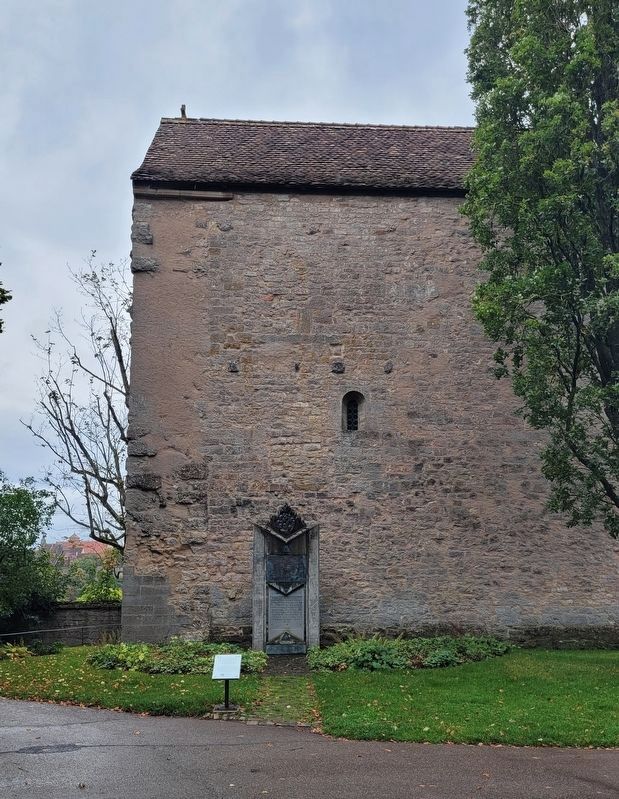
2. The Blasius Chapel, Memorial Stone and Marker
The marker is the small while marker located at the sidewalk and the Memorial Stone is next to the chapel.

Regionally, this marker is in German Franconia and on the Romantic Road. Globally, it is in Europe, the European Union, Atlantic Europe, Central Europe, the Schengen Area, Western Europe, and the Western World. Historically, it finds itself in what was once the Holy Roman Empire and also the former West Germany.
Other nearby markers. At least 8 other markers are within walking distance of this marker: Reichsburg Rothenburg ob der Tauber / Imperial Castle of Rothenburg ob der Tauber (within shouting distance of this marker); Burgtorturm / Castle Gate Tower (about 90 meters away, measured in a direct line); Turm an der Fürbringerscheune / Tower at the Fürbringer Barn (about 150 meters away); Ehemaliger Jüdischer Betsaal / The Former Jewish Prayer Hall (about 150 meters away); König Ferdinand und Kaiser Karl V / King Ferdinand and Emperor Charles V
Photographed by James Hulse, October 4, 2024
3. The Memorial Stone at the Blasius Chapel
Also see . . . Rintfleisch massacres. Wikipedia
It occurred in the Franconian region during the civil strife between the elected King of the Romans, Count Adolf of Nassau, and his Habsburg rival Duke Albert of Austria, when Imperial authority, traditionally concerned with the protection of the Jews, had temporarily collapsed. Already in 1287, the death of Werner of Oberwesel in the Rhineland had been blamed on Jews, and about 500 were killed in revenge, followed by a series of blood libels. When finally King Adolf was deposed and killed in the Battle of Göllheim on 2 July 1298, the Franconian nobility gathered at Albert's election in Frankfurt.(Submitted on December 8, 2024, by James Hulse of Medina, Texas.)
Photographed by James Hulse, October 4, 2024
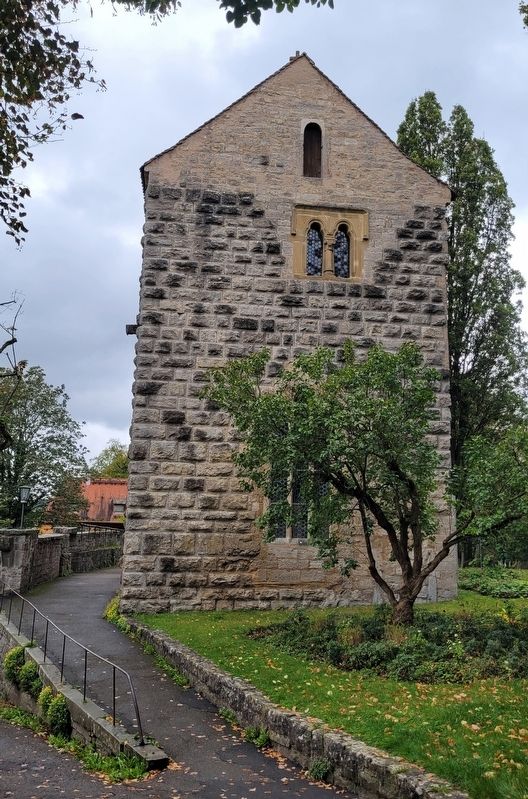
4. The Front view of the Blasius Chapel
Credits. This page was last revised on December 9, 2024. It was originally submitted on December 7, 2024, by James Hulse of Medina, Texas. This page has been viewed 279 times since then and 51 times this year. Photos: 1. submitted on December 8, 2024, by James Hulse of Medina, Texas. 2, 3, 4. submitted on December 9, 2024, by James Hulse of Medina, Texas.
