Weybridge in Addison County, Vermont — The American Northeast (New England)
Weybridge Carleton's Raid Memorial
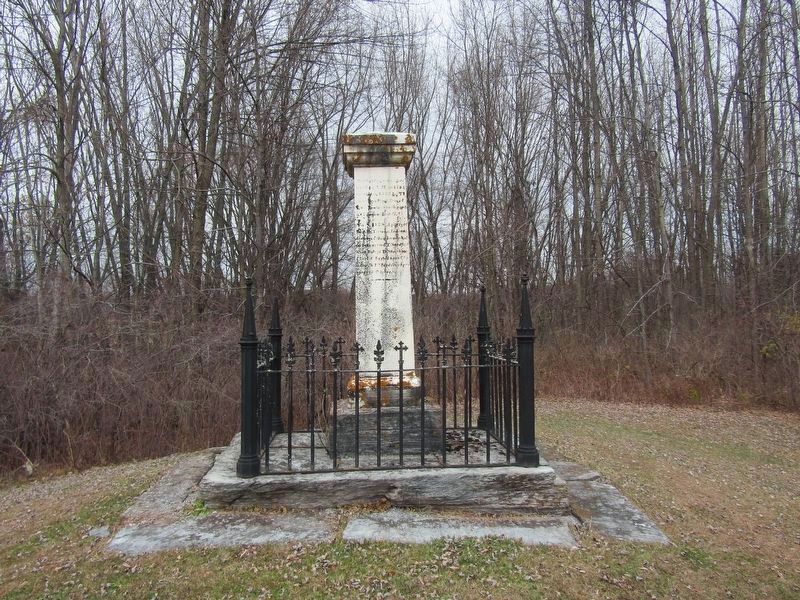
Photographed by Conrad Ward, November 30, 2024
1. Weybridge Carleton's Raid Memorial
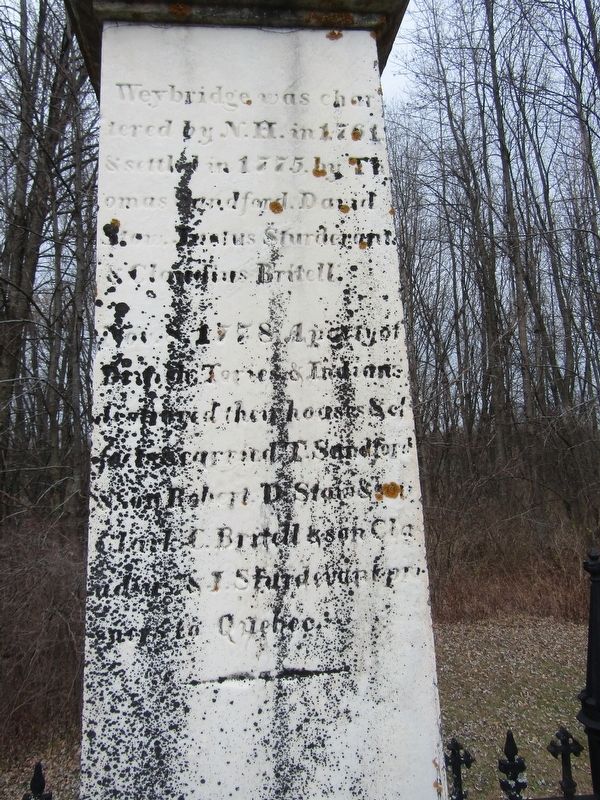
(south side)
Weybridge was chartered by N.H. in 1761 and settled in 1775 by Thomas Sandford, David Stow, Justus Sturdevant & Claudius Britell.
Nov. 8, 1778, a party of British Torries & Indians destroyed their houses and effects & carried Sandford & son, Robert D. Stow & son, Claudius C. Britell & son & J. Studevant prisons to Quebec.
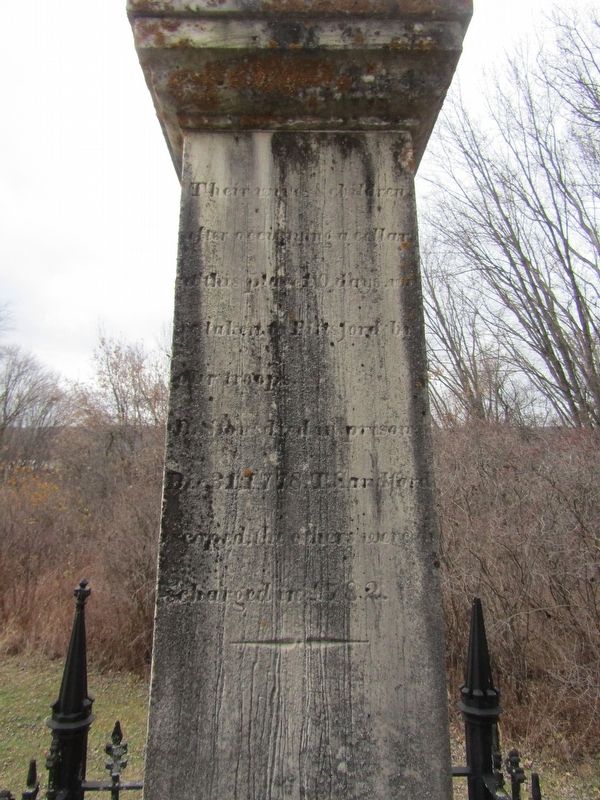
(east side)
Their wives and children, after occupying a cellar at this place for 10 days, were taken to Pittsford by our troops. D. Stow died in prison Dec. 31 1778. T. Sandford escaped. The others were discharged in 1782.
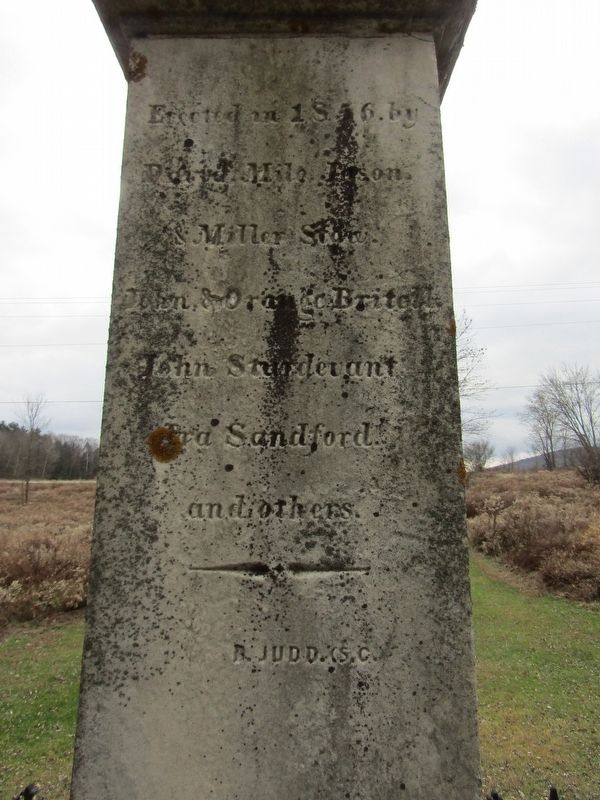
(north side)
Erected in 1856 by David, Milo, Jason and Miller Stow, John and Orange Britell, John Sturdevant, Ira Sanford and others."
[B or R] Judd S.C.
Erected 1856.
Topics. This memorial is listed in these topic lists: Settlements & Settlers • War, US Revolutionary. A significant historical date for this entry is November 8, 1778.
Location. 44° 3.811′ N, 73° 14.548′ W. Memorial is in Weybridge, Vermont, in Addison County. It is on Weybridge Road (Vermont Route 23) south of Thompson Hill Road, on the left when traveling south. Touch for map. Memorial is at or
this page online

Regionally, this memorial is in the Champlain Valley and in Greater Burlington. It is also in the American Northeast and in New England. Globally, it is in North America, the Western Hemisphere, the Western World, and the Anglosphere. Historically, it finds itself in what was once the Viceroyalty of New France and also the Vermont Republic.
Other nearby markers. At least 8 other markers are within 5 miles of this marker, measured as the crow flies: Charity and Sylvia (approx. 2.2 miles away); Silas Wright (approx. 2.3 miles away); The U.S. Government Morgan Horse Farm (approx. 3.3 miles away); War Memorial (approx. 3½ miles away); Chipman Hill (approx. 4.7 miles away); Wetland Resources (approx. 4.9 miles away); Snow Geese (approx. 4.9 miles away); The Dead Creek Wildlife Management Area (approx. 4.9 miles away). Touch for a list and map of all markers in Weybridge.
Also see . . .
1. Why is There a Marble Column in the Middle of a Field in Weybridge?.
Because something really awesome happened here.(Submitted on December 8, 2024.)Spies! Prison escapes! Duping the British army! And hunkering in a musty root cellar with only shriveled roots to eat for 10 days! It was all to avoid capture as the British raided and burned their way through Addison County, trying to ensure that the Continental Army had no supplies to fall back on when they left.Photographed by Conrad Ward, November 30, 20242. South Face
2. Weybridge Township History.
"Weybridge is watered by Otter Creek, which affords it good mill sites . . . Some parts of the town are mountainous, but the soil is generally good; the basis being limestone, it yields good crops . . . The settlement was commenced about the beginning of the revolutionary war, by David Stow and John Sanford, but the settlers were soon after dispersed or made prisoners by the enemy. The settlement was recommenced on the return of peace. The first settlers were mostly from Massachusetts."(Submitted on December 8, 2024.)
3. Carleton's Raid (Wikipedia). (Submitted on December 8, 2024.)
Photographed by Conrad Ward, November 30, 2024
3. East Face
Photographed by Conrad Ward, November 30, 2024
4. North Face

Photographed by Conrad Ward, November 30, 2024
5. Weybridge Carleton's Raid Memorial

Photographed by Conrad Ward, November 30, 2024
6. Weybridge Carleton's Raid Memorial
It is set back quite a ways from the road.
Credits. This page was last revised on December 13, 2024. It was originally submitted on December 8, 2024, by Conrad Ward of Guilford, Connecticut. This page has been viewed 379 times since then and 70 times this year. Photos: 1, 2, 3, 4, 5, 6. submitted on December 8, 2024, by Conrad Ward of Guilford, Connecticut. • Michael Herrick was the editor who published this page.
