Steinsfurt in Sinsheim in Rhein-Neckar-Kreis, Baden-Württemberg, Germany — Central Europe
Leopard 1
Photographed by James Hulse, September 24, 2024
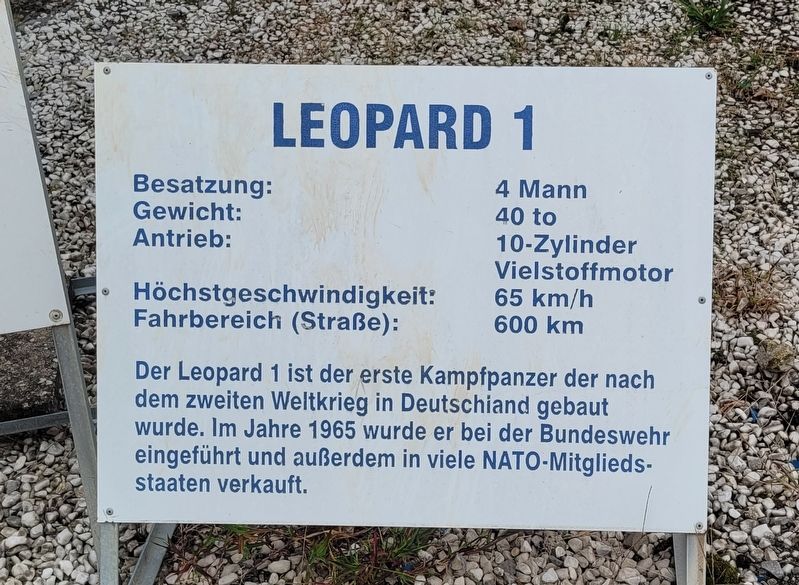
1. Leopard 1 Marker

Besatzung: 4 Mann
Gewicht: 40 to
Antrieb: 10-Zylinder Vielstoffmotor
Höchstgeschwindigkeit: 65 km/h
Fahrbereich (Straße): 600 km
Der Leopard 1 ist der erste Kampfpanzer der nach dem zweiten Weltkrieg in Deutschiand gebaut wurde. Im Jahre 1965 wurde er bei der Bundeswehr eingeführt und außerdem in viele NATO-Mitgliedsstaaten verkauft.
Crew: 4 men
Weight: 40 tons
Drive: 10-cylinder
Multi-fuel engine
Top speed: 65 km/h
Range (road): 600 km
The Leopard 1 is the first battle tank built in Germany after the Second World War. It was introduced into the German army in 1965 and was also sold to many NATO member states.
Erected by Technik Museum Sinsheim.
Topics. This historical marker is listed in this topic list: Military. A significant historical year for this entry is 1965.
Location. 49° 14.276′ N, 8° 53.798′ E. Marker is in Sinsheim, Baden-Württemberg, in Rhein-Neckar-Kreis. It is in Steinsfurt. It is at the intersection of Eberhard-Layher-Straße and In d. Au on Eberhard-Layher-Straße. The marker and the static display are located outside of Hall 1 of the Technik Museum.
this page online

Regionally, this marker is on the German Upper Rhine. Globally, it is in Europe, the European Union, Atlantic Europe, Central Europe, the Schengen Area, Western Europe, and the Western World. Historically, it finds itself in what was once the Roman Empire, the Holy Roman Empire, and the former West Germany.
Other nearby markers. At least 8 other markers are within walking distance of this marker: Schiffskanone und Panzerplatte / Ship's Cannon and Armor Plate (here, next to this marker); Schützenpanzer HS 30 / HS 30 Infantry Fighting Vehicle (here, next to this marker); T55 (a few steps from this marker); Schwere 21 cm Kanone / Heavy 21 cm Cannon (a few steps from this marker); US Kampfpanzer M48 / US M48 Battle Tank (a few steps from this marker); Marinegeschütz / Naval Gun (a few steps from this marker); US Panzerhaubitze M7B2 / US Self-Propelled Howitzer M7B2 (a few steps from this marker); Einmann-Bunker 2. Weltkrieg / One-Man Bunker World War II (a few steps from this marker). Touch for a list and map
Photographed by James Hulse, September 24, 2024
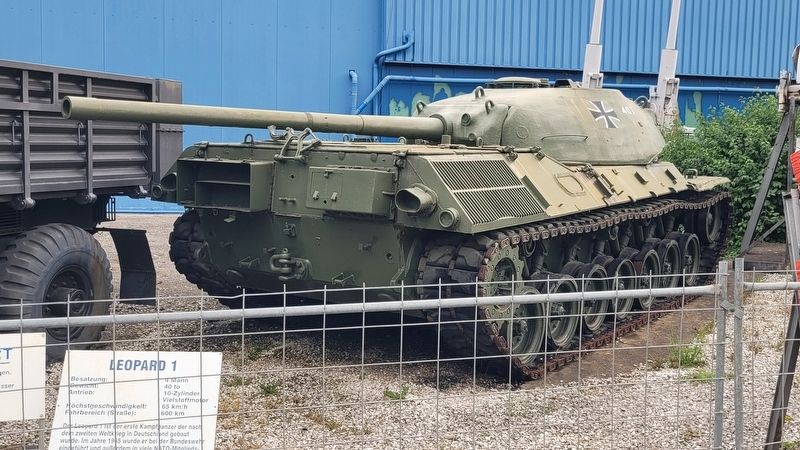
2. The Leopard 1 tank and Marker
More about this marker. The static displays and markers are located on the grounds of the Technik Museum. There is an entrance fee to visit the museum and markers.
Also see . . . Leopard 1. Wikipedia
The Kampfpanzer Leopard (styled as Kampfpanzer Leopard 1 or Leopard I after the introduction of the Leopard 2) is a main battle tank designed by Porsche and manufactured by Krauss-Maffei in West Germany, first entering service in 1965. Developed in an era when HEAT warheads were thought to make conventional heavy armour of limited value, the Leopard design focused on effective firepower and mobility instead of heavy protection. It featured moderate armour, only effective against low caliber autocannons and heavy machine guns, giving it a high power-to-weight ratio. This, coupled with a modern suspension and drivetrain, gave the Leopard superior mobility and cross-country performance compared to most other main battle tanks of the era, only being rivaled by the French AMX-30 and Swedish Strv 103. The main armament of the Leopard consisted of a German license-built version of the British Royal Ordnance L7 105 mm rifled gun, one of the most effective and widespread tank guns of the era.(Submitted on December 11, 2024, by James Hulse of Medina, Texas.)
Credits. This page was last revised on December 11, 2024. It was originally submitted on December 10, 2024, by James Hulse of Medina, Texas. This page has been viewed 120 times since then and 15 times this year. Photos: 1, 2. submitted on December 11, 2024, by James Hulse of Medina, Texas.
