
The Loop District in Chicago in Cook County, Illinois — The American Midwest (Great Lakes)
Marquette Building
Holabird and Roche, architects; 1894
| — | Chicago Landmark | — |

Photographed by Sean P. Flynn, December 11, 2024
1. Marquette Building Marker
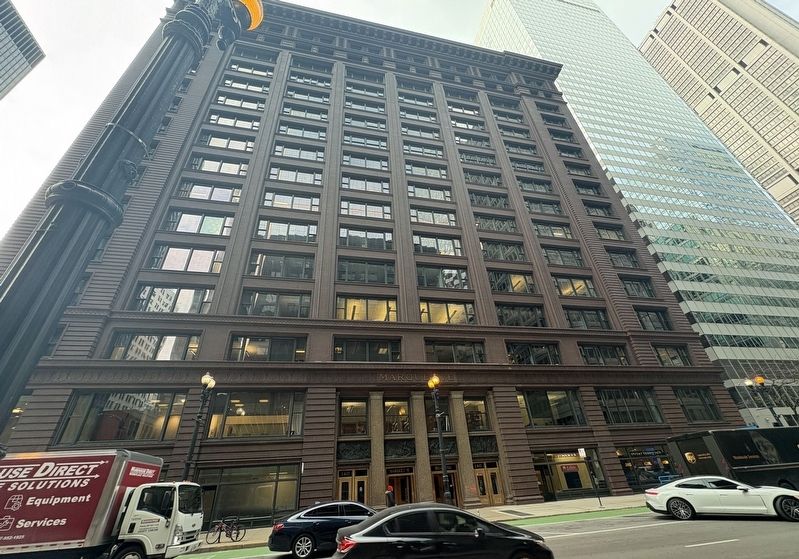
In this building, an appropriate exterior expression for the new skeleton-framed skyscraper was found. The facade clearly reveals its underlying structure with broad windows set in a framework of narrow piers and spandrels. In its open and well-lit interior layout, the Marquette significantly influenced the design of commercial structures.
Designated a Chicago Landmark on June 9, 1975 by the City Council of Chicago.
Richard J. Daley, Mayor
Erected by Commission on Chicago Historical and Architectural Landmarks.
Topics and series. This historical marker is listed in these topic lists: Architecture • Exploration • Industry & Commerce • Religion & Religious Structures. In addition, it is included in the Illinois, Chicago Landmarks Commission, and the National Historic Landmarks
this page online
Location. 41° 52.787′ N, 87° 37.777′ W. Marker is in Chicago, Illinois, in Cook County. It is in The Loop District. It is on Dearborn Street north of Adams Street. The marker is inside the Marquette Building, accessible after walking through the security desk via the Dearborn Street entrance. Touch for map. Marker is at or near this postal address: 140 South Dearborn Street, Chicago IL 60610, United States of America. Touch for directions.

Regionally, this marker is in the American Midwest. Globally, it is in North America, on the Great Lakes, in the Western Hemisphere, in the Western World, and in the Anglosphere. Historically, it finds itself in what was once the Viceroyalty of New France, the territory of the Mississippian Culture, and

Photographed by Sean P. Flynn, December 11, 2024
2. Marquette Building Marker
Other nearby markers. At least 8 other markers are within walking distance of this marker: Inland Steel Building (about 400 feet away, measured in a direct line); Inland Steel Company Building (about 400 feet away); Majestic Building and Theatre (about 400 feet away); Float by Noah MacMillan (about 500 feet away); First Jewish House of Worship (about 500 feet away); State Street (about 600 feet away); Rookery Building (about 700 feet away); Potter Palmer (about 800 feet away). Touch for a list and map of all markers in Chicago.
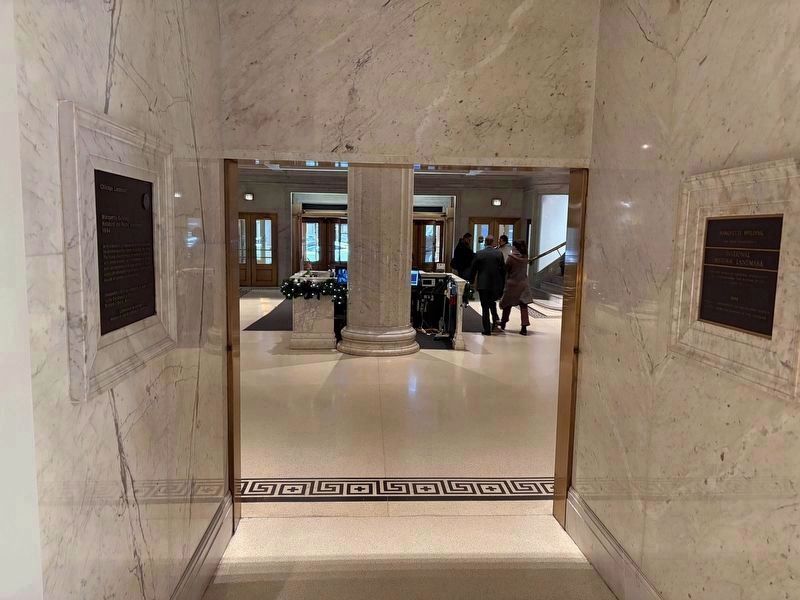
More about this marker. The marker is in a small hallway between the building's main lobby, which features glass mosaics designed by Louis Comfort Tiffany, and a small museum-like area dedicated to the history of Native Americans in the Chicago region.
Regarding Marquette Building. The
Photographed by Sean P. Flynn, December 11, 2024
3. Marquette Building Marker
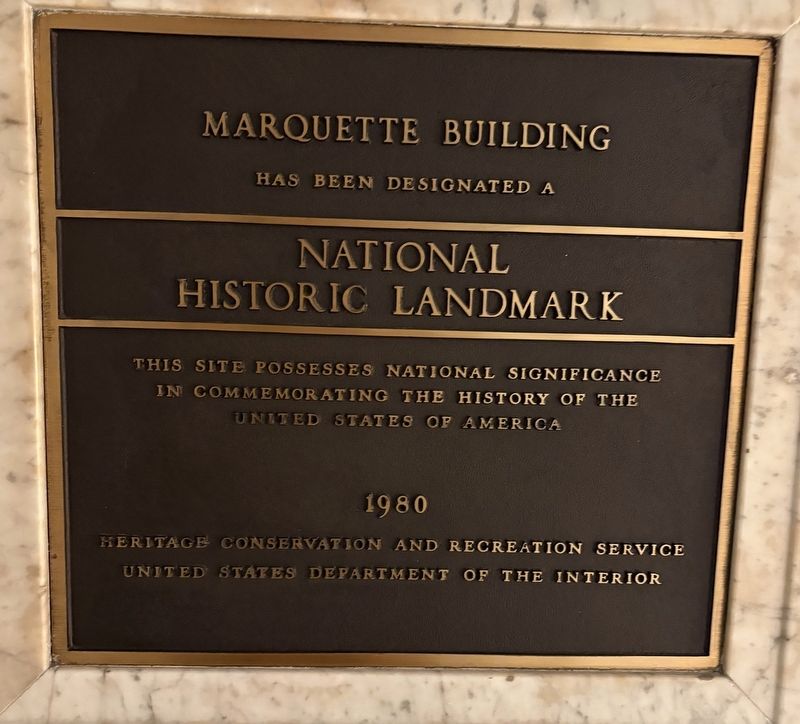
The Chicago Landmark marker is on the left; a National Historic Landmark marker is on the right. The front lobby of the building, home to Tiffany glass murals depicting the explorers Jacques Marquette and Louis Jolliet's first encounters with the Native Americans who lived in what would become the Chicago region.
For many years the building served as headquarters for several railroad lines; still an active office building, it is owned by the John D. and Catherine T. McArthur Foundation, whose headquarters are here. A small museum near the historical markers looks at the history of Native Americans
Photographed by Sean P. Flynn, December 11, 2024
4. Marquette Building National Historic Landmark plaque
In the building's central lobby, glass mosaics, designed by legendary artist Louis Comfort Tiffany, depict Fr. Marquette's first journey to the area in 1673, with fur trader Louis Jolliet. The duo traveled from Wisconsin to the Mississippi River, reaching the Arkansas River, before turning around and returning via the Illinois and Des Plaines rivers. From the Des Plaines, they "portaged" — carried their canoes over land — to the South Branch of the Chicago River, near where Fr. Marquette would camp a few years later. Jolliet is credited with suggesting after this trip that a canal could be built here to connect the Great Lakes with the Mississippi — a feat that would happen about 175 years later with the completion of the Illinois and
Photographed by Sean P. Flynn, December 11, 2024
5. Marquette Building
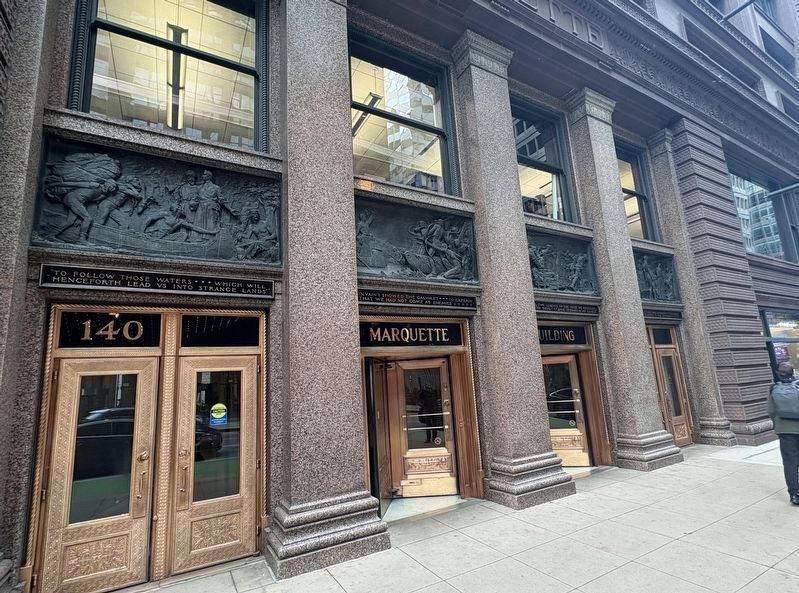
Four bronze reliefs above the Dearborn Street entry into the Marquette Building depict Fr. Marquette's 1674-75 return to the Chicago region, where he stopped en route to connecting with the Illinois Indians to set up a mission. As winter set in in December 1674, Fr. Marquette and two companions set up winter camp along the South Branch of the Chicago River, where they stayed until the March thaw flooded their camp and forced them out. Marquette resumed his journey and did eventually connect with the Illinois not far from the modern day location of Starved Rock State Park. However, he became ill, likely from dysentery he had picked up during his first journey with Jolliet. The final of the four reliefs shows Marquette's death and burial, which occurred in what today is Ludington, Michigan.
Also see . . .
1. Chicago Architecture Center: Marquette Building.
Photographed by Sean P. Flynn, December 11, 2024
6. Marquette Building bronze reliefs
Four bronze reliefs depicting Fr. Jacques Marquette's 1674-1675 visit to Chicago adorn the Dearborn entryway into the building. The final relief shows Marquette's death and burial in Michigan. Beneath each relief are quotes, listed below from left to right:
• "To follow those waters, which will henceforth lead us into strange lands."
• "In vain I showed the Calumet, to explain that we had not come as enemies."
• "Passing two leagues up the river resolved to winter there, being detained by my illness."
• "The De Profundis was intoned, the body was then carried to the church."
• "To follow those waters, which will henceforth lead us into strange lands."
• "In vain I showed the Calumet, to explain that we had not come as enemies."
• "Passing two leagues up the river resolved to winter there, being detained by my illness."
• "The De Profundis was intoned, the body was then carried to the church."
Excerpt: "Early on, the Marquette Building was wildly profitable. However, by the mid-20th century occupancy declined and the building’s owners were no longer able to afford much of its costly upkeep. In the 1950s, the original terra cotta cornice was removed. This was a common practice at the time, as it was more economical to remove decorative cornices than to restore, fix, or maintain them."(Submitted on December 12, 2024, by Sean P. Flynn of Oak Park, Illinois.)
2. Chicagology: The Winter Quarters of Father Marquette, 1674. (Submitted on December 12, 2024, by Sean P. Flynn of Oak Park, Illinois.)
Additional commentary.
1. About the marker
This marker is included as part of the Commission on Chicago Landmarks series.
— Submitted December 11, 2024, by Sean P. Flynn of Oak Park, Illinois.

Photographed by Sean P. Flynn, December 11, 2024
7. Tiffany glass mosaics in the lobby of the Marquette Building
The mosaics depict Marquette's Mississippi River voyage with fur trader Louis Jolliet in 1673.

William T. Barnum; courtesy of Chicago History Museum (ICHi-039479), circa 1925
8. Marquette Building 1925
Terra cotta ornamentation at the top of the building, visible in this 1920s-era photo, was removed in the 1950s.
Credits. This page was last revised on December 10, 2025. It was originally submitted on December 11, 2024, by Sean P. Flynn of Oak Park, Illinois. This page has been viewed 3,541 times since then and 677 times this year. Photos: 1, 2, 3, 4, 5, 6. submitted on December 11, 2024, by Sean P. Flynn of Oak Park, Illinois. 7, 8. submitted on December 12, 2024, by Sean P. Flynn of Oak Park, Illinois.
