West Helena in Phillips County, Arkansas — The American South (West South Central)
Unbroken Forest
Photographed by Cosmos Mariner, September 16, 2024
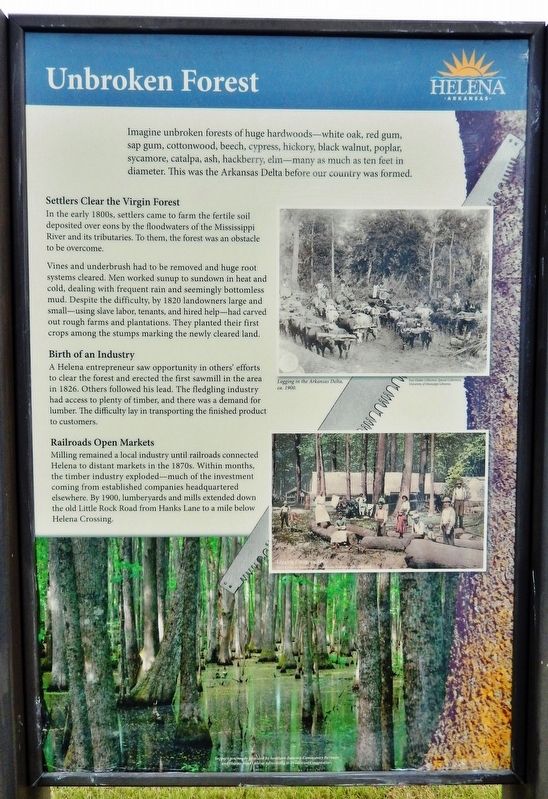
1. Unbroken Forest Marker
Imagine unbroken forests of huge hardwoods — white oak, red gum, sap gum, cottonwood, beech, cypress, hickory, black walnut, poplar, sycamore, catalpa, ash, hackberry, elm — many as much as ten feet in diameter. This was the Arkansas Delta before our country was formed.
Settlers Clear the Virgin Forest
In the early 1800s, settlers came to farm the fertile soil deposited over eons by the floodwaters of the Mississippi River and its tributaries. To them, the forest was an obstacle to be overcome.
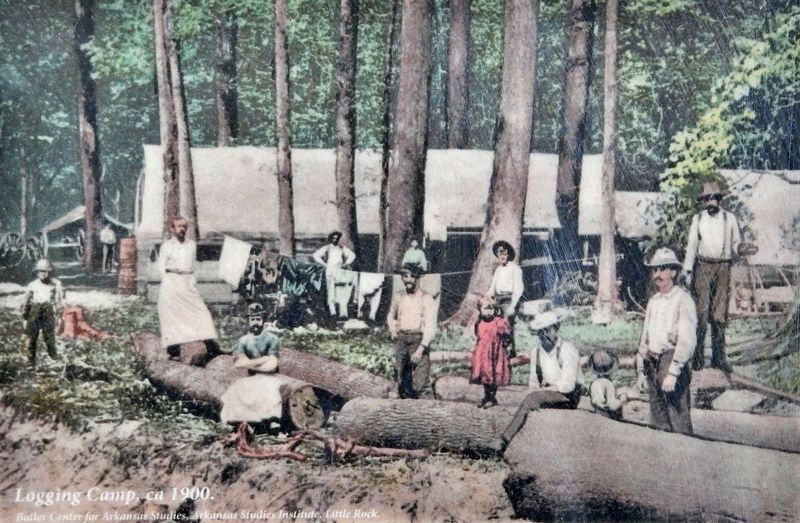
Vines and underbrush had to be removed and huge root systems cleared. Men worked sunup to sundown in heat and cold, dealing with frequent rain and seemingly bottomless mud. Despite the difficulty, by 1820 landowners large and small — using slave labor, tenants, and hired help — had carved out rough farms and plantations. They planted their first crops among the stumps marking the newly cleared land.
Birth of an Industry
A Helena entrepreneur saw opportunity in others' efforts to clear the forest and erected the first sawmill in the area in 1826. Others followed his lead. The fledgling industry had access to plenty of timber, and there was a demand for lumber. The difficulty lay in transporting the finished product to customers.
Railroads Open Markets
Milling remained a local industry until railroads connected Helena to distant markets in the 1870s. Within months, the timber industry exploded — much of the investment coming from established companies headquartered elsewhere. By 1900, lumberyards and mills extended down the old Little Rock Road from Hanks Lane to a mile below Helena Crossing.
Support generously provided by Southern Bancorp Community Partners and Helena-West Helena Advertising & Promotion Commissions.
Topics. This historical marker is listed in these topic lists: Horticulture & Forestry • Industry & Commerce
this page online
Location. 34° 32.64′ N, 90° 38.815′ W. Marker is in West Helena, Arkansas, in Phillips County. It is on Plaza Avenue 0.1 miles east of U.S. 49, on the left when traveling east. This marker is one of six interpretive panels in the Plaza Avenue median at this location. Touch for map. Marker is at or near this postal address: 57 Plaza Avenue, West Helena AR 72390, United States of America. Touch for directions.

Regionally, this marker is in the Arkansas Delta, in Crowley’s Ridge, in the Mississippi Alluvial Plain, and in the Quapaw Homeland. It is also in the American South, specifically in the Upper South, in the Mississippi Delta, and in the Great River Road Region. Globally, it is in North America, the Western Hemisphere, the Western World, and the Anglosphere. Historically, it finds itself in what was once the territory of the Mississippian Culture, the Louisiana Purchase, one of the Confederate States of America, and the Antebellum South.
Other nearby markers. At least 8 other markers are within 3 miles of
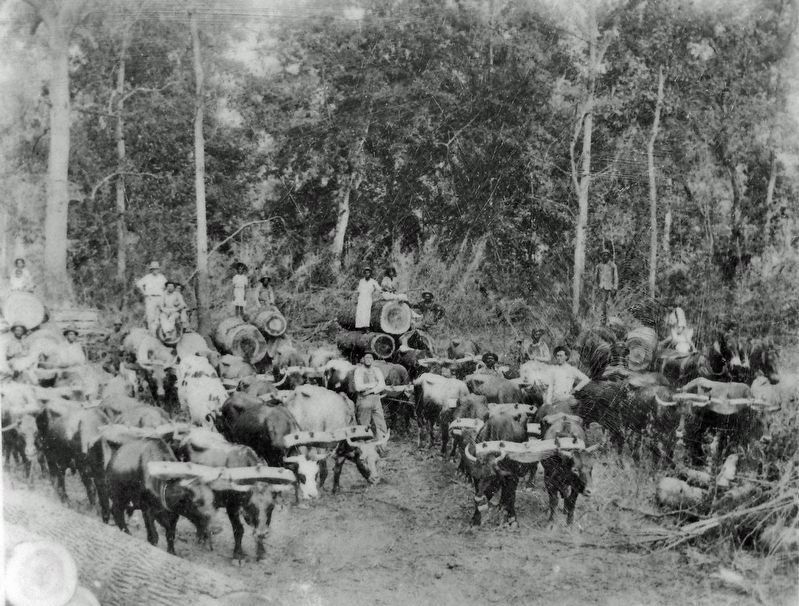
Ivey Gladin Collection, Special Collections, University of Mississippi Libraries
2. Marker detail: Logging in the Arkansas Delta, ca. 1900
Related markers. Click here for a list of markers that are related to this marker. West Helena, Arkansas
Also see . . . Timber Industry (Encyclopedia of Arkansas).
Excerpt: The timber industry in Arkansas developed in all directions after the Civil War. The industry’s development depended first upon the availability of abundant forests. From Little Rock in central Arkansas to the north, west, and south are forests and marketable timber. To the east is the Delta, where hardwood grows in the swamps and river bottoms.(Submitted on December 14, 2024, by Cosmos Mariner of Cape Canaveral, Florida.)
After the Civil War, the development of powered machinery allowed individuals to set up small sawmills. But these served only the local communities.The means to get lumber to larger, growing markets in the Northeast and the Midwest did not exist until railroad builders saw opportunity and began to extend their lines into Arkansas and Texas. Once the mainlines were in place, Northern lumber entrepreneurs began to acquire timberlands, especially in south Arkansas.Courtesy Butler Center for Arkansas Studies, Arkansas Studies Institute, Little Rock3. Marker detail: Logging Camp, ca. 1900
The relationship between railroads and the timber industry was mutually beneficial. The railroads needed cross ties and products to carry to market; the timber industry needed transportation and the mechanical skills supplied by railroad men.
Courtesy Butler Center for Arkansas Studies, Arkansas Studies Institute, Little Rock
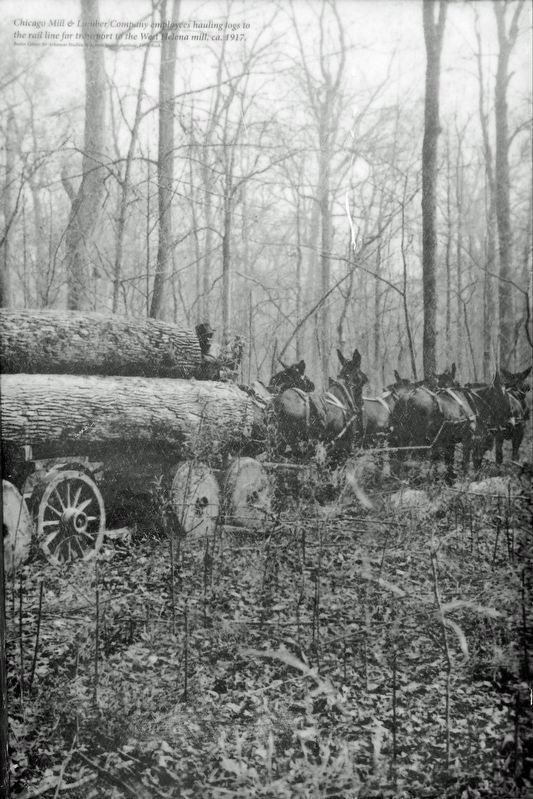
4. Marker detail: Hauling logs. ca. 1917
(photo covers backside of marker) Chicago Mill & Lumber Company employees hauling logs to the rail line for transport to the West Helena mill, ca. 1917.

Photographed by Cosmos Mariner, September 16, 2024
5. Unbroken Forest Marker
Looking west through the Plaza Avenue median; this marker is the first one from the front on the left. A restored and preserved Union Pacific caboose is on exhibit just to the west of this group of six interpretive panels.
Credits. This page was last revised on December 14, 2024. It was originally submitted on December 12, 2024, by Cosmos Mariner of Cape Canaveral, Florida. This page has been viewed 144 times since then and 20 times this year. Photos: 1, 2. submitted on December 13, 2024, by Cosmos Mariner of Cape Canaveral, Florida. 3, 4, 5. submitted on December 14, 2024, by Cosmos Mariner of Cape Canaveral, Florida.
