Gamle Oslo , Norway — Northern Europe (a Nordic Country in Scandinavia)
Bispeborgen
⎯⎯⎯
Bishop’s Castle
Photographed by Andrew Ruppenstein, July 9, 2024
1. Bispeborgen / Bishop’s Castle Marker

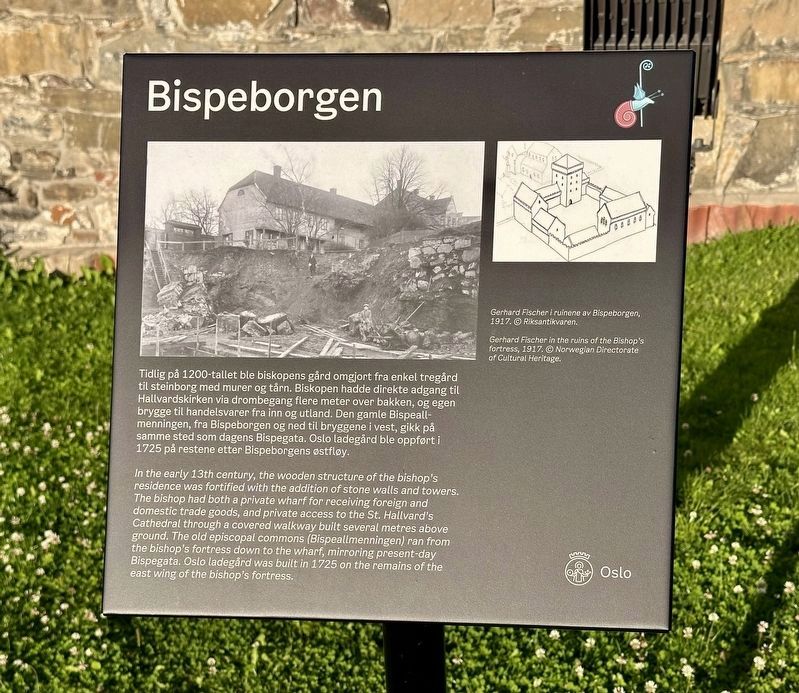
Tidlig på 1200-tallet ble bijkopend gård omgjort fra enkel tregård til steinborg med murer og tårn. Biskopen hadde direkte adgang til Hallvardskirken via drombegang flere meter over bakken, og egen brygge til handelsvarer fra inn og utland. Den gamle Bispeallmenningen, fra Bispeborgen og ned til bryggene i vest, gikk på samme sted som dagens Bispegata. Oslo ladegård ble oppført i 1725 på restene etter Bispeborgens østfløy.
In the early 13th century, the wooden structure of the bishop's residence was fortified with the addition of stone walls and towers. The bishop had both a private wharf for receiving foreign and domestic trade goods, and private access to the St. Hallvard's Cathedral through a covered walkway built several metres above ground. The old episcopal commons (Bispeallmenningen) ran from the bishop's fortress down to the wharf, mirroring present-day Bispegata. Oslo ladegård was built in 1725 on the remains of the east wing of the bishop's fortress.
Erected by Stad Oslo.
Topics. This historical marker is listed in these topic lists: Forts and Castles
this page online
Location. 59° 54.36′ N, 10° 46.042′ E. Marker is in Oslo. It is in Gamle Oslo. It can be reached from the intersection of Bispegata. The marker is on the west side of the Oslo Ladegård, accessible from Bispegata. Touch for map. Marker is at or near this postal address: Oslo gate 13, Oslo 0192, Norway. Touch for directions.

Regionally, it is in the North Atlantic Region, on the Atlantic Arc, in Europe, in Atlantic Europe, in Scandinavia, in the Nordic Countries, in the Schengen Area, and in the Western World.
Other nearby markers. At least 8 other markers are within walking distance of this marker: Oslo Ladegård / Oslo Warehouse (a few steps from this marker); Bispealmenningen (within shouting distance of this marker); Hallvardskatedralen / St. Hallvard Cathedral (within shouting distance of this marker); Olavsklosteret / St. Olaf Monastery (within shouting distance of this marker); Willy Brandt (approx. 0.4 kilometers away); Josephine Thrane (approx. 0.6 kilometers away); Pellerins Margarinfabrikk / Pellerins Margarine Factory (approx. 0.7
Photographed by Andrew Ruppenstein, July 9, 2024
2. Bispeborgen / Bishop’s Castle Marker - wide view
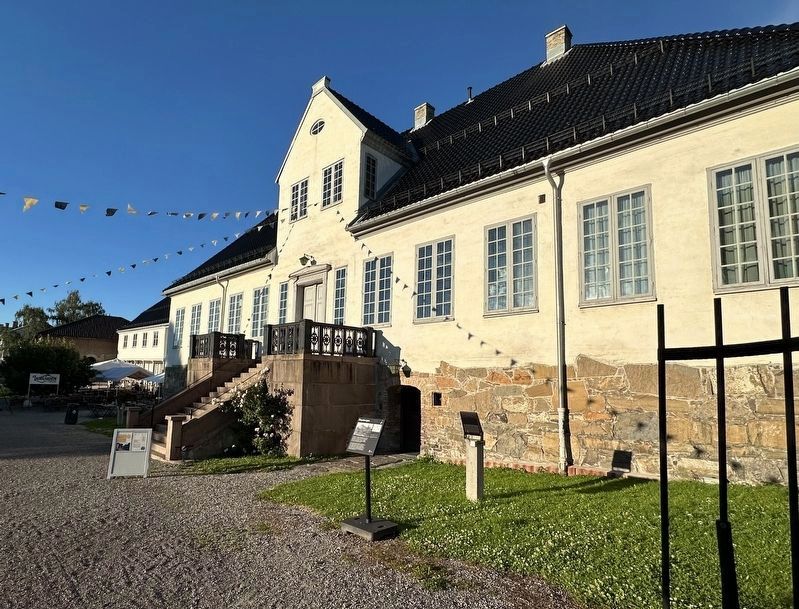
The building visible here is the Oslo Ladegård, built upon the site of the Bishop’s Castle.
Also see . . . Oslo bispeborg (lokalhistoriewiki, in Norwegian). Excerpt (in translation):
The Bishop's Castle in Oslo was the residence of the Bishop of Oslo from the 13th century until the Reformation. It was located at the square in the Old Town, and together with Hallvard Cathedral, it formed the ecclesiastical center of the capital.(Submitted on December 12, 2024.)
The castle was begun in the early 13th century by Nikolas Arnesson, replacing an older wooden bishop's palace from the early 12th century. In 1314 Oslo became the country's capital, and throughout the 14th century the castle was expanded. During this century it was completed as a closed fortification. The castle was connected to the cathedral via a bridge from the tower to the church.
Due to the position of the church in the Middle Ages, the bishop's castle was also a political center. It was here that the first union treaty with Sweden was signed in 1319, after the death of Håkon V Magnusson.
In 1523 Swedish forces attacked Oslo, and the castle was badly damaged. During the Reformation in 1537, large parts of it were demolished, and from 1554 the bishop had his residence in a wing of the closed Olav Monastery. This was later rebuilt into the Oslo Bishop's Palace. Mayor Kristen Mule took over the site in 1579 and had a Renaissance building erected there. It is known for the fact that James VI of Scotland (later James I of England) and Anne of Denmark were married there on 23 November 1589.
Credits. This page was last revised on December 12, 2024. It was originally submitted on December 12, 2024, by Andrew Ruppenstein of Lamorinda, California. This page has been viewed 117 times since then and 26 times this year. Photos: 1, 2. submitted on December 12, 2024, by Andrew Ruppenstein of Lamorinda, California.
