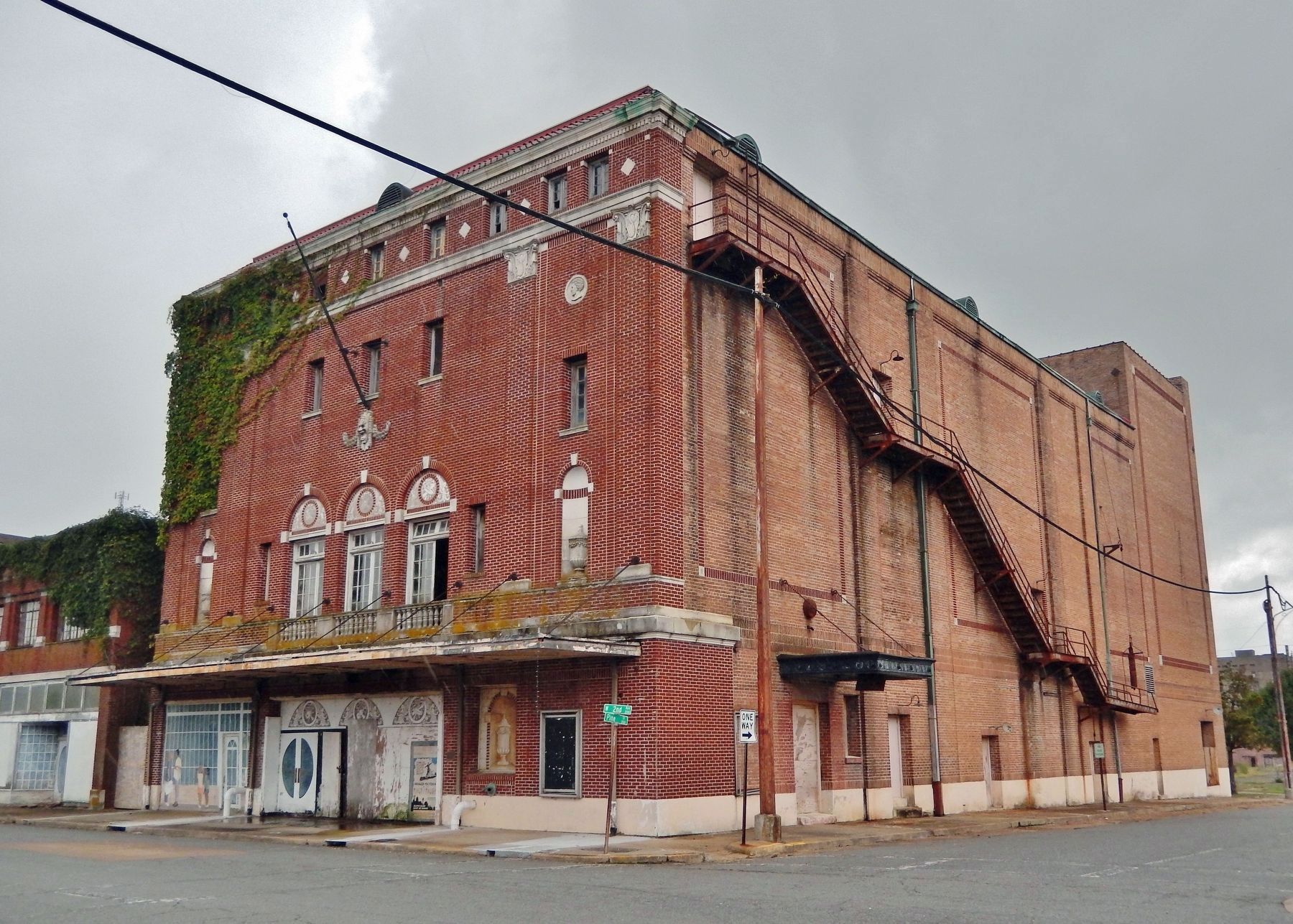
Saenger Theatre
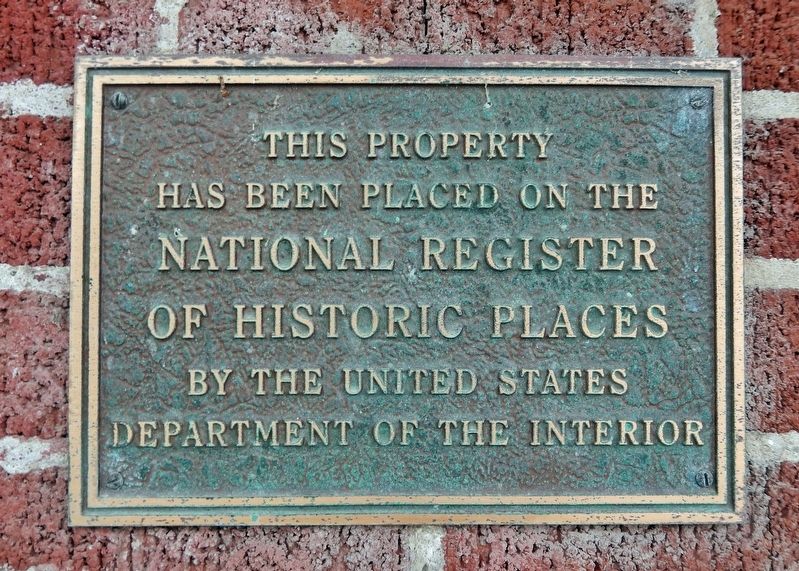
has been placed on the
National Register
of Historic Places
by the United States
Department of the Interior
Topics and series. This historical marker is listed in these topic lists: Architecture • Arts, Letters, Music • Entertainment • Industry & Commerce. In addition, it is included in the National Register of Historic Places (NRHP) series list. A significant historical year for this entry is 1924.
Location. 34° 13.693′ N, 92° 0.253′ W. Marker is in Pine Bluff, Arkansas, in Jefferson County. It is at the intersection of West 2nd Avenue and South Pine Street, on the left when traveling west on West 2nd Avenue. The marker is mounted at eye-level, directly on the subject building, just to the right of the front/lobby entrance. Touch for map. Marker is at or near this postal address: 120 West 2nd Avenue, Pine Bluff AR 71601, United States of America. Touch for directions.

Regionally, this marker is in the Arkansas Delta and in the Quapaw Homeland. It is also in the American South and specifically in the Upper South. Globally, it is in North America, the Western Hemisphere, the Western World,
this page online
Other nearby markers. At least 8 other markers are within walking distance of this marker: Barraque Street (about 500 feet away, measured in a direct line); Auguste La noir de Serville (about 500 feet away); Battle of Pine Bluff (about 500 feet away); Joseph Bonne Cabin (about 600 feet away); A Memorial to the War that United the North and South (about 600 feet away); Jefferson County First Court House (about 600 feet away); Methodist Church (approx. 0.3 miles away); Saint Andrew's — A Black Episcopal Mission (approx. 0.3 miles away). Touch for a list and map of all markers in Pine Bluff.
Other markers no longer nearby. Dedicated to Miss Willie K. Hocker (was about 600 feet away but has been confirmed missing); a different marker also named Dedicated to Miss Willie K. Hocker (was about 600 feet away but has been confirmed missing).
Regarding Saenger Theatre. National Register of Historic Places № 95000348.
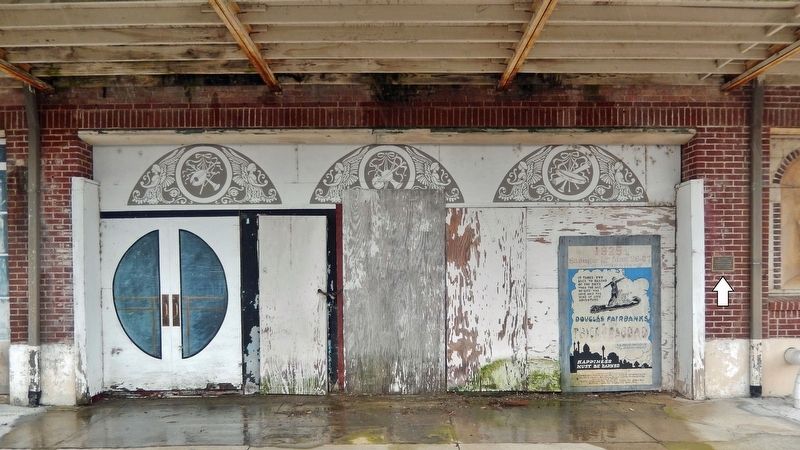
From the National Register Nomination prepared by Patrick Zollner, Arkansas Historic Preservation Program, 2/7/1995:
The Saenger Company asked assistance from the wealthy Simmons estate and several business firms in Pine Bluff to build a modern theater that could provide the city with "high-class road attractions." Pine Bluff had not really had a facility equipped to accommodate live performances by the many traveling theatrical troupes since the Elk Theater burned in 1915. After a few months of negotiations, Saenger firm signed an agreement with the Simmons estate, and the Pine Bluff Chamber of Commerce agreed to sell 1,000 tickets at $10 each for the opening performance. The architect's plans were published in the Pine Bluff Commercial on June 7, 1923. The Little Rock firm of Stewart and McGehee submitted the low bid of $162,000, which did not include electrical work, seating, stage equipment, painting, and decorating. Total cost of completing the structure was estimated at $180,000. When completed in 1924, the theater could seat 1532 people including four boxes seating 32 patrons.Regarding the interior, the Saenger Theater is very
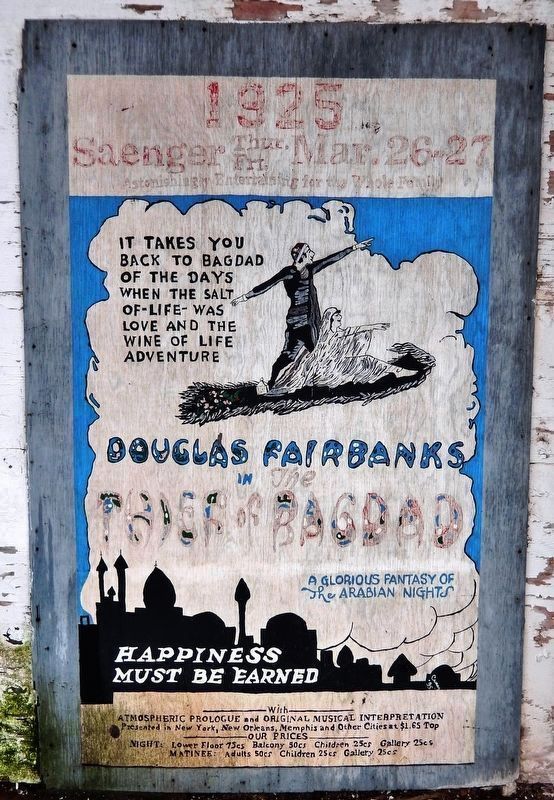
similar to the 1927 Weil-designed Jefferson Theater in Beaumont, Texas. David Naylor in his Great American Movie Theaters described the Saenger as a "Florentine-style picture palace," and indeed the interior is highly decorative with a prodigious use of plaster ornament.Photographed by Cosmos Mariner, September 16, 20243. Thief of Bagdad (1925) Poster RecreationMounted on right side of lobby entrance.
Prices:
Night: Lower floor 75¢ Balcony 50¢ Children 25¢ Gallery 25¢
Matinee: Adults 50¢ Children 25¢The mid-1920's were the pinnacle for the quintessentially American architectural genre, the motion picture palace. These structures were usually designed to imitate the palaces of the Old World; however, the nature of the film business added complexities never encountered before by architects. The Saenger Theater in Pine Bluff is a good example of the Saenger Amusement Company's high style theaters which were constructed throughout the country. It was designed by the architect, Emile Weil, who was the Saenger Amusement Company's regular architect.
Also see . . .
1. History of the Saenger Theatre in Pine Bluff. Abandoned Arizona website entry:
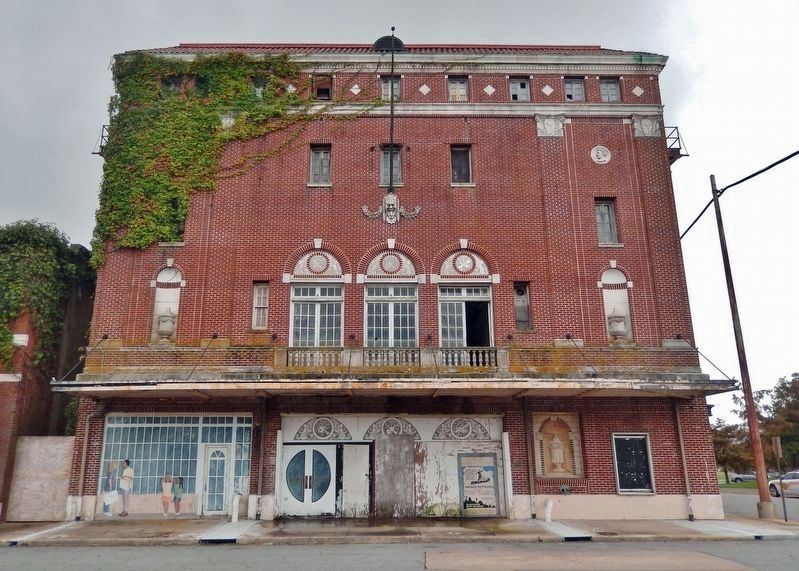
(by Emily Cowan & includes many interior photos) Excerpt: Pine Bluffians and citizens all across Jefferson County waited for weeks in preparation of the opening, finally to have a modern theatre. Deemed the “Showplace(Submitted on December 15, 2024, by Cosmos Mariner of Cape Canaveral, Florida.)of the South”, the Saenger Theatre opened in Pine Bluff on November 17, 1924, and the silent film “America” debuted the following day. But unlike most grand openings, this one lasted and set a new attendance record for the matinee and evening performances. Dinner parties following the events were held at the Hotel Pines just across the way. It aimed to make Pine Bluff an entertainment center for people in southeast Arkansas.Photographed by Cosmos Mariner, September 16, 20244. Saenger Theatre (front/north elevation)From the National Register Nomination: The front, or northern, elevation is the only styled elevation and reflects the use of Classical Revival components. The first story, however, is indicative of the 1929 Art Deco-style revisions and consists of a central ticket office flanked by triple-leaf, half-moon glazed doors. The doors immediately adjacent to the ticket office, which is currently boarded over, have the half-moon facing the office, while the outer pairs have the half moons oriented toward each other. To the west is a brick wall with a large window opening that is now filled in with wood. Above the entrance, the facade is dominated by three arched window bays, each containing double-leaf, twelve-pane French doors capped with a six-pane transom. A turned balustrade of stone or cast concrete extends across the base of the window bays. The next level above is defined by a cast concrete gargoyle head with a crown. The mouth is open as if in a mocking laugh, and garlands are draped at each side of the head. This level also contains a double-hinged, eight-pane casement window above each exterior niche. The fourth level reveals three double-hinged, eight-pane windows in the center of the facade and the four modified Corinthian pilaster capitals with a stylized "S" relief.Over the years the Saenger has seen many stars come through its doors. Some of the celebrities include Judy Garland, Gloria Swanson, Norma Talmadge, producer D. W. Griffith, Al G. Fields Minstrels, Ziegfeld Follies, and proprietor Julian Saenger. Harry Houdini performed his great act on this very stage and hired a local youth, Stanley Clark, to be his stooge. Later, Clark went on to perform magic for children on the same stage. Children’s shows were on Saturdays, with the price of admission being an empty Coke bottle. School plays, high school graduations, and dance recitals were also held there.
2. Saenger Theatre. Wikipedia
Links to national Register of Historic Places Registration form:
Excerpt: Built in 1924 to a design by Emile Weil, it is a Classical Revival brick building with an ornate interior that was last restyled in 1937. It is one of only a handful of Saenger movie palaces that remain. It was added to the National Register of Historic Places in 1995.(Submitted on December 15, 2024, by Cosmos Mariner of Cape Canaveral, Florida.)
Credits. This page was last revised on August 18, 2025. It was originally submitted on December 14, 2024, by Cosmos Mariner of Cape Canaveral, Florida. This page has been viewed 366 times since then and 57 times this year. Photos: 1, 2, 3, 4, 5. submitted on December 15, 2024, by Cosmos Mariner of Cape Canaveral, Florida.
